Which sofa are customers meant to buy when your best room photograph shows a large arrangement, your starting price describes a smaller one and the pictured fabric has a different supply position? A collection name alone won't untangle that offer for somebody seeing it for the first time.
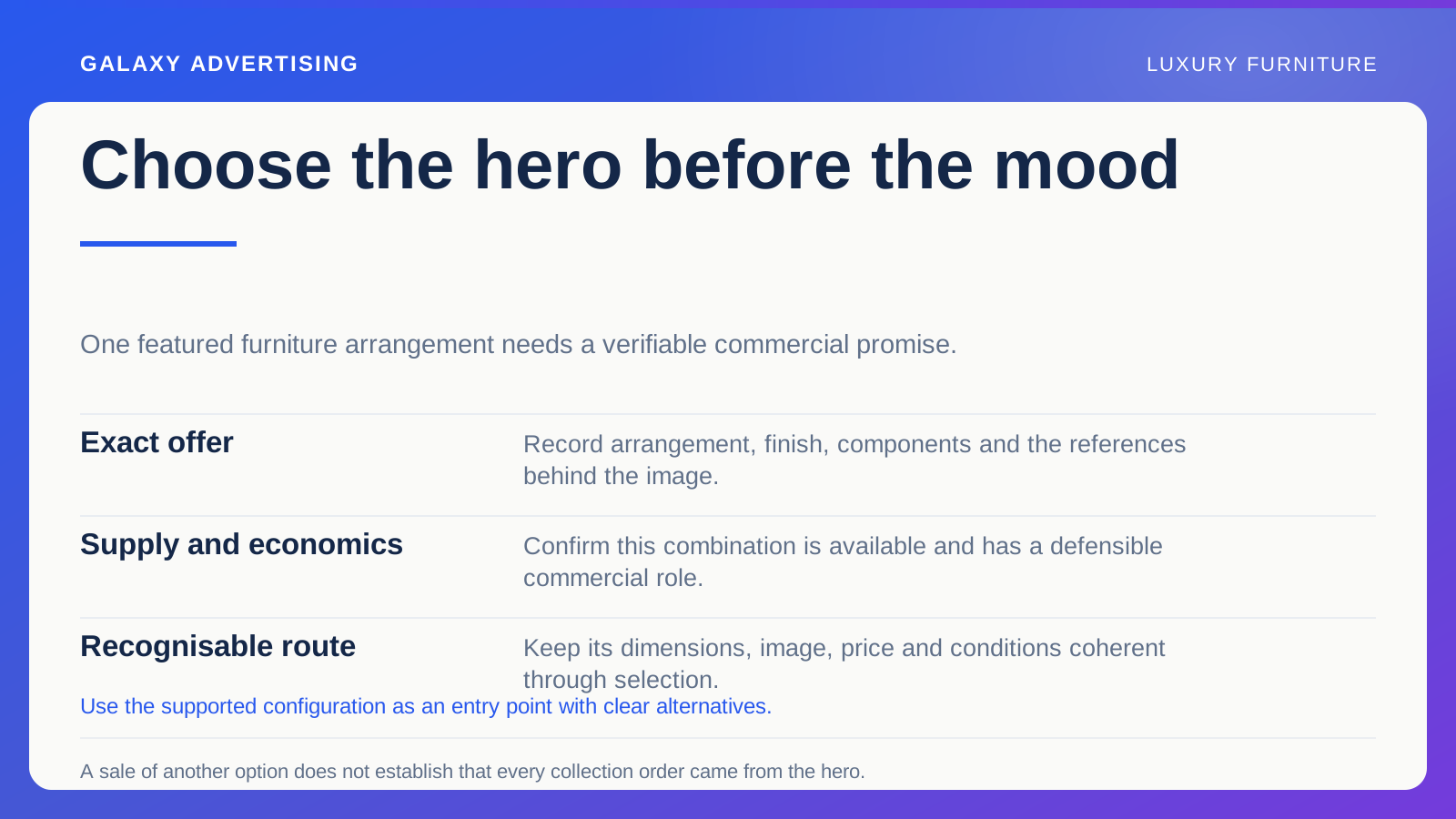
The range may be commercially attractive. But choosing its mood before its actual offer leaves the campaign difficult to verify. Start with one hero configuration, meaning the selected arrangement and finish that carry the campaign. You can then preserve a useful route for customers who need something different.
Name the offer inside the photograph
Identify the exact arrangement, finish and included components in the intended creative. Record the references your business uses to distinguish them from other options in the collection. A clear internal record gives the campaign something specific to describe and maintain.
Don't rely on the collection name. It may work in a showroom conversation while saying too little about the package behind the headline price or the dimensions somebody should inspect. New visitors don't arrive knowing your range as well as your team does.
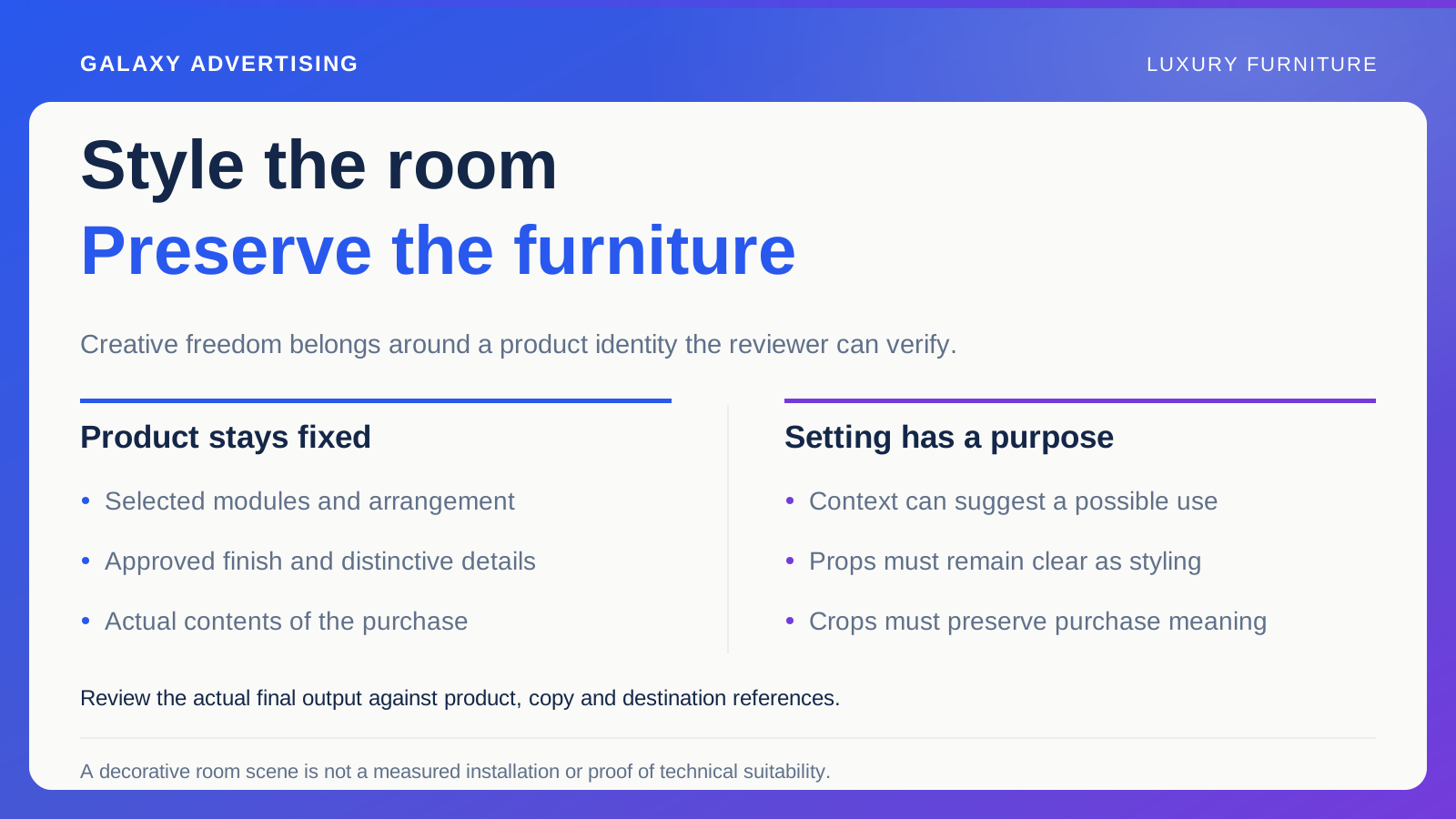
Compare the proposed image with the available offer. If it includes an optional module or styling accessory, decide how that relationship will be made clear. The first impression must remain attached to something you can actually supply under the stated conditions.
Verify the arrangement and finish you intend to feature
Ask the responsible team to confirm the supply position of this particular combination. A general status for the collection might not describe the version you're about to make prominent. Availability needs checking at the level of the actual promise.
Keep the information source and owner visible. When conditions change, the account manager needs a dependable update route. Hoping somebody notices an old photograph in a live advert is a rather fragile way to maintain the offer.
If the strongest visual version isn't ready, choose whether to change the subject or the message. Keeping the image at any cost and relying on the destination to explain a different offer leaves the customer to discover the mismatch after clicking.
Ask why this configuration deserves the investment
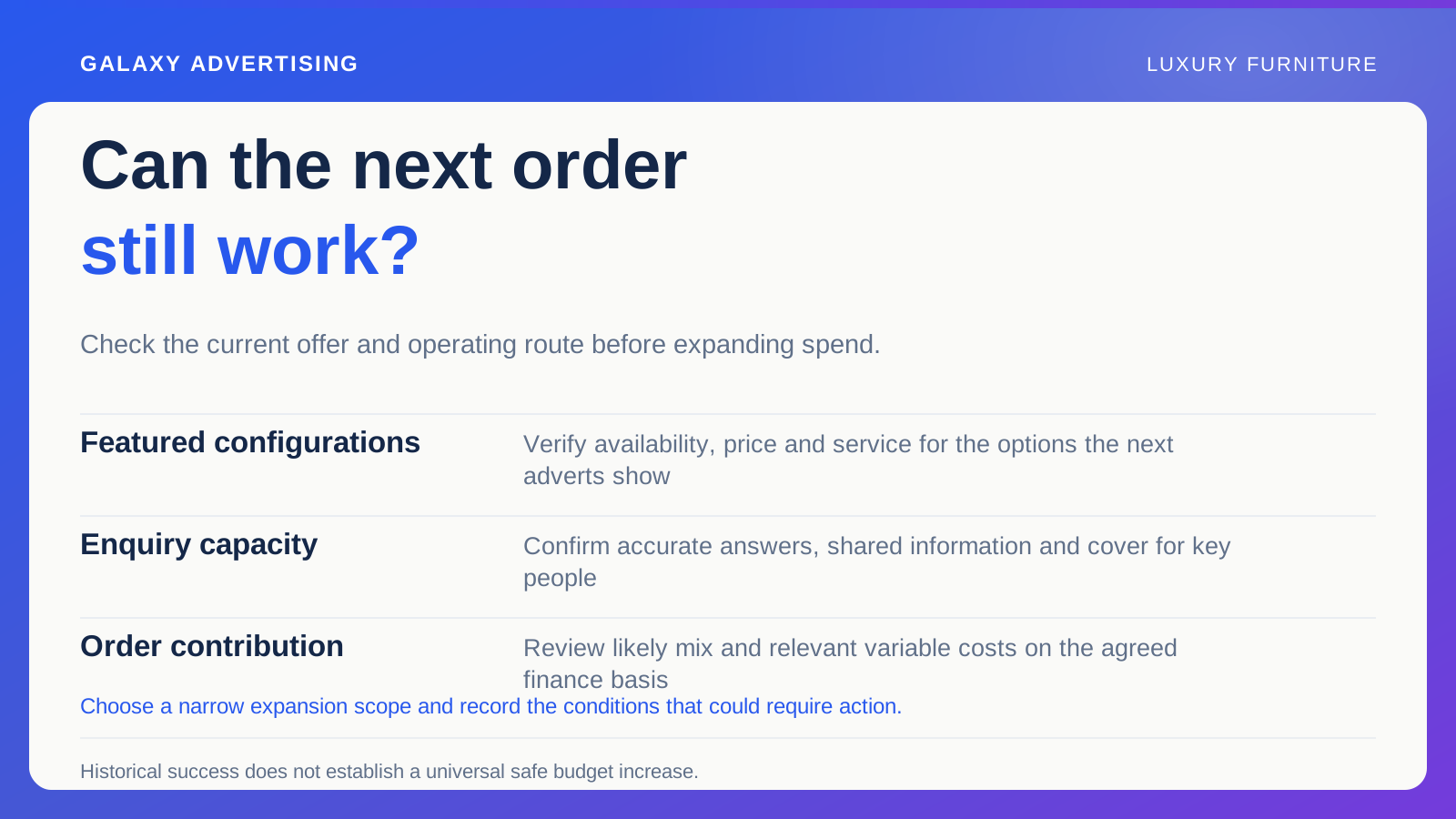
Establish its commercial role. Consider contribution, the money remaining after the costs included in your calculation, alongside the customers this arrangement serves and the practical work of fulfilling its orders. A beautiful configuration still needs a reason to receive acquisition spend.
A visually impressive large order isn't automatically your best priority. Different configurations can leave different amounts after relevant costs while the advertising report shows a favourable revenue average. Look behind that average before giving the whole range equal confidence.
If the case depends on an unverified product mix or cost estimate, say so. Identify what needs confirming before a larger commitment. You can investigate a promising proposition without presenting that investigation as proof that unrestricted expansion is already justified.
Make the page recognise what the advert showed
Identify the arrangement shown and provide its relevant dimensions, finish reference, price and purchase conditions. Customers shouldn't need to decode internal option names before understanding the creative. The destination needs to preserve the context that earned the click.
Use the hero as a clear entry point, while keeping meaningful alternatives visible. Someone may like the collection and need a smaller arrangement. Let them compare the differences without implying that all configurations share the same price or supply conditions.
Test the selection behaviour on a phone. When an option changes, the relevant image and information should remain coherent. Specific campaign messaging only helps if the product route carries that context through the ordinary choices a customer makes.
Give the other options a preparation task
Separate an unsuitable option from one that needs a specific correction. Missing configuration imagery can be produced; an unclear finish label can be resolved. A materially weak commercial proposition calls for a different kind of decision. Don't file all three under “not ready”.
Record the work, its owner and the condition for reconsidering promotion. You can develop the range without forcing every option into the first campaign or leaving incomplete variants forgotten. A variant is the selected size, colour or configuration, and each needs an intelligible status.
Nor must the entire collection wait for perfection when one clearly defined, accurate offer is ready. Narrow the first promise responsibly. Start with the supportable configuration while giving other opportunities the preparation they actually need.
Know when the hero needs to change
Agree the events that trigger review: a finish becoming unavailable, a material price change or a different service arrangement. Identify who can revise creative and who can correct the underlying product information. Those may be separate responsibilities.
Maintain a version record connecting asset, caption and destination. Replacing the hero means reviewing the full proposition, rather than swapping a photograph and assuming the old wording still applies. The image isn't the only place the promise lives.
The replacement also needs its own rationale. Another arrangement from the same collection might serve a different room or buying task. Being available and sharing a collection name doesn't make it equivalent in every campaign situation.
Before release, ask customer service to review the chosen arrangement. They may recognise recurring confusion between option names or know that an automated reply still contains an earlier photograph. Correct that connected material so the proposition stays consistent beyond the campaign page.
Review demand with the configuration still attached
Look at what interested customers eventually selected and the questions raised along the way. The hero may introduce the collection while orders concentrate on other arrangements. Keep that distinction in the commercial review instead of assuming introduction and final selection are identical.
A sale of another option doesn't automatically make the featured arrangement irrelevant. Equally, you can't credit every collection order to it without evidence. Use the records available to choose a proportionate next step.
A hero configuration turns a preference for a beautiful range into a promise your team can verify and maintain. Customers can still explore alternatives. They simply no longer have to imagine that every attractive part of the collection belongs to one interchangeable purchase.