 TikTok Ads
What if adding a discount makes your TikTok opening easier to write but the resulting order less worthwhile? The editor gets a clear hook and the account team gets a new message. Neither benefit establishes that the promotion makes commercial sense.
A product demonstration earning interest isn't, by itself, a reason to reduce its price. The offer needs a defined job.
It might encourage a useful package, move suitable inventory or remove a genuine buying obstacle. Establish that purpose and the resulting contribution, meaning money remaining after the costs included in your calculation, before deciding how prominently the incentive appears in the video.
Say what the promotion needs to change
Choose a specific outcome instead of asking for more sales in general. Perhaps you want customers to choose a complete accessory package or buy a particular stocked configuration. That gives the offer something concrete to support and the review something to assess.
Check whether the incentive addresses the obstacle you've observed. Questions about dimensions or compatibility can remain unanswered at a lower price. Improving information may be the more appropriate first step, even if a discount feels quicker to brief.
For a hypothetical desk retailer, the uncertainty could concern which storage accessory fits the model. A clearly described compatible package might help. A discount across unrelated accessories creates a different proposition and may leave that exact question unresolved. Keep the offer connected to the task rather than treating all incentives as interchangeable.
Calculate the contribution consistently
Use agreed net revenue and relevant variable costs. Include product, payment, packing and fulfilment costs that change with the order, plus a transparent allowance for relevant returns where appropriate. The scope of the calculation should be understood before comparing results.
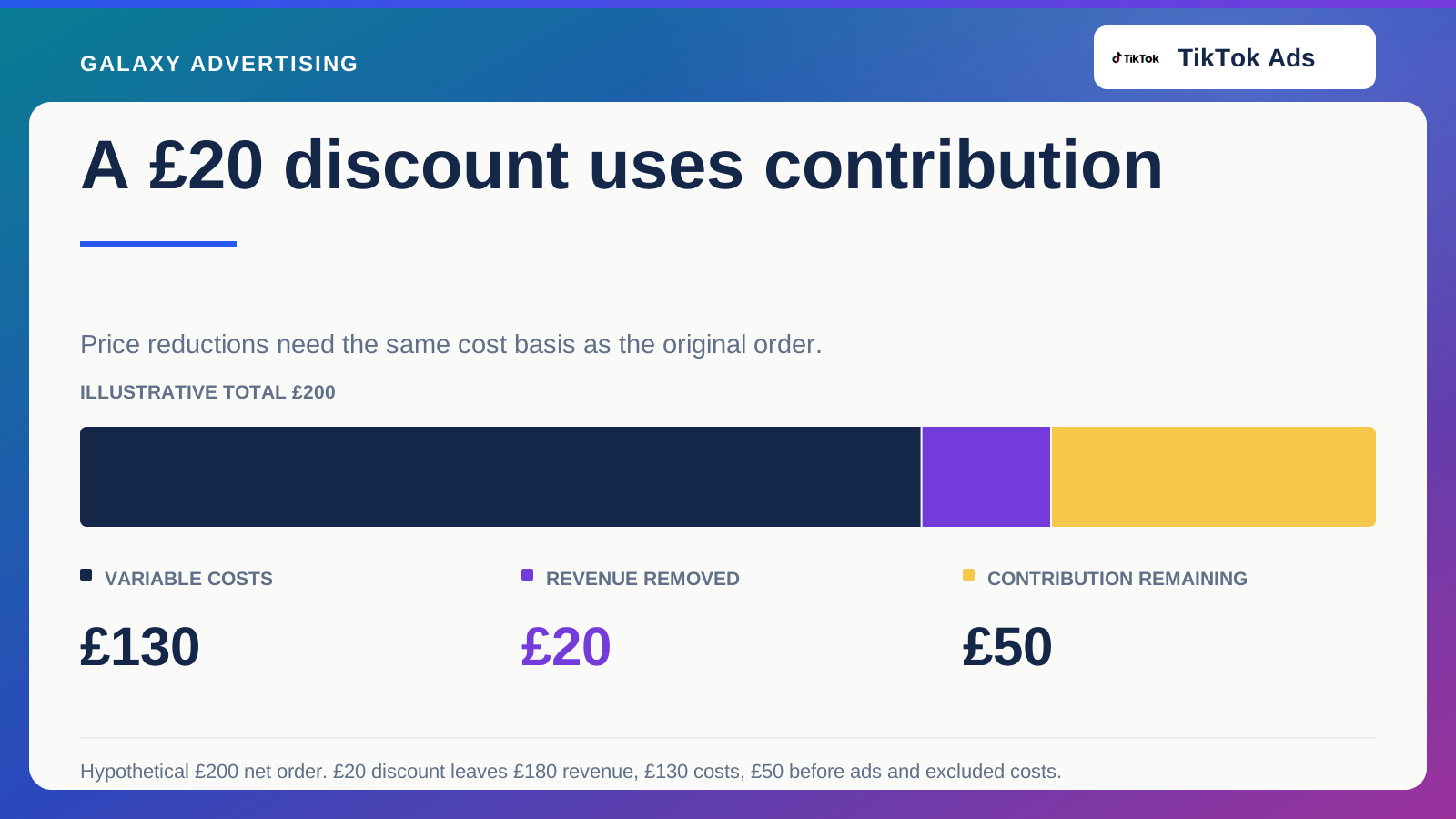
Consider a hypothetical £200 net order with £130 of relevant variable costs. It leaves £70 before advertising and other excluded costs. Reduce revenue by £20 without changing those costs and the available contribution becomes £50. The reduction isn't merely a small percentage of the original £70.
Those figures illustrate arithmetic, rather than recommend a target. A modest percentage reduction in selling price can consume a substantial share of the acquisition allowance. Make that consequence clear to the creative team before a discount becomes the supposedly inexpensive way to produce another concept. The badge costs more than the time needed to add it.
Compare what the alternatives actually do
A bundle, relevant service or delivery incentive can change the decision differently from a direct discount. Each needs its own cost calculation and factual review. An appealing alternative isn't automatically a cheaper one for the business to provide.
A gift still has a cost. Include its effect on packing, shipping and service where material. A delivery incentive can also have different economics by location or order type. Those differences belong in the commercial view rather than being hidden by one headline benefit.
Choose according to the job. A compatible bundle can simplify a real decision. An unrelated extra may simply add apparent value. The distinction affects both the proposition and what you can reasonably expect the campaign to teach you. A stronger looking package isn't necessarily a clearer answer.
Make the advertised package recognisable
Show what the stated price or incentive actually concerns. Does it apply to the demonstrated configuration, selected products or a defined package? The customer should be able to identify that relationship without assembling the offer from separate clues.
Don't combine a premium arrangement in the footage with the entry price of a smaller option unless the connection is genuinely clear. The destination needs to identify the promoted offer without sending someone across several pages to reconstruct it. The visual and price should support the same understanding.
Keep essential conditions intelligible. A short asset cannot carry everything, but its main impression shouldn't be contradicted elsewhere. If extensive qualifications are needed to explain what the offer means, make the presentation clearer before production. More conditions aren't always the answer to an unclear proposition.
Verify that the store can deliver the incentive
Ask merchandising and operations to confirm stock, package contents and delivery arrangements. More orders can expose a fulfilment constraint that was manageable at lower volume. The intended effect of the offer needs support behind it.
Test the website route under the real eligibility conditions. Check the selected product, displayed price and required steps. A promotional message in the advert doesn't establish that checkout applies it correctly. Follow the actual route rather than stopping at the campaign page.
Give the release owner a clear path for urgent exceptions. If a bundle component becomes unavailable, the whole package needs a decision. Don't assume any substitute preserves the advertised value. The exception can change what the customer thinks they're buying, not just the warehouse's picking task.
Review the result against an explained comparison
Compare observed product mix, contribution and relevant customer outcomes with the objective. Include spending, stock and other activity that may affect interpretation. Those conditions help explain what happened rather than leaving the promotion to claim every favourable change.
Don't attribute every increase in reported revenue to the incentive. People may have bought anyway, brought purchases forward or selected another package because the underlying offer changed. A stronger causal claim requires evidence suited to the available comparison.
If a useful comparison isn't supportable, report the observed economics honestly. Worthwhile orders under recorded conditions don't establish that the brand should discount whenever results soften. The decision can be bounded without being useless.
Ask customer service to explain the proposed package using only what a new visitor sees. If an internal spreadsheet is needed to identify the accessory, fix the presentation before interpreting enquiries as demand for a bigger incentive. The offer should simplify its intended decision rather than create another set of conditions to untangle.
Retire the offer as carefully as you released it
Record every asset, caption and destination carrying the promotion. When conditions end or change, verify the live route. Updating a planning document doesn't remove an old message from circulation.
Keep the learning separate from the promotional edit. A clearer package explanation may have helped while the incentive itself proved too expensive. You can carry that understanding into another asset without repeating the margin reduction.
The video should explain a relevant reason to act while leaving an acceptable order for the business. When the promotion mainly solves the problem of writing an opening, the commercial decision needs to come earlier.