Which exact video worked, and could your team find it without asking the editor? When the campaign report names “Video final new 3” as the strongest asset, that is a fairly practical question.
The editor remembers several similar files. The account manager cannot tell whether the live one had the revised opening or the earlier price. The reported result could be accurate while the useful production learning has almost disappeared.
Begin the measurement plan with identity. Connect what people saw, why you made it and the version that received the activity. Otherwise a larger dashboard can offer plenty of detail while leaving the next brief dependent on somebody's memory.
Name the idea as well as the file
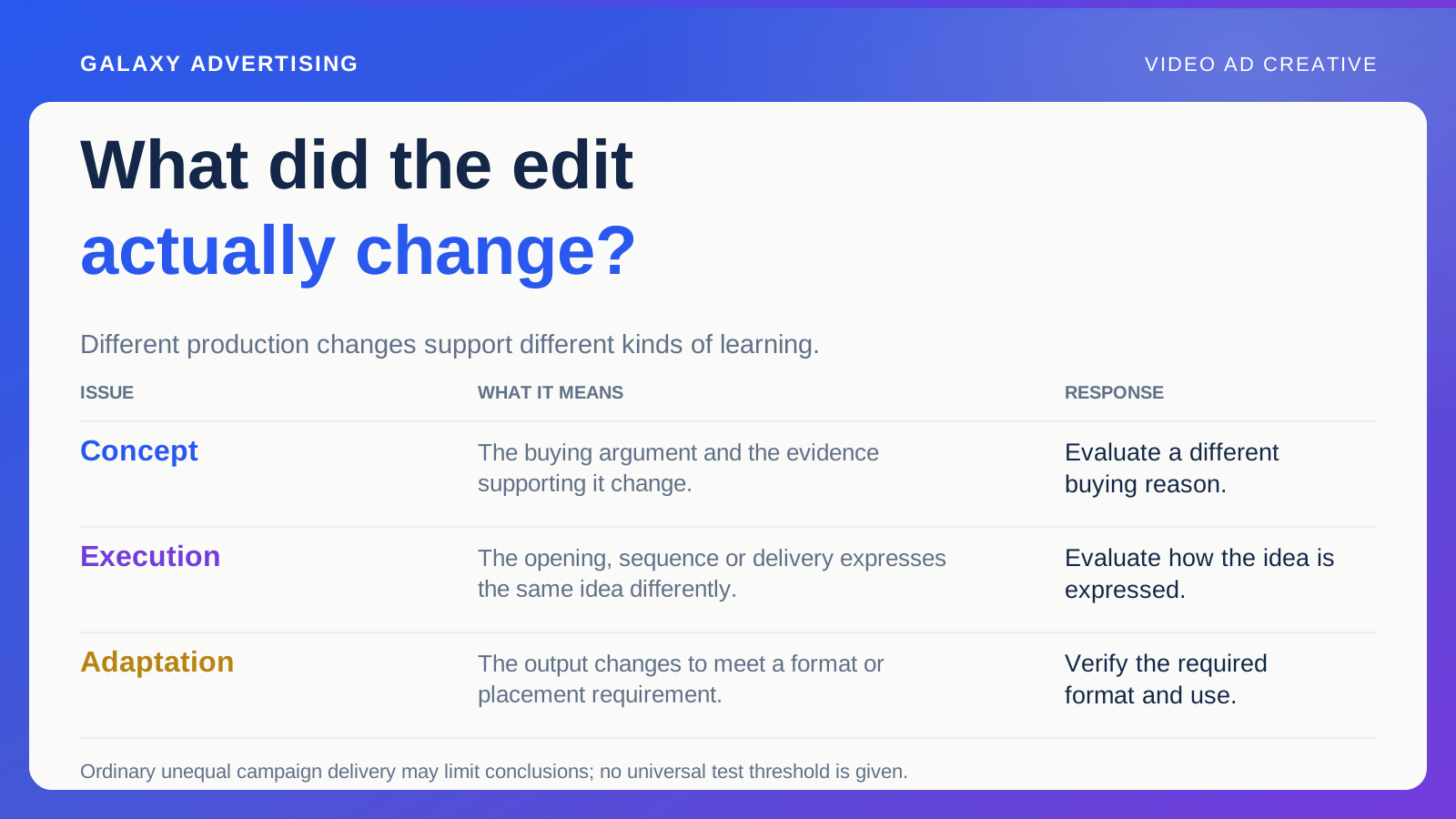
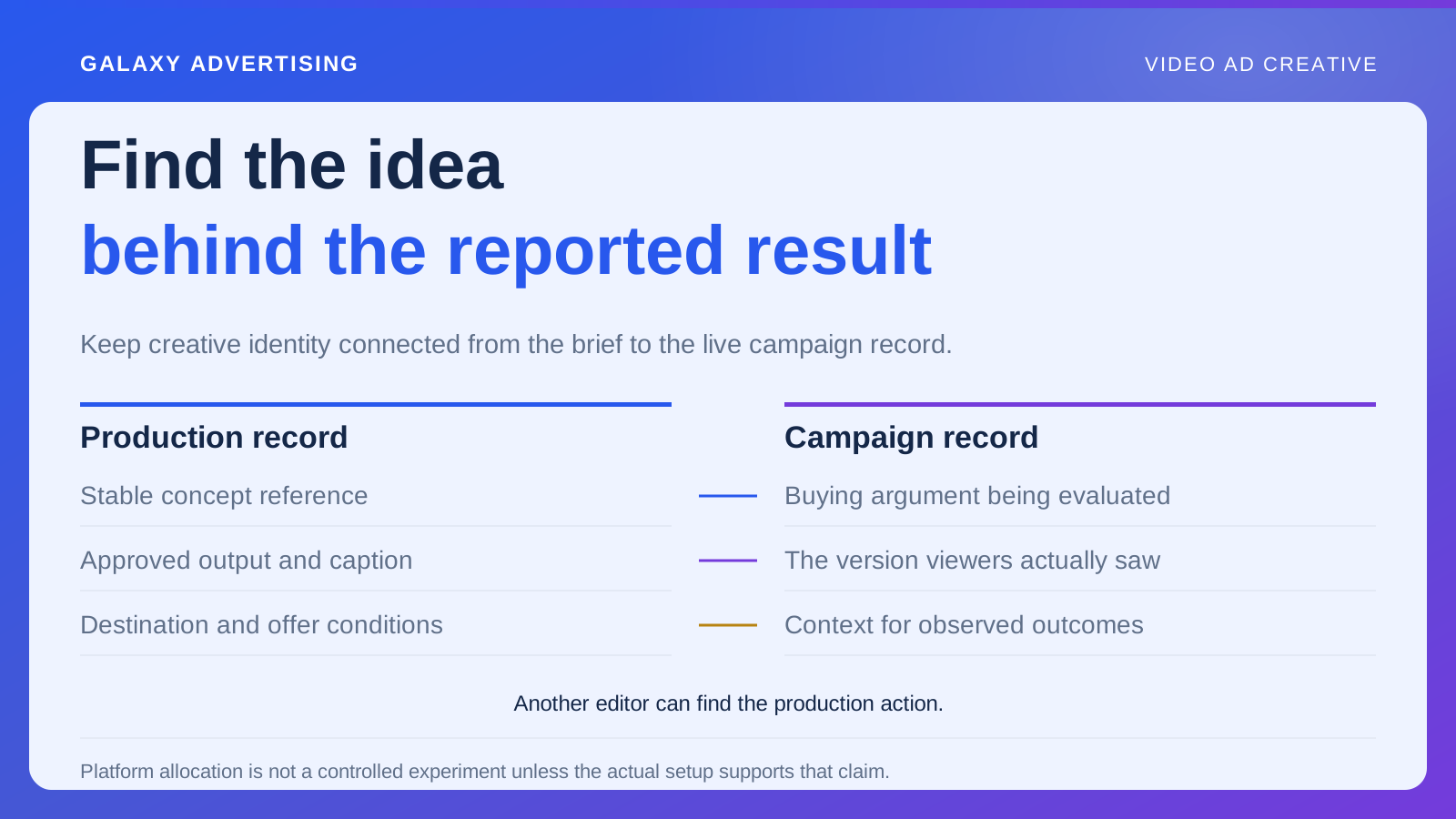
Give the buying argument a stable concept reference. Record the customer question, evidence shown and relevant product. That reference should survive changes to crop, length and closing copy.
Identify executions and approved outputs separately. A changed opening could be an execution change; a different demonstration could be a new concept. Agree a distinction that both production and account teams can apply consistently, so the names help rather than start another debate.
Keep them readable. Encoding every imaginable detail in a filename makes the scheme difficult to maintain. What matters is a reliable connection from the live asset to the full record. The filename does not need to become the entire brief.
Keep what people actually saw together
Store the accepted master, caption, destination and material offer conditions together. When reviewing an outcome, your account team needs to establish the complete communication the customer encountered.
If a platform processes an upload, or the team adapts it for another placement, keep its relationship to the approved source clear. Inspect the output. Do not assume the uploaded file and displayed presentation are identical in every relevant respect.
Record destination changes too. A video can look exactly the same while the commercial route changes beneath it. Without that note, a later comparison could credit the creative for an effect associated with a different product page.
Choose evidence that answers your question
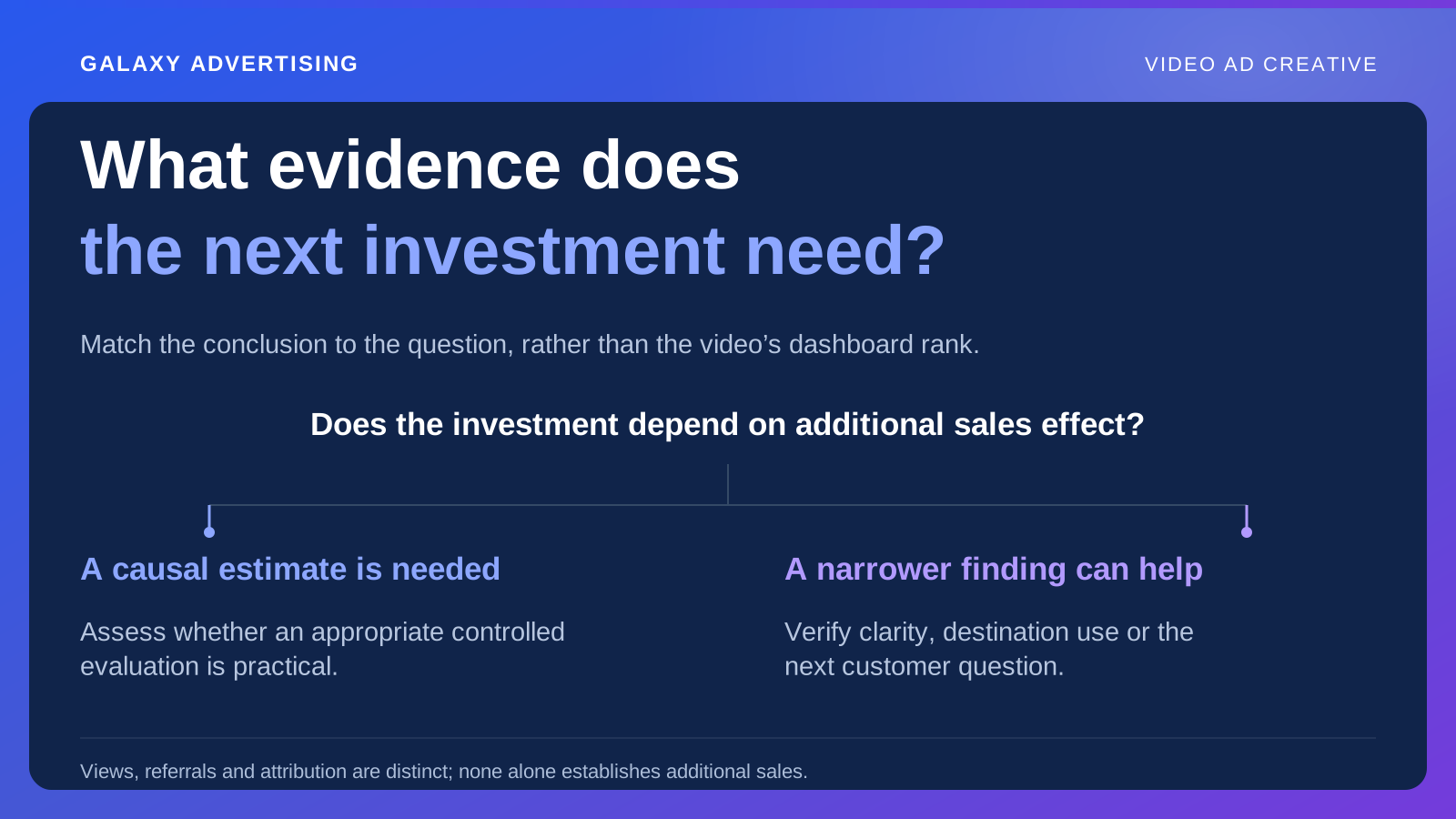
A feature demonstration needs a different review from an introduction intended to establish relevance. Attention measures can help you investigate whether people watch the sequence. They cannot establish product suitability or contribution, the money remaining after the costs included in the calculation.
Identify which platform observations are actually available and which website actions your business records reliably. An exact measure available in another account or service is not automatically available in yours.
Tie each observation to a decision. A sharp attention drop near a confusing transition may warrant inspecting the edit. Enquiries about another configuration may warrant reviewing the promise. Neither observation dictates a single explanation or proves a particular commercial effect.
Write down what made the comparison different
Record meaningful differences in distribution, spend, availability and destination. A video with little delivery under one set of conditions cannot be casually compared with another given substantially different opportunities.
Platform allocation is not a controlled experiment unless the actual setup supports that interpretation. Explain how the assets were used and what that allows you to conclude. That context makes the reported difference easier to judge.
Focus on conditions relevant to the decision. You are identifying plausible competing explanations, rather than building an exhaustive operational log. Burying findings beneath unrelated campaign detail makes it harder for the next person to use them.
Look at the offer behind the outcome
Review the products and orders associated with the available activity. Attention might concern a configuration people cannot buy. The resulting product mix might carry different contribution and service costs from the one you expected.
Use the commercial definitions your business has agreed. Attributed gross revenue is not the money retained after advertising, fulfilment and other relevant costs. The production report should keep those meanings distinct.
If the records cannot support a precise connection, say so. You could still learn that a demonstration is understandable or its destination inconsistent. Those findings have practical value without an invented return calculation to make the plan look complete.
Keep customer questions beside the numbers
Collect relevant questions, misunderstandings and individual feedback in a proportionate form. A customer can point out a product detail that an attention chart cannot explain.
Record the source and limits. One enquiry could reveal an ambiguity worth fixing without showing that every viewer misunderstood it. Repeated questions might justify a new concept, but their commercial prevalence still needs careful interpretation.
Leave unrelated personal details out of the creative library. The useful material concerns the buying question and product communication. Agree appropriate handling with the people responsible for the underlying customer records.
Could another editor use this record?
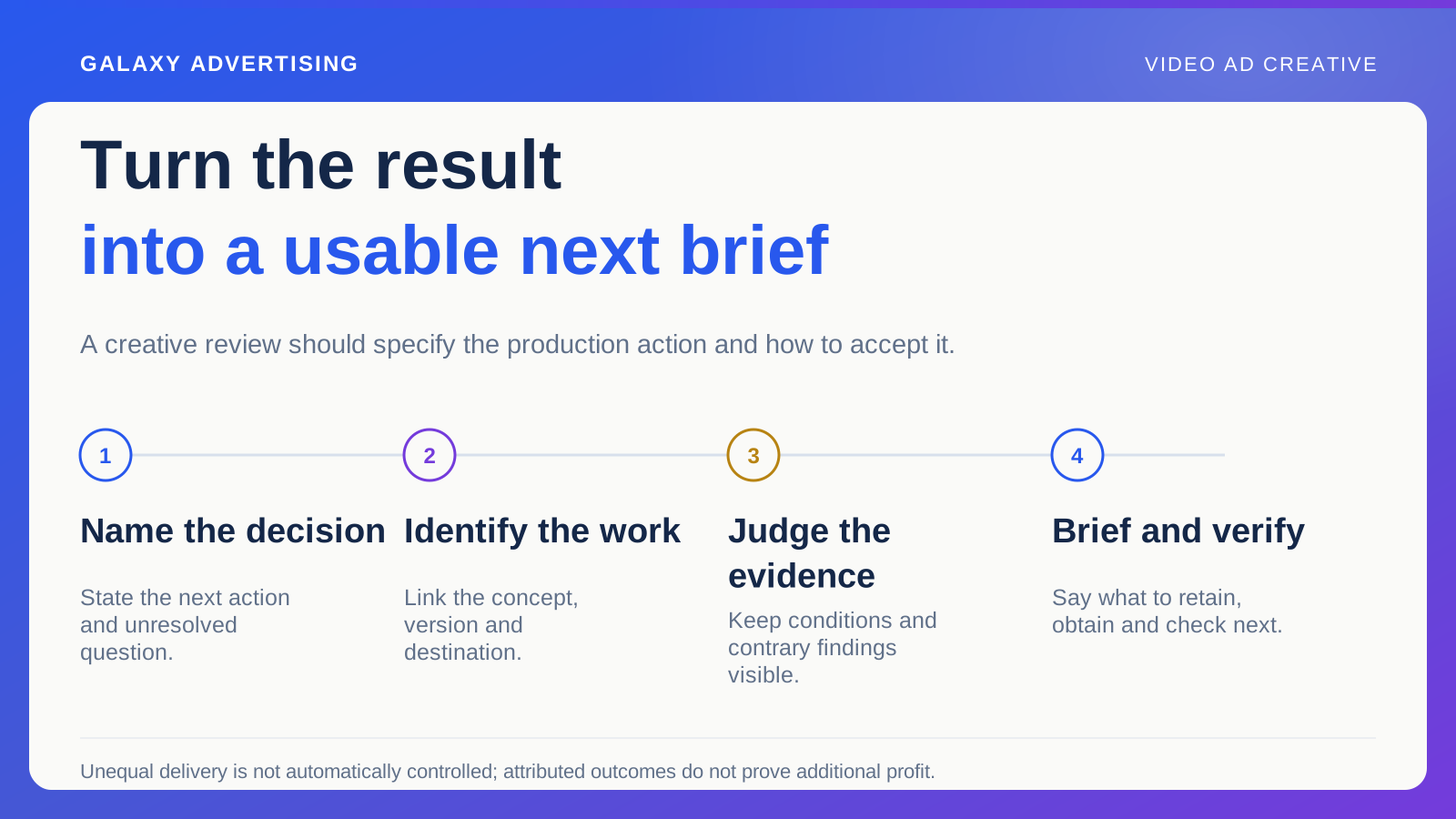
Ask an editor who did not manage the campaign to identify the concept, approved version and next proposed production action. If they cannot, the record is not yet passing on the knowledge they need.
Add the missing reference or explanation. Expecting the editor to decode a platform identifier does not close the gap between roles.
That bridge is the practical reason for keeping creative identity: it connects the numbers your account manager reviews with the argument and footage a producer can change. A usable record should let both people recognise the same piece of work.
Leave the next production question clear
For each concept, record what you learned, what remains uncertain and what happens next. The answer could be a clearer opening, missing footage, another argument or no more production.
Keep rejected explanations alongside successful ones. A later team should understand why a concept changed, rather than repeat the exercise because nobody recognises the filename holding the earlier result.
Every asset does not need a precise incremental revenue claim. It needs enough identity, context and judgement for your next production decision to be better informed. A result becomes useful knowledge when somebody else can find the idea behind it and know what to do with it.