 ChatGPT Ads
It's tempting to call it a test when we're really just trying the newest advertising channel. Put several product families live, change the website, add a promotion, and any orders give everyone something encouraging to discuss.
What they don't necessarily give you is a reason to invest in a particular offer. Too much has moved at once to explain what deserves the next commitment.
You don't need a laboratory. You do need a clear question, manageable scope and honest limits. A useful test ends with something more actionable than announcing that an entire channel works or fails for your business.
Ask a question the evidence can reach
Begin with the decision. A hypothetical specialist lighting retailer might ask whether a particular range can attract commercially suitable enquiries at an affordable cost. That's more concrete than debating whether conversational advertising is the future.
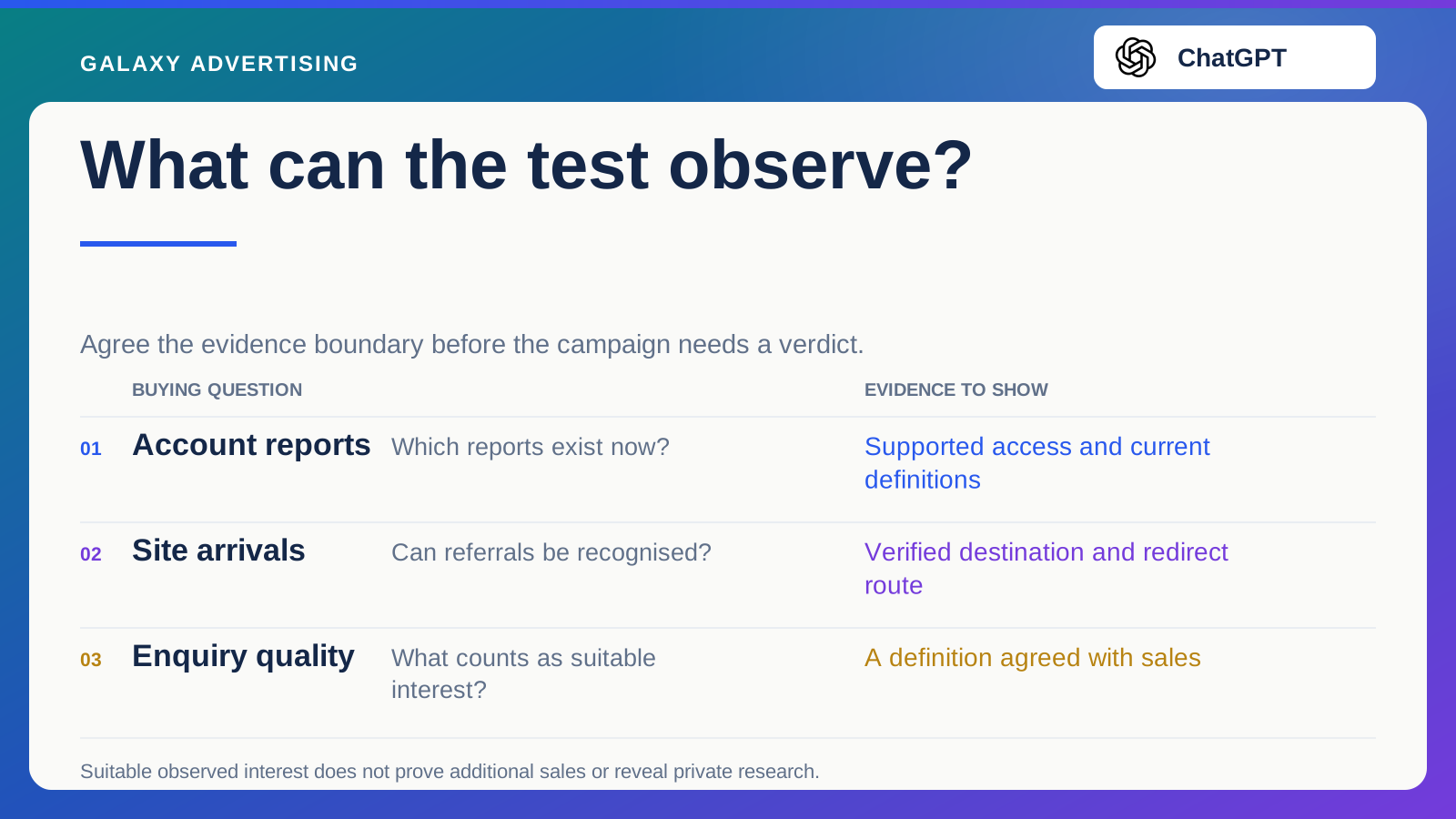
Define suitable before launch. The product family, delivery area and questions the sales team can help answer might all matter. Don't choose a definition afterwards because it makes the available responses look better.
Then check whether the evidence can support your question. If an order usually follows a longer consultation, a short campaign may reveal the quality of initial interest without settling the eventual cost and value of acquiring customers. Narrow the claim to match. An early signal cannot carry a whole commercial conclusion.
Keep the moving parts manageable
Choose a coherent offer, destination and advertising argument. Keep the range small enough that you can understand changes in price or availability when you review it.
Record other activity that could affect interpretation. A large email promotion, a new store offer or a website redesign changes the conditions around the campaign. Those events don't make every observation worthless, but they weaken a simple before and after comparison.
Necessary repairs still come first. Fix a broken destination or inaccurate offer rather than preserving an attractive experiment at the customer's expense. Record what changed and adjust the interpretation. Customer accuracy matters more than pretending the original conditions survived untouched.
Put a boundary around the commitment
Agree the approved spend, responsibilities and review conditions. There isn't a universal test budget for every product and retailer. Your commitment should reflect your economics and how much uncertainty you're willing to fund.
Separate urgent operational problems from the broader performance judgement. An advertised model becoming unavailable or a package description becoming misleading needs prompt action. Neither should sit unresolved until the scheduled review.
Name who can authorise continuation. If the test automatically spends more whenever it hasn't produced certainty, it has no real boundary. You should know which evidence will be considered and who accepts responsibility for funding the next step.
Be honest about the comparison
If you're comparing two messages, write down what differs and what stays consistent. Changing the product, destination and argument together can compare complete offers. It cannot isolate the effect of a phrase.
Look at actual delivery before declaring a winner. Unequal exposure, different operating conditions and a small number of orders can all affect the outcome. Explain those limits in the report rather than hiding them behind a ranking.
If you need a more controlled design, have the account team verify what the platform and available tools support. Don't borrow an experimental control from another system because it makes the proposal look tidy. Your method has to exist in the actual implementation.
Put the campaign beside the customer response
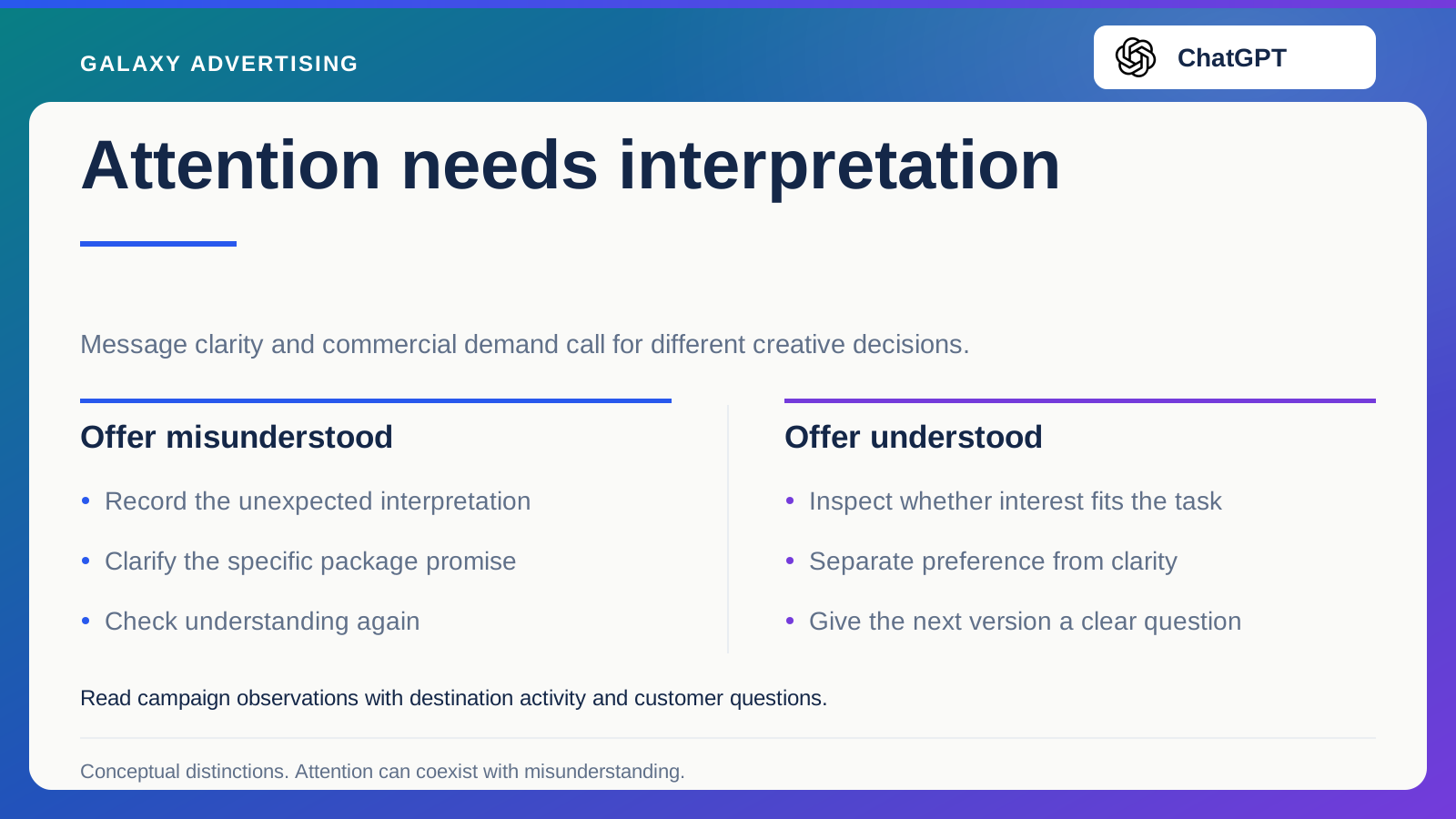
Review available campaign metrics alongside destination activity, enquiries and order records. They answer different questions. Attention doesn't establish suitability, and an enquiry count doesn't establish completed contribution, the money left after the costs included in your calculation.
Ask sales to review a small sample using the definition agreed before launch. Were people exploring the intended offer? Did they understand the package and conditions? Were their recurring questions reasonable, or had ambiguity in the advert created them?
Keep the unfavourable findings. Plenty of requests for products you don't supply may point to an inaccurate proposition, even if engagement looks encouraging. That is useful learning. The next correction belongs in the offer and message, rather than automatically in a larger budget.
Inconclusive doesn't mean worthless
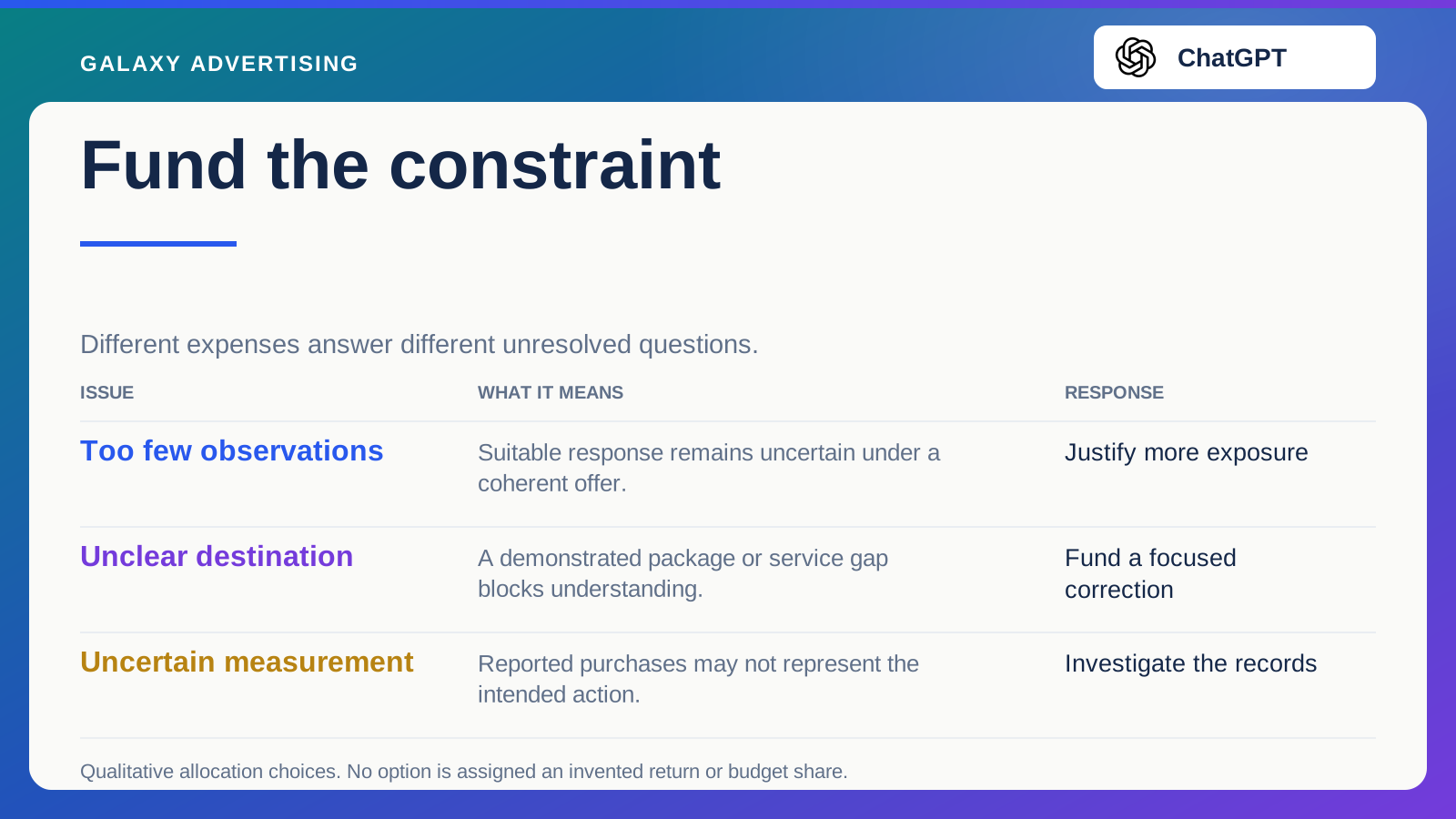
A test can leave its main question unanswered while revealing something specific. The destination might work properly and the product attract relevant exploration, while evidence about eventual orders remains insufficient.
State those findings separately. Lack of certainty doesn't justify either a confident success story or a declaration that the channel has no commercial value. Both can outrun what you observed.
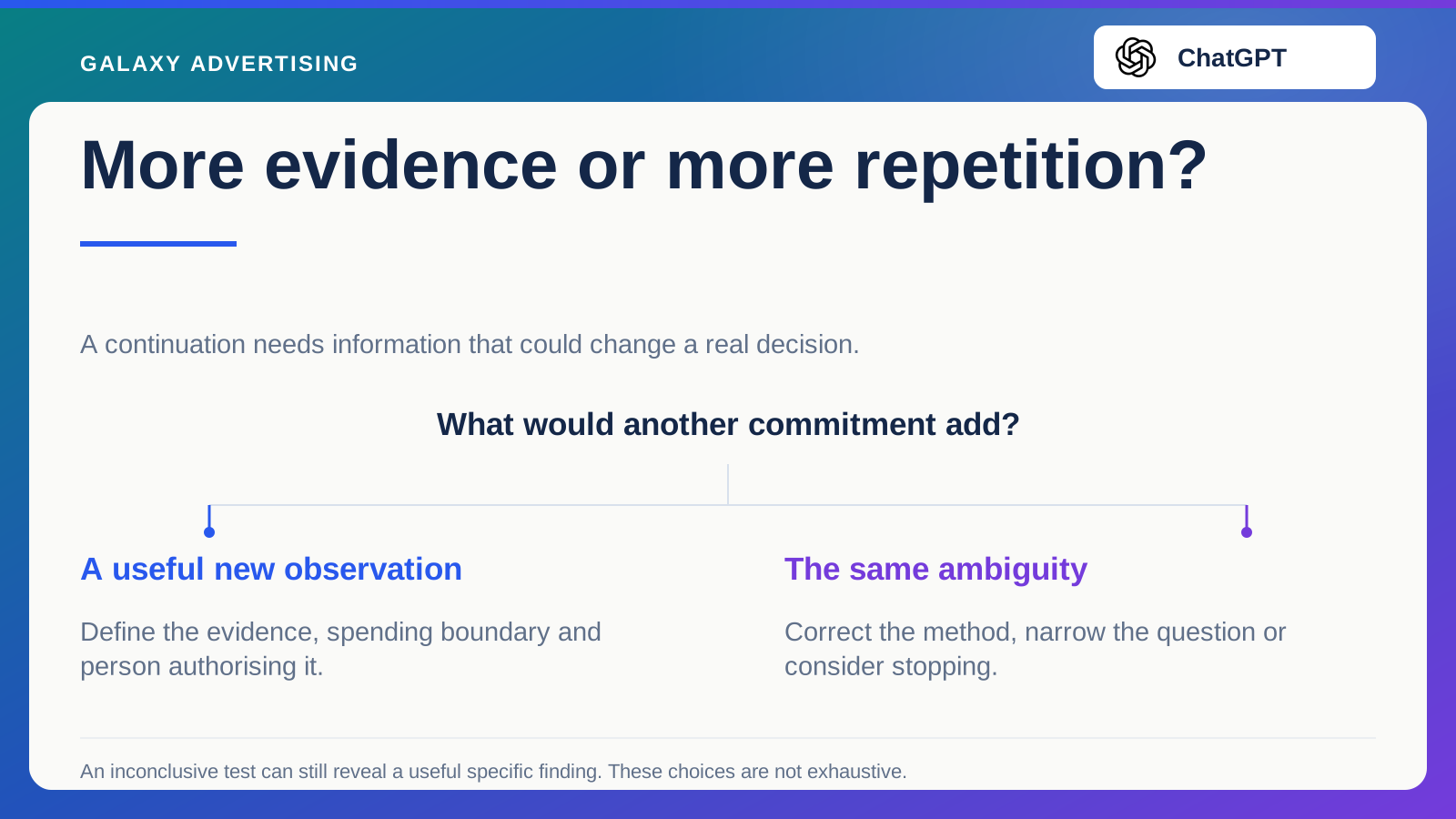
Now ask whether more evidence is worth buying. A continuation needs to say what changes, or what additional information you expect, and why that information matters to an actual decision. Simply repeating the same uncertain activity with no clearer question isn't automatically a sensible experiment.
End with someone owning the next move
Choose stopping, a defined correction or a bounded continuation. Connect the decision to the observation behind it and assign the person who will carry it out.
Preserve the original hypothesis, the actual conditions and the limitations. That gives the next test a useful starting point. It also makes it harder for an ambiguous result to become a supposedly proven method when somebody retells it months later.
A disciplined test makes uncertainty affordable and informative. It doesn't promise that a new channel can solve an unrelated product or fulfilment problem. It earns a defensible answer to a narrower question and a reason for the next investment.
Include the result that would make you choose another use of the money. That could mean resolving product information or funding a better understood route. If every possible outcome leads to continuing, you haven't given the business a meaningful choice. Naming the alternative before launch gives the eventual recommendation something real to stand against.