 ChatGPT Ads
What if the money set aside for your next ChatGPT Ads test would be more useful fixing the product page first? If that page still omits the delivery arrangement, spending everything on traffic leaves a fairly obvious problem waiting for every visitor.
Calling one expense marketing and another website work doesn't tell you which deserves priority. Both draw on the same business's money and attention.
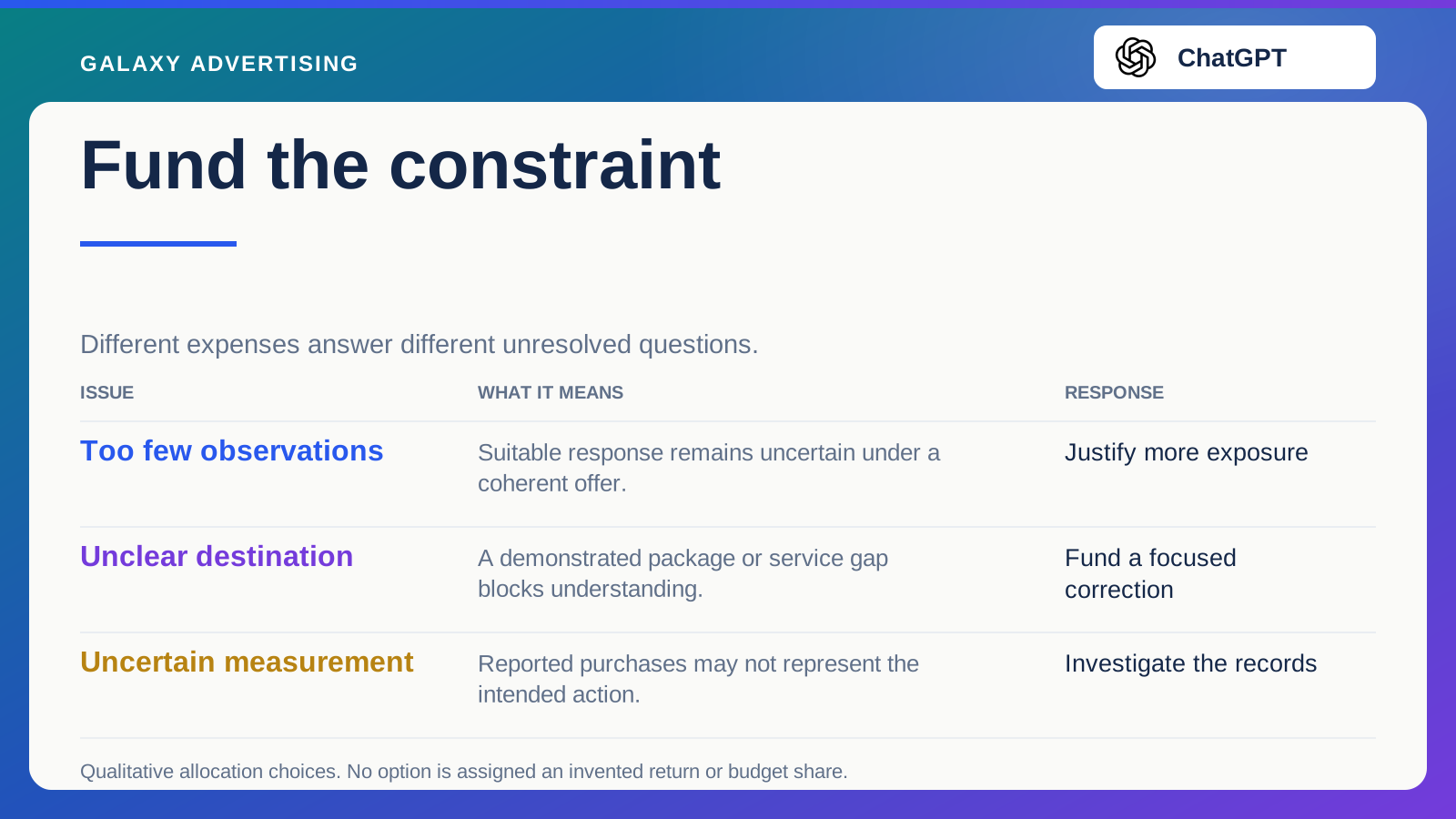
Follow the constraint preventing a good decision. Sometimes you need more observations. Sometimes you already have enough evidence of an avoidable problem. More demand can make a campaign bigger without making its learning any better.
What is stopping you deciding today?
Write down the decision and the information missing from it. Do you need to know whether suitable people respond, whether they understand the offer, or whether the resulting orders are measured consistently? Those aren't interchangeable questions.
More media can expose more people to an offer. It won't explain why a transaction value was recorded incorrectly. A clearer product page can remove ambiguity, but it won't establish how much suitable demand the channel can supply.
Ask for the observation behind each proposed expense. A destination improvement needs a demonstrated gap or a clear hypothesis. More budget needs an explanation of the useful evidence that extra spend is expected to provide. Otherwise you're choosing between requests that haven't yet made their case.
Count the work before the traffic
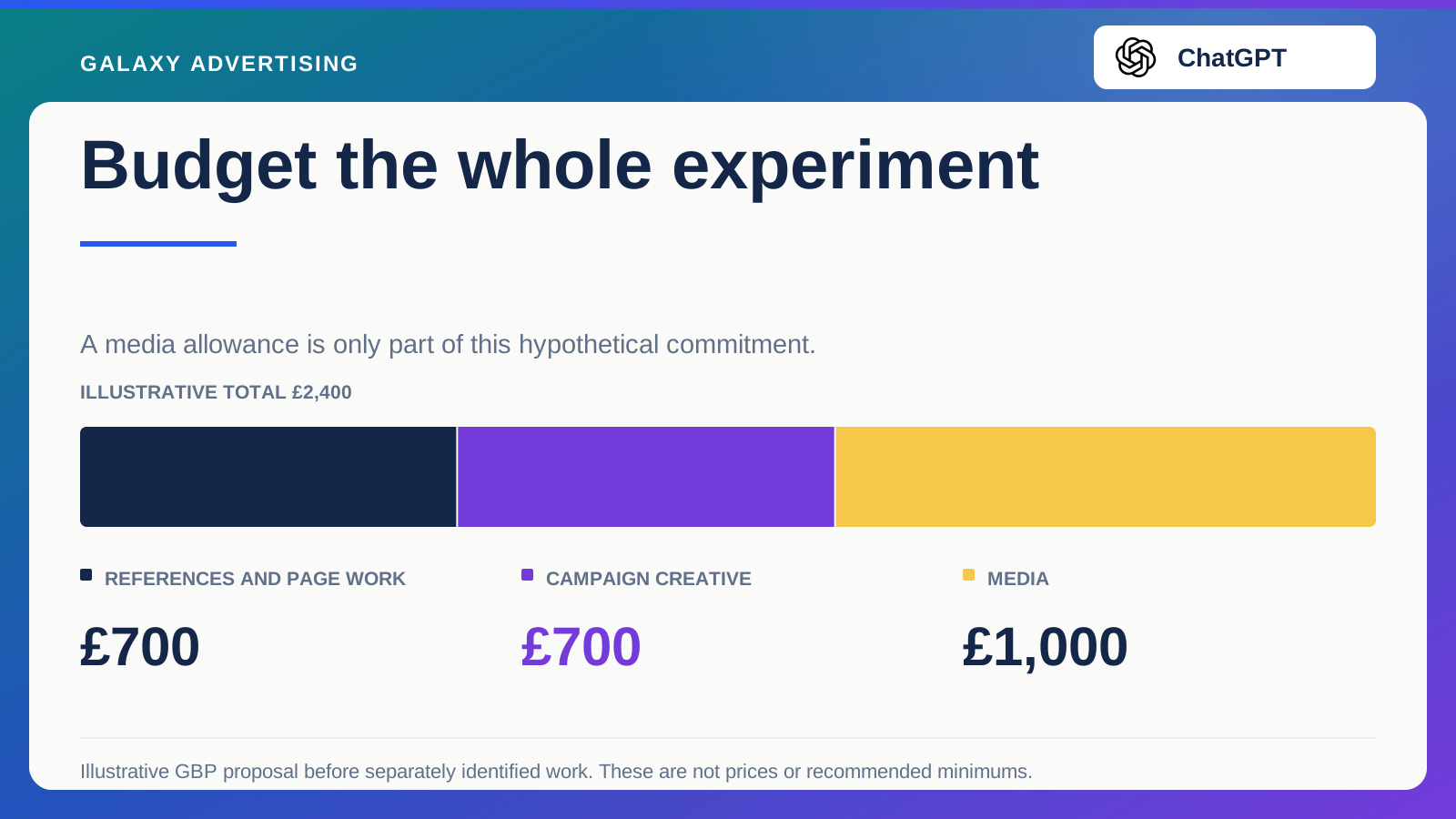
List everything needed to make the test interpretable: product references, creative, destination corrections, implementation and review. Show those costs beside the media commitment. Another team's time isn't a free contribution simply because it comes out of a different plan.
Some preparation helps elsewhere too. An accurate configuration diagram could support organic visitors and existing paid campaigns. Record that wider usefulness, while keeping the entire resulting benefit out of the new test's claimed achievement.
Reusable doesn't mean unlimited priority. The work still needs a purpose and sensible scope. Correcting a misleading package may be more valuable than a full redesign that delays the experiment without answering a better defined question. Be clear what improvement you're actually buying.
Compare the next amount of money fairly
Imagine a hypothetical £600. It could buy more exposure, a focused destination correction or part of a measurement investigation. That's an illustration, not a recommended budget.
Describe what each option should produce and what would remain uncertain. More exposure may reveal more about enquiry quality. A page correction may make a known offer understandable. Measurement work may establish whether reported purchases represent the intended action.
You don't need to pretend every option has a precise financial return you can calculate in advance. You need reasoning the budget owner can challenge. A bounded recommendation with visible limitations is more useful than a confident forecast resting on unsupported assumptions. Say what the expense is expected to resolve, and where that expectation stops.
Remember what else the business needs
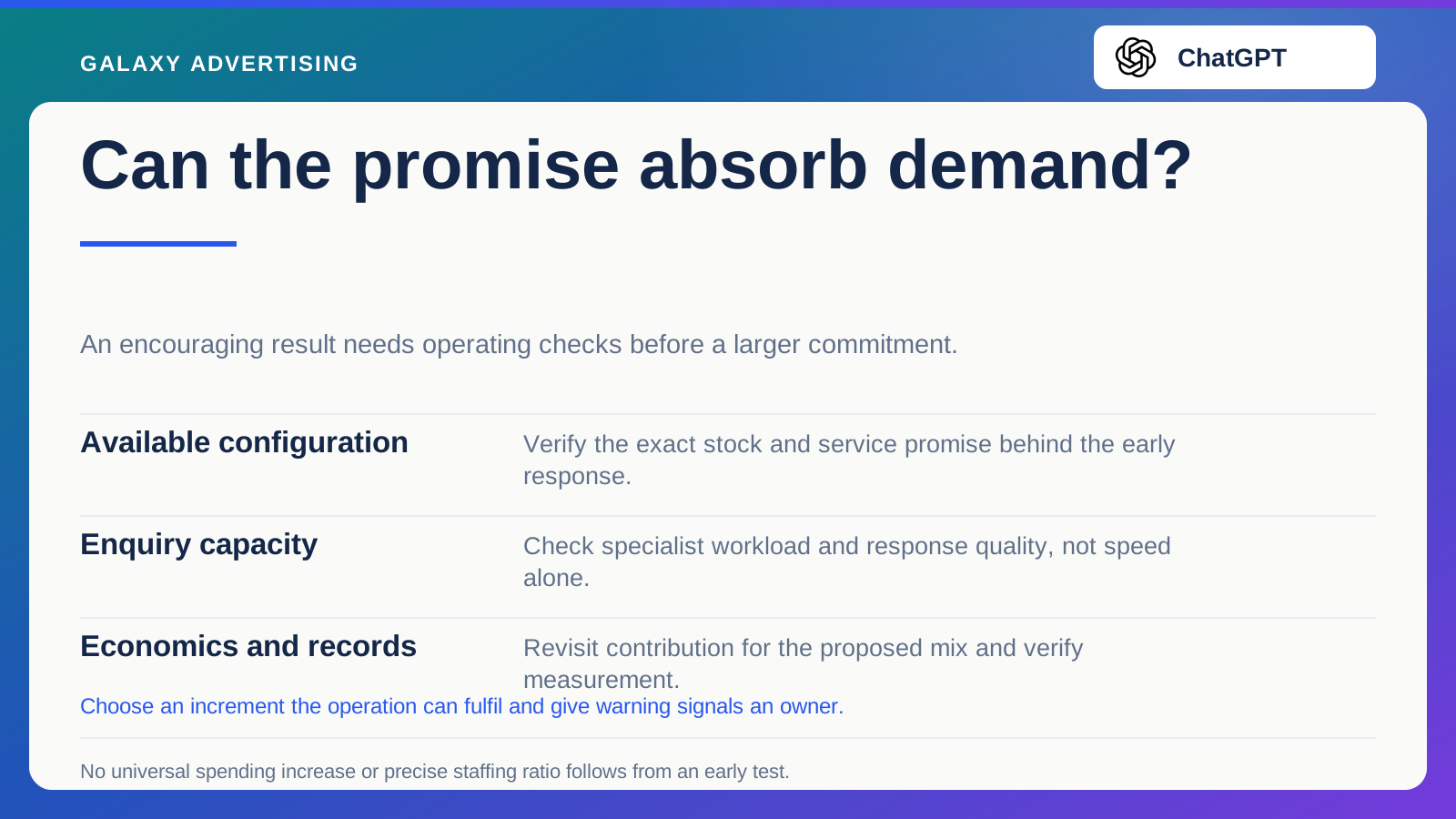
A new channel test competes with other uses of money and staff time. Check whether the commitment would weaken acquisition activity you already depend on or overload the people handling enquiries.
That doesn't give established campaigns an automatic claim on every available pound. A familiar average return says little about whether the next increment has the same economics. Equally, being new isn't evidence that a channel deserves priority over a demonstrated operational need.
Make the opportunity cost concrete. Which product range, campaign improvement or service task would you defer? The test isn't an isolated line in a media plan. Naming what waits gives you a more honest comparison of the options and their effect on the rest of the business.
Release money when the essentials are ready
Where it makes sense, sequence the commitment. Confirm the advertised offer, complete essential destination checks and verify the measurement route before authorising more exposure. Use the order your business needs, rather than treating it as a universal ritual.
Make each dependency observable. Saying the website is ready leaves room for very different interpretations. Saying the promoted package shows its included components and current delivery arrangement on the phone route gives somebody a condition they can check.
Dependencies shouldn't become an indefinite postponement. If the test stays blocked, name the owner and the consequence. The budget holder can then choose a narrower scope, fund the correction or redirect the money. Leaving it assigned to work nobody can launch doesn't settle anything.
Pay attention to the cost of understanding it
Reserve time for the people who must explain orders, enquiries and implementation. Producing data nobody has capacity to review isn't an efficient investment in learning, however busy the campaign looks.
Keep the analysis proportionate. A bounded first test might need a carefully reviewed sample and an honest conclusion. It doesn't automatically need a complex reporting project. The point is a defensible next action, rather than a dashboard demanding more attention than the campaign warrants.
Record that review cost when comparing future experiments. Complicated product enquiries and extensive manual reconciliation create an operational burden. That belongs in the discussion about whether you can maintain the route as investment grows, alongside the media cost itself.
Give the allocation a reason you can revisit
Present the chosen allocation with the constraint it addresses, the work it funds and the evidence expected afterwards. Include what it cannot establish. The budget owner can then accept uncertainty with some understanding of what the commitment means.
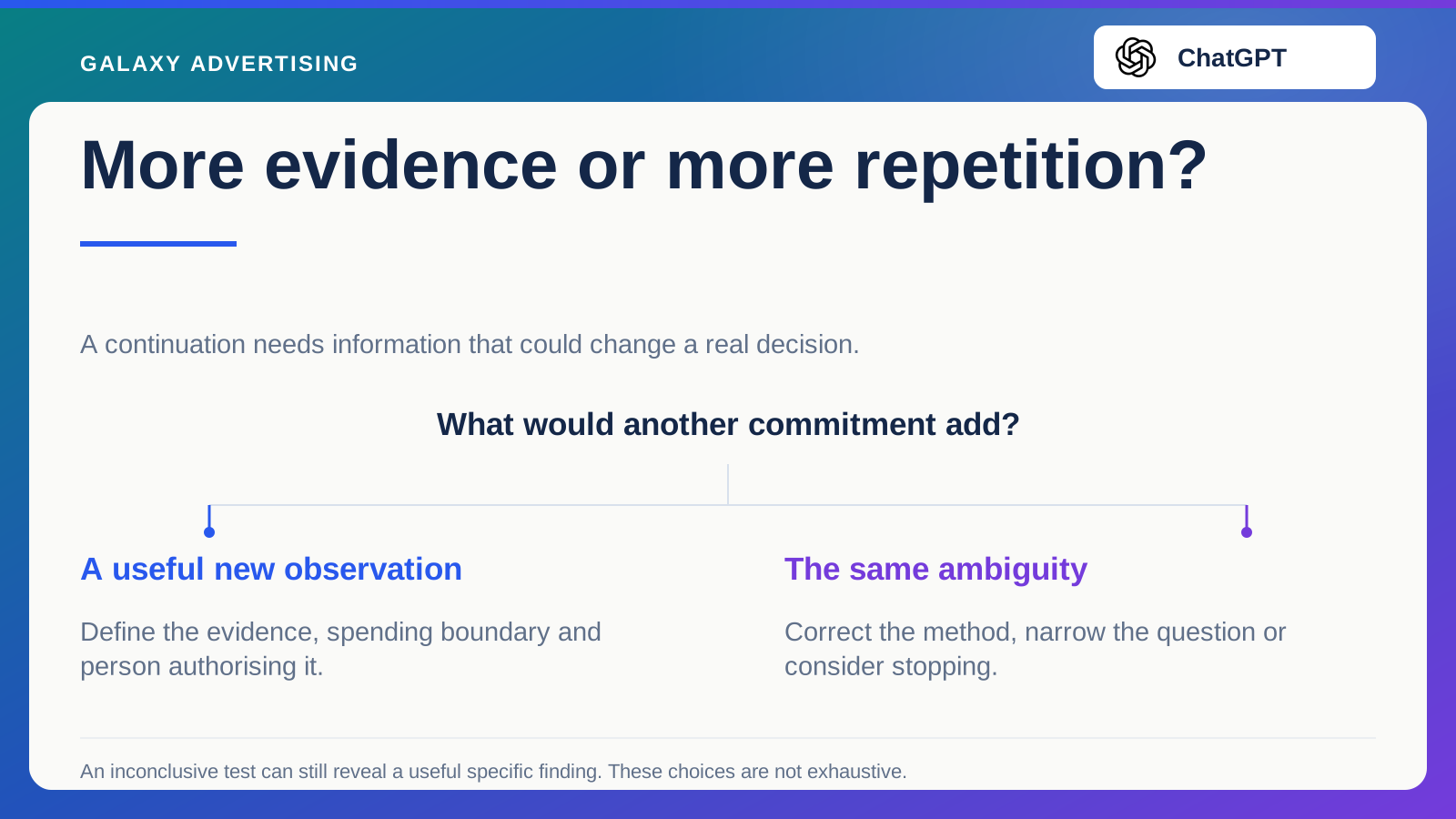
At review, compare the learning with the expectation. If the page correction didn't clarify the offer, investigate why. If more exposure still leaves the answer inconclusive, reconsider the question or method before authorising the same expense again.
There isn't a fixed percentage that makes a ChatGPT Ads budget sensible. There is an affordable commitment that resolves a useful uncertainty in a coherent buying route. Your next expense may well be media. Being able to explain why is what gives the decision its value.