 Meta Ads
A creator demonstrating your chair can't automatically establish your manufacturing history, typical delivery performance or other customers' experiences. A confident face on screen doesn't give every claim the same foundation.
That's easy to overlook when a retailer asks for more social proof and commissions someone to praise a new chair. The contributor may have something genuinely useful to show. The brief still needs to distinguish that from everything the business wants viewers to believe.
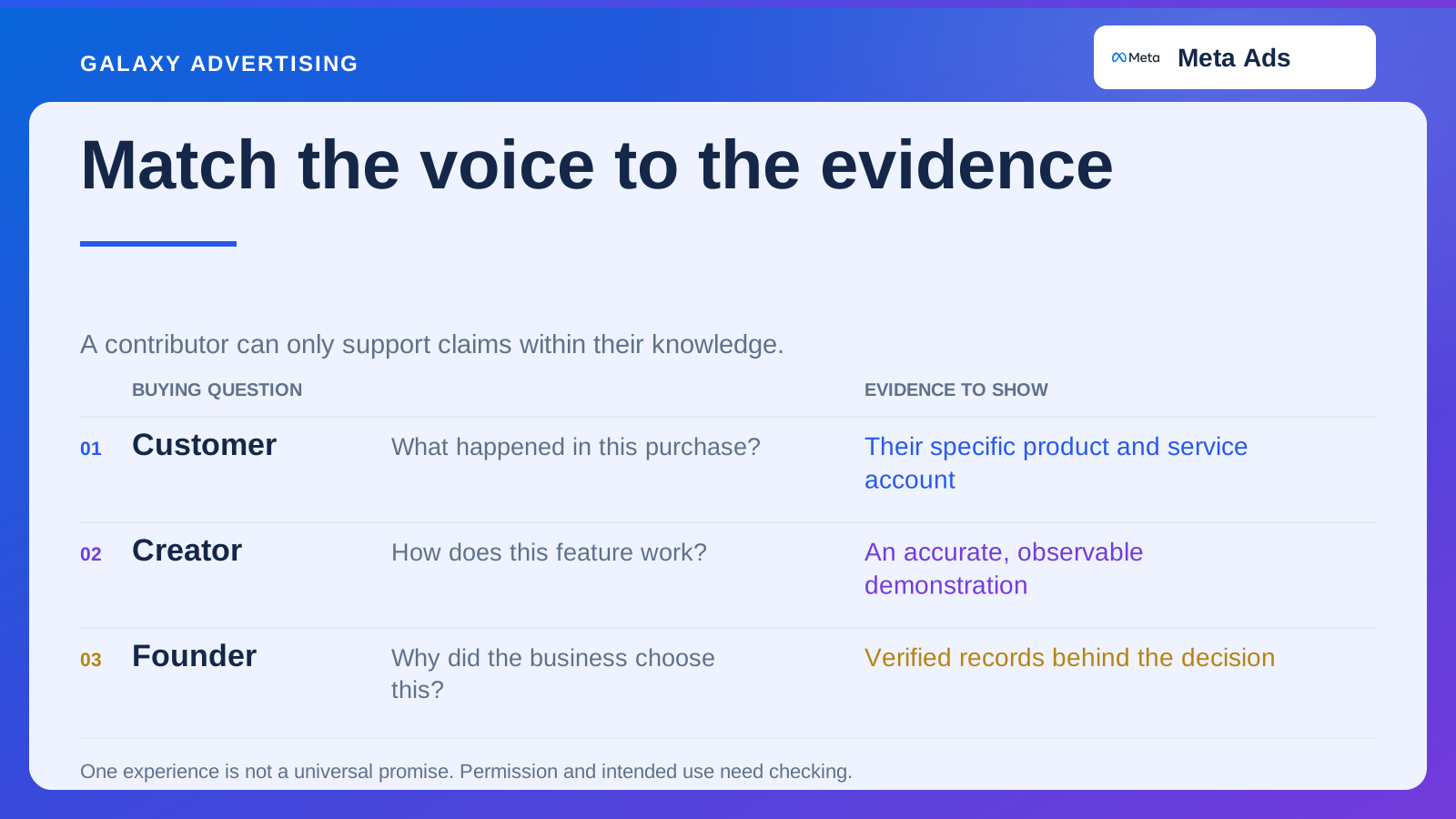
Choose the voice according to the question. Founders can explain business decisions, customers can describe particular purchases and creators can make demonstrations understandable. Their evidence has different boundaries.
Name the doubt you want to address
Start with the actual hesitation. Is someone unsure about scale, concerned about assembly or trying to understand why you selected a particular material? Each question points towards a different source of evidence.
A visible scale demonstration may do more than an enthusiastic quotation. A founder can explain a sourcing decision where the underlying facts are verified. A customer's account can help viewers understand how an actual purchase unfolded.
“Build trust” isn't a complete brief. It leaves the producer guessing which evidence to obtain. Specify the uncertainty and the observation that would help someone assess it. Then selecting a contributor becomes a practical editorial decision, rather than a preference for a fashionable format.
Keep the customer's experience specific
A customer can describe their own experience and the product they received. Preserve the context needed to understand it, including configuration or service details that affect the meaning.
Don't edit one experience into a promise about every order. A prompt delivery to one person doesn't establish the arrangements for every configuration. Broader service claims still need verified operational information.
Keep their words connected to what happened. If an edit swaps product footage or introduces another offer, check the resulting impression again. A useful testimonial retains its specificity. Turning it into a vague endorsement that could fit any retailer removes the detail that makes it worth hearing.
Let creators show something viewers can assess
A creator can place a product in a recognisable situation and explain an unfamiliar feature. That contribution is strongest when viewers can observe something relevant alongside the spoken explanation.
For a hypothetical adjustable chair, that might mean showing the control in use and the resulting position. A request for confident delivery isn't permission to invent performance or suitability claims. Supply approved facts and clear boundaries in the brief.
Distinguish direct experience from supplied brand copy. Don't leave people with an inaccurate impression about what the creator has personally used or verified. Establish the permissions and disclosures needed for the intended use with the people responsible for that work. The presentation and its authorised use both need attention.
Give the founder a decision to explain
A founder often has useful context about why the business made a particular choice. That could be the range it carries, a service it designed or its response to a recurring customer problem. Another contributor may not possess that context.
The explanation still needs evidence. Confidence doesn't establish a technical claim, and it doesn't prove a comparison with every alternative. Ask for the relevant records and keep statements within what those records support.
Avoid a company history unless the history helps the buying decision. A concise explanation of an important product or service choice can answer more than an elaborate origin story. The useful test is whether the customer's practical uncertainty has become easier to assess.
Check what the footage adds to the words
Plan supporting material after deciding what the speaker can credibly establish. Don't pair a customer's delivery account with footage implying an additional installation service they never received. The combination changes the apparent claim.
A creator discussing a finish needs footage of that actual finish under reasonably consistent conditions. A generic room scene may provide atmosphere. It doesn't verify the particular product difference being discussed.
Review the edit with the sound off, then without the picture. This checks comprehension rather than predicting performance. It can show whether either element introduces an unsupported promise, or whether the combination changes the meaning of material that's accurate separately. Review the impression, as well as the individual statements.
Keep permission records with the asset
Record the contributor, permitted uses, agreed restrictions and person who can clarify them. Make the record accessible to people managing later versions and placements. Receiving a file doesn't establish every right the campaign might need.
When the intended use changes, ask the responsible person to verify that it remains covered. A seemingly simple edit can change the context in which someone's words or image appear. Familiar footage can still require a fresh check of the intended use.
This article doesn't replace legal review of a specific agreement. The operational need is a reliable record of what's authorised, available to production and media teams. Unclear ownership can make a valuable asset difficult to use responsibly, however good the material looks.
Ask whether the evidence answered the original question
Evaluate the asset against the hesitation in the brief. Can a viewer see the relevant scale, understand the business decision or recognise the boundaries of the customer's experience? An engaging delivery can't compensate for evidence that never arrives.
Then inspect the campaign and customer observations available. Useful follow up questions might show that you've clarified one issue and exposed another. Carry that into the next brief. Every video doesn't need to answer the entire purchase journey.
Use several kinds of evidence deliberately. A creator shouldn't have to impersonate a customer; a founder can't supply independent validation simply by speaking confidently; a testimonial can't guarantee future outcomes. Giving each voice a claim it can support makes the next production decision clearer, and gives the viewer something more useful than reassurance alone.