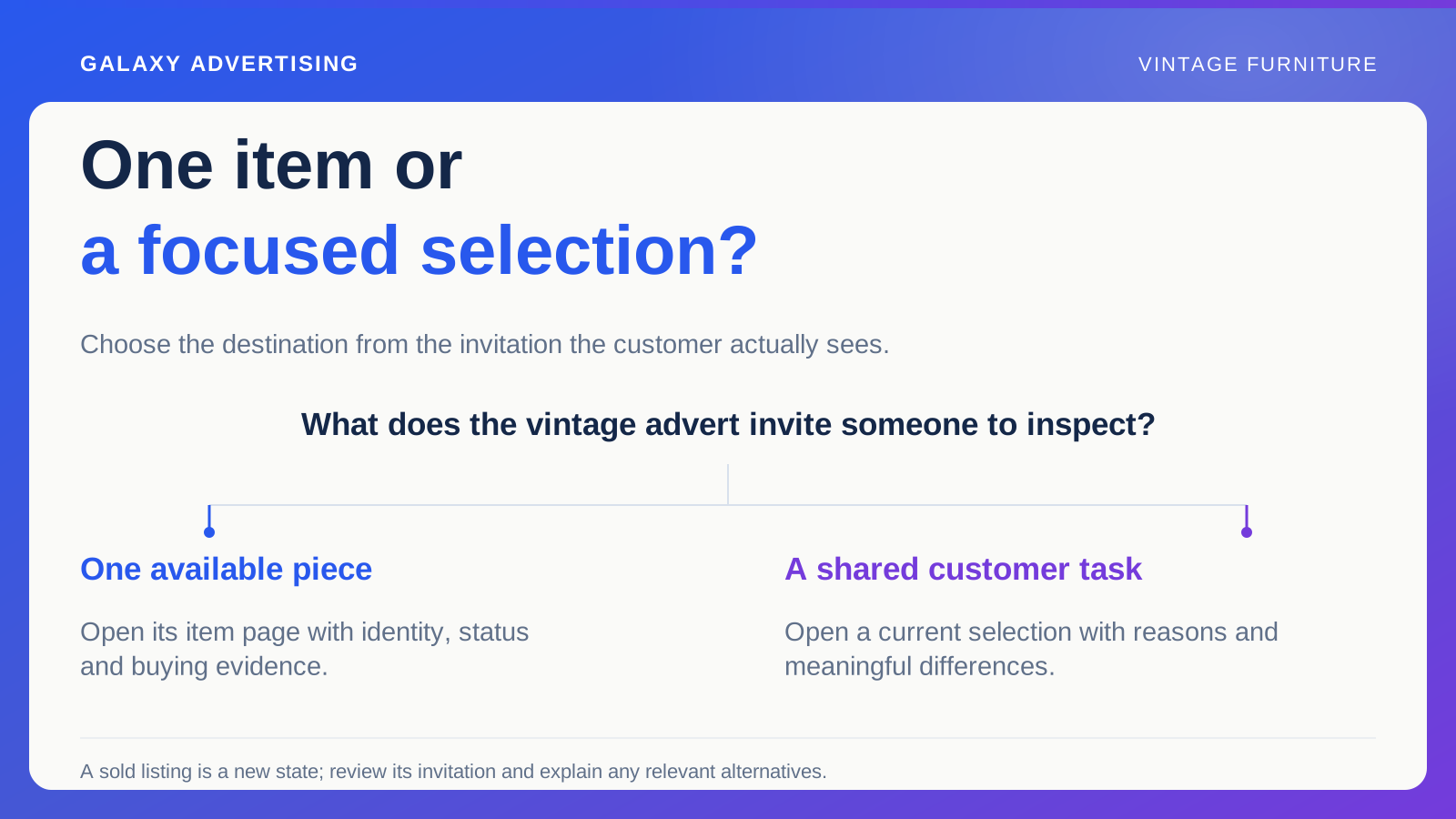
What should you recommend when a customer wants something similar to the sold teak cabinet? Sending every available cabinet gives them plenty to look at, but leaves them doing the hard part: deciding which differences matter and whether anything serves the same purpose.
An alternative is a new offer. With unique stock, it cannot be a replacement copy of the original. Explain the relationship between the pieces and the differences someone needs to assess. You can preserve their interest without suggesting that similar style means equivalent dimensions, condition or history.
Find out what they wanted to keep
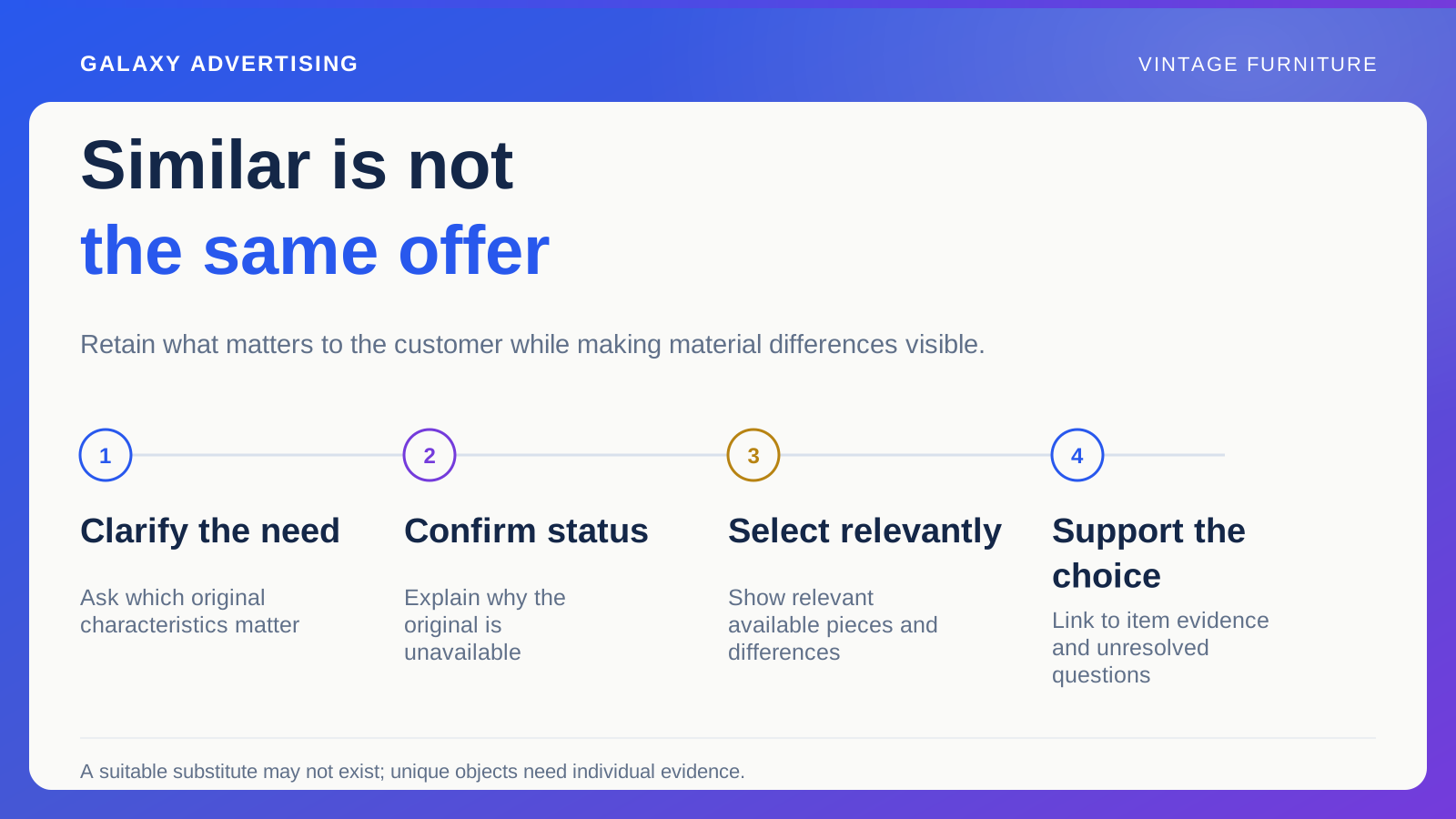
Ask which characteristics made the original piece relevant. Perhaps it was the proportions, storage arrangement, material appearance or a particular documented history. Those answers point towards different selections. Start with the customer's reason, rather than the broad category the object belongs to.
The most obvious visual feature isn't necessarily decisive. Someone who admires a cabinet's appearance may actually need its compact depth for a particular space. Larger pieces in the same material would answer a different question. They might look related without meeting the practical requirement.
Treat the original enquiry as a starting point, rather than a complete specification. Clarify what matters and explain where available stock does or doesn't meet it. You're trying to make a useful comparison. You aren't establishing that a suitable substitute must exist just because the customer wants one.
Be clear that the original offer has changed
State whether the original object is sold, reserved or otherwise unavailable under your actual process. Offering alternatives shouldn't blur that position. The customer needs to know why you're discussing another piece and which purchase remains possible.
If you retain the original page, keep useful item information while making status clear. Someone should be able to distinguish a historical reference from an available purchase. Leaving that distinction for them to infer creates an unnecessary uncertainty before the comparison has even begun.
Keep related links and campaign messages consistent. A sold label on the page won't repair an advert still inviting people to buy the piece. Introduce the alternative route honestly, rather than relying on the customer to discover the mismatch after clicking.
Choose a small selection and explain your reasons
Select alternatives with a meaningful relationship to the customer's task. Explain why each is included and which characteristic it retains from the original interest. A shorter, reasoned selection can be more useful than a page that leaves all the interpretation to the reader.
For a hypothetical compact cabinet comparison, one piece could share a similar footprint. Another could have a comparable internal arrangement. Those are different reasons for relevance. Name the distinction so the customer can judge which aspect matters more to them.
Don't pad the selection with loosely related stock to suggest abundant choice. Sometimes you have no close alternative. Saying so clearly can help more than a crowded page where the only connection is that everything is furniture. The recommendation should earn its place.
Compare the actual pieces fairly
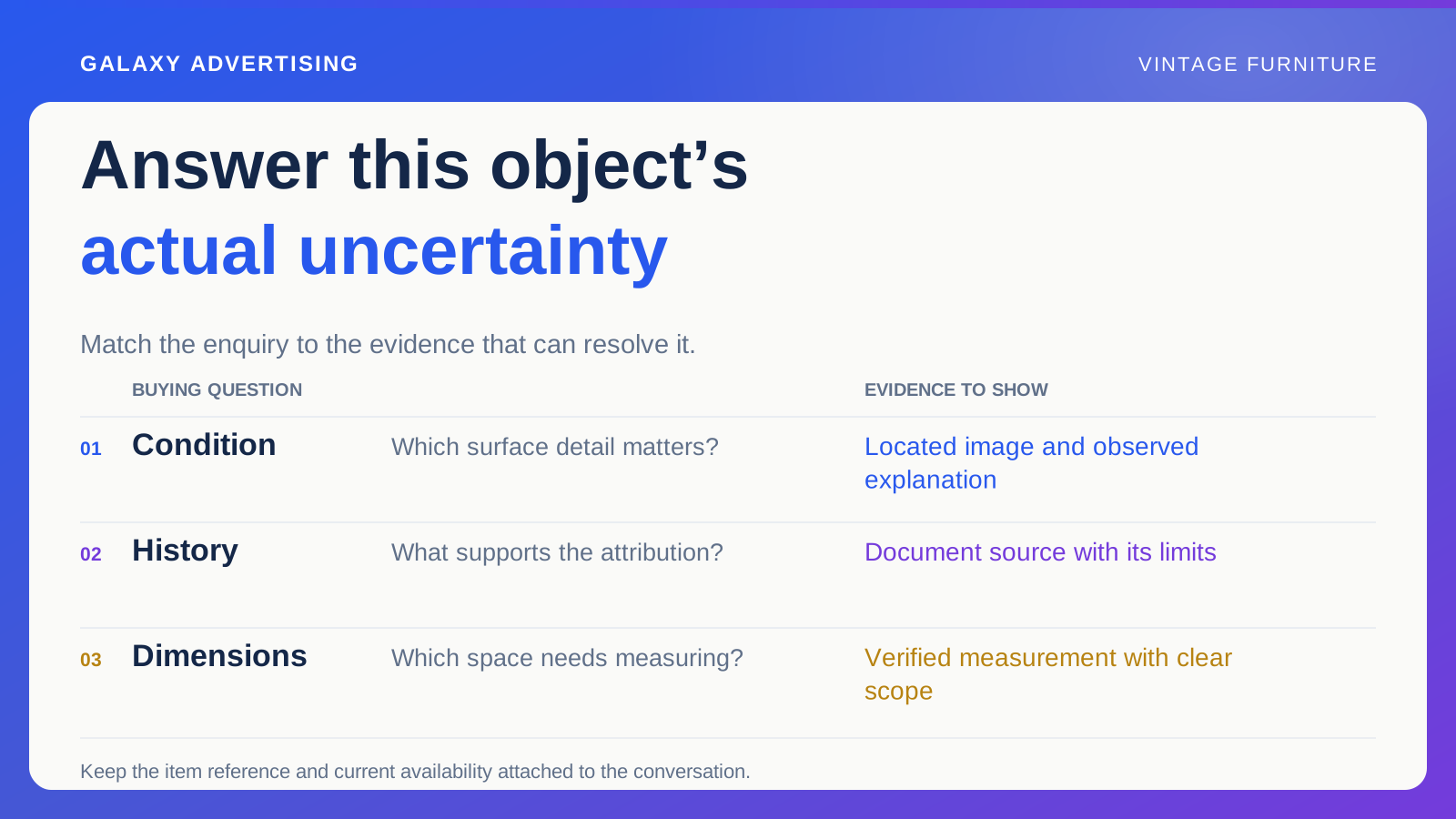
Use verified dimensions, condition records and documented information for each object. Preserve qualifications around uncertain attributions or approximate period descriptions. Don't strengthen them because a neat comparison would be easier to present. The evidence still sets the limit.
Explain material differences plainly. A similar silhouette doesn't establish matching capacity, construction or purchase service. The customer needs to see where equivalence stops, rather than discover that limit after choosing what appeared to be a straightforward substitute.
Use consistent visual references where practical, while keeping individuality visible. Each piece has its own surfaces, details and condition. A comparison should help people inspect those differences. Forcing unique objects into a falsely standardised product table can make that judgement harder, even if the layout looks orderly.
Don't let the old price dictate the new comparison
A sold price may provide useful historical context. It doesn't automatically establish the right value for another object. Condition, preparation, source and fulfilment circumstances can all differ. Carry those differences into the discussion rather than treating the old price as a rule.
Explain the current offer for each available alternative, including what's included and relevant service conditions. The customer needs a basis for evaluating today's purchase. A persuasive story about why one price ought to resemble another doesn't provide that basis.
Avoid a precise market comparison without adequate evidence. You can exercise commercial judgement on your price and explain meaningful differences without claiming to have measured the entire market. Superficially similar listings elsewhere aren't automatically equivalent offers either. Keep the claim within what you can support.
Make the next question easy to answer
Link directly to individual item records and identify further information that may help. An internal measurement or condition detail might decide between the options. Provide a route to get that answer, rather than leaving the customer with a comparison they cannot finish.
Retain their requirements during follow up. If you already know the relevant constraint, don't restart with another generic selection. Keep the recommendation reason in the customer record where appropriate, so a colleague knows compact depth mattered rather than assuming any similar timber appearance will do.
If you offer stock alerts or another continuing service, explain what it actually does. Don't imply that the same unique object will return or guarantee an exact match. The useful promise concerns how you'll handle future relevant information. You cannot control which pieces arrive.
Keep recommendations relevant as stock moves
The alternatives may sell too. Assign someone to check availability and update the route when current suggestions no longer apply. An accurate recommendation today doesn't maintain itself through the next stock change. The handover needs an owner.
Preserve the reasoning as well as the links. If a page concerns compact depth, new suggestions should serve that requirement or explain why the selection changed. Mechanical replacement can leave the heading apparently accurate while the stock underneath no longer helps.
Similarity becomes useful when it helps someone understand their options without erasing the differences. They may choose another piece, wait for a better arrival or decide your current stock doesn't meet their needs. A credible recommendation leaves room for each of those judgements.