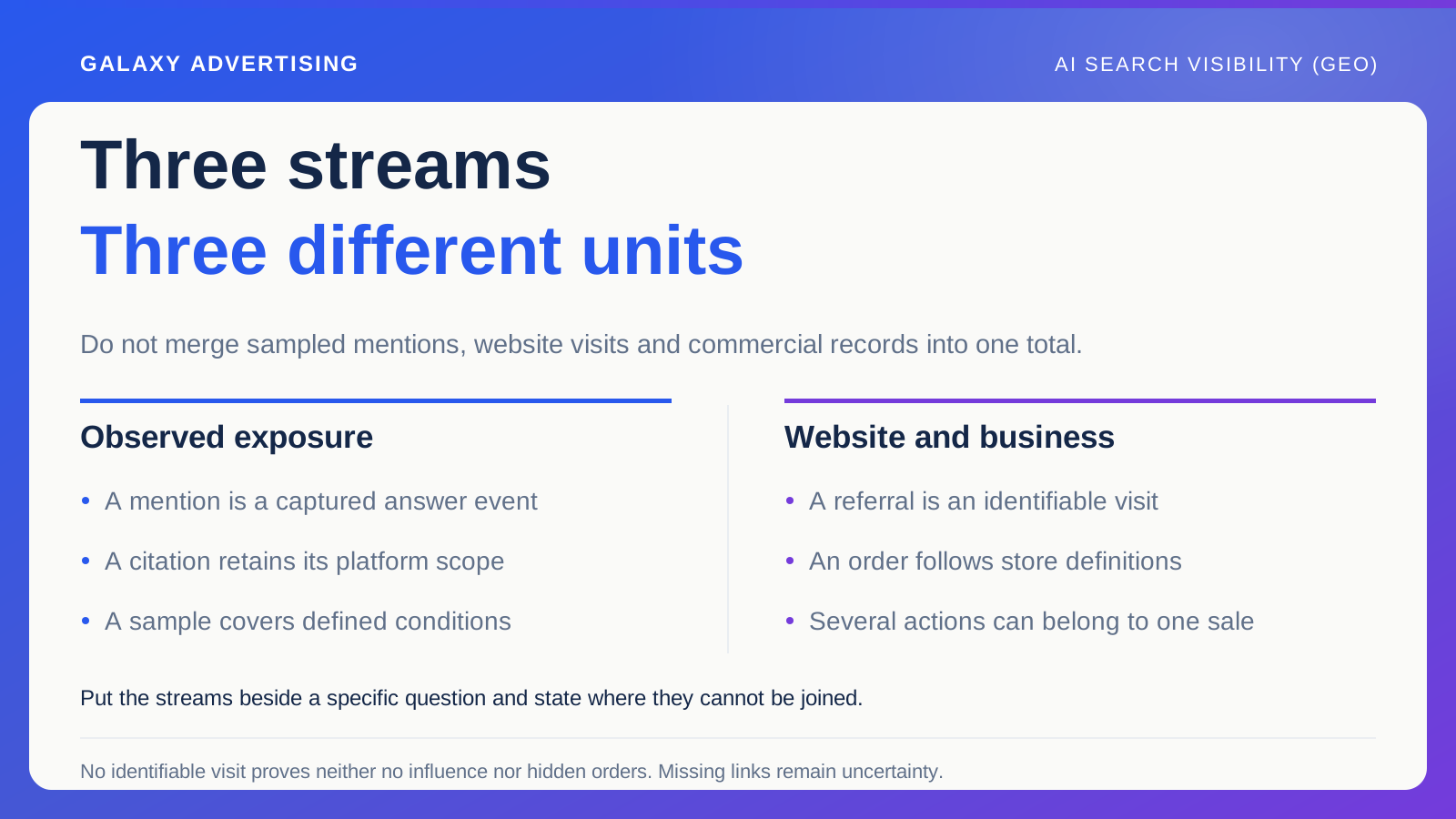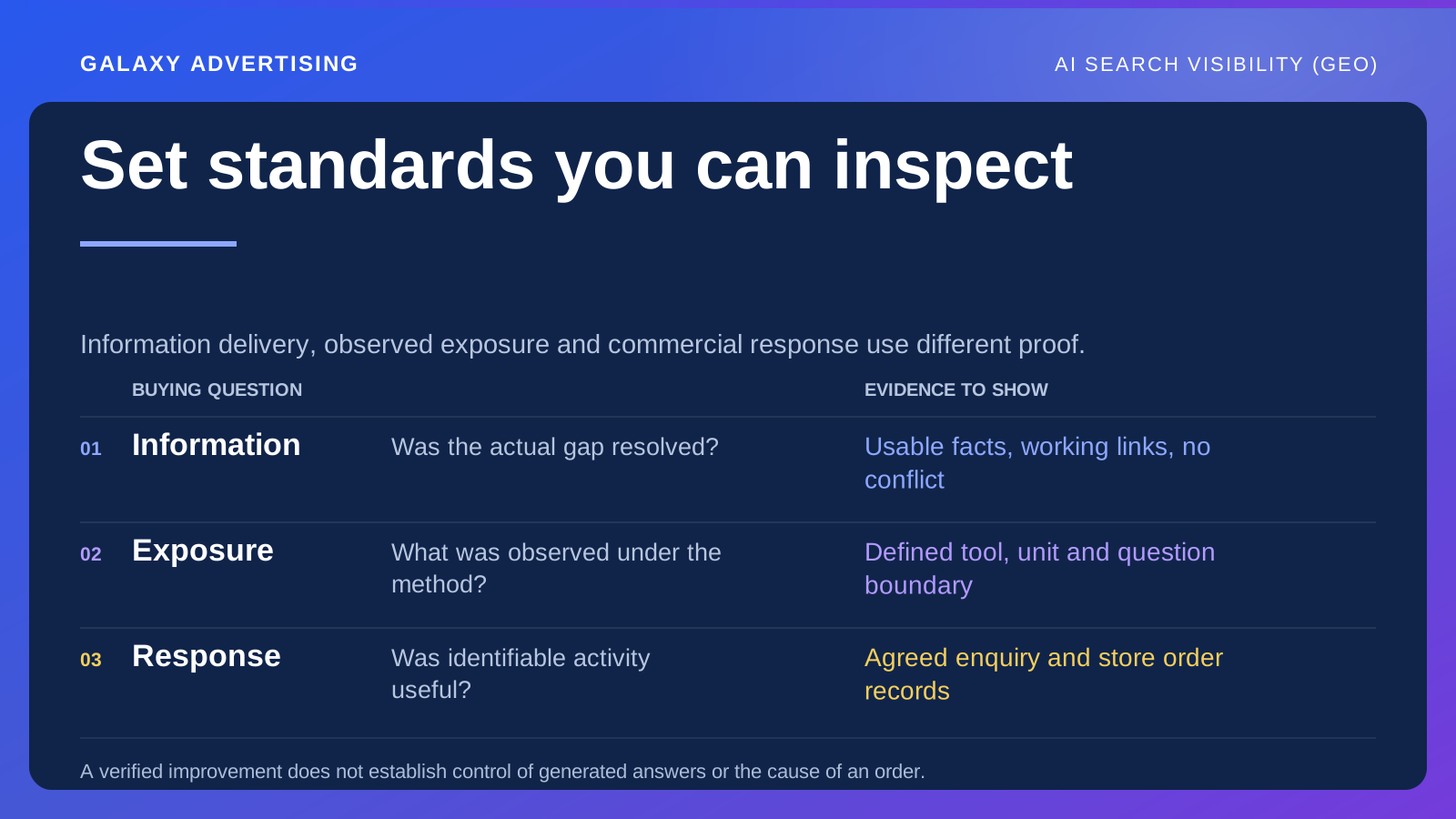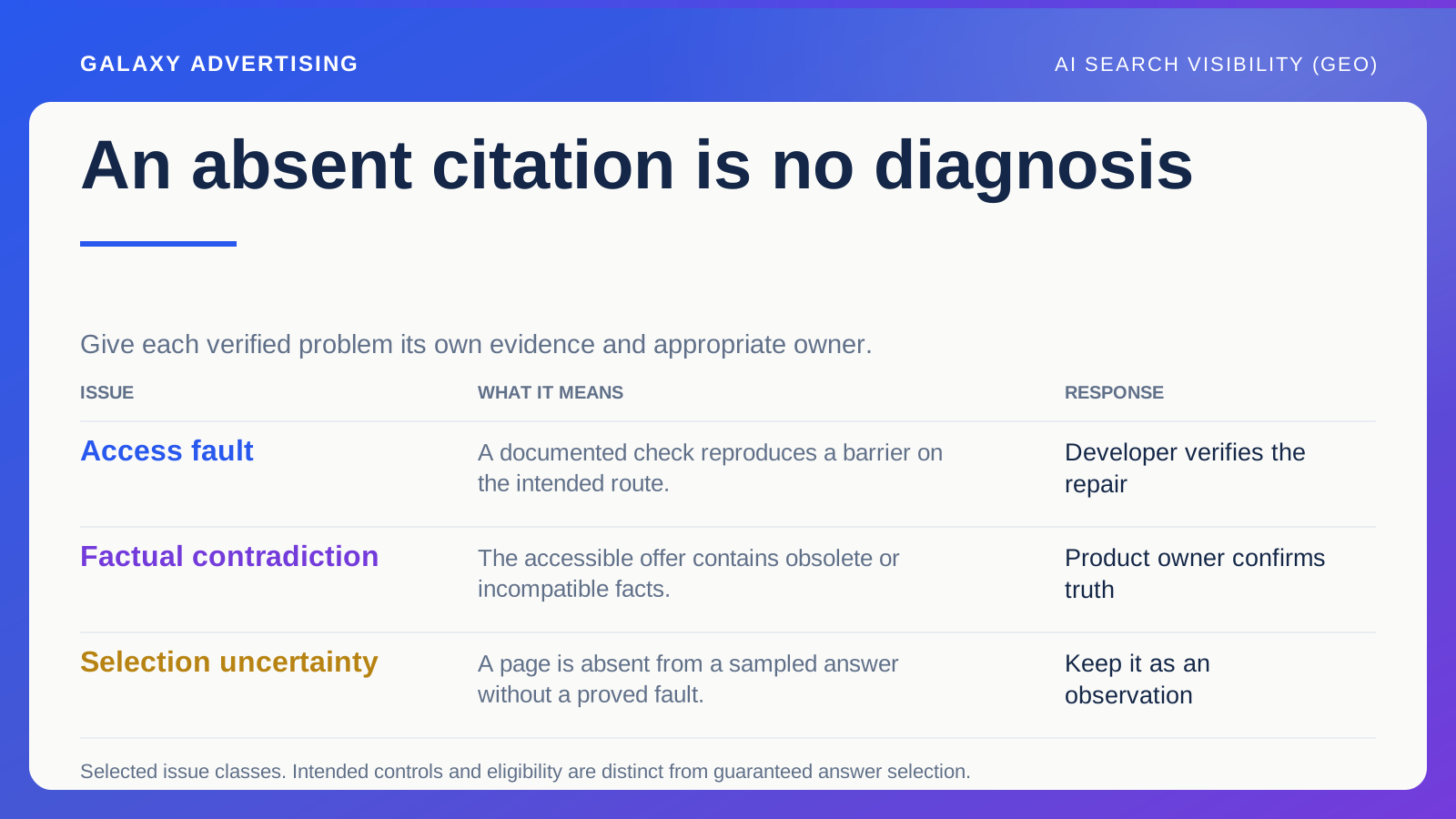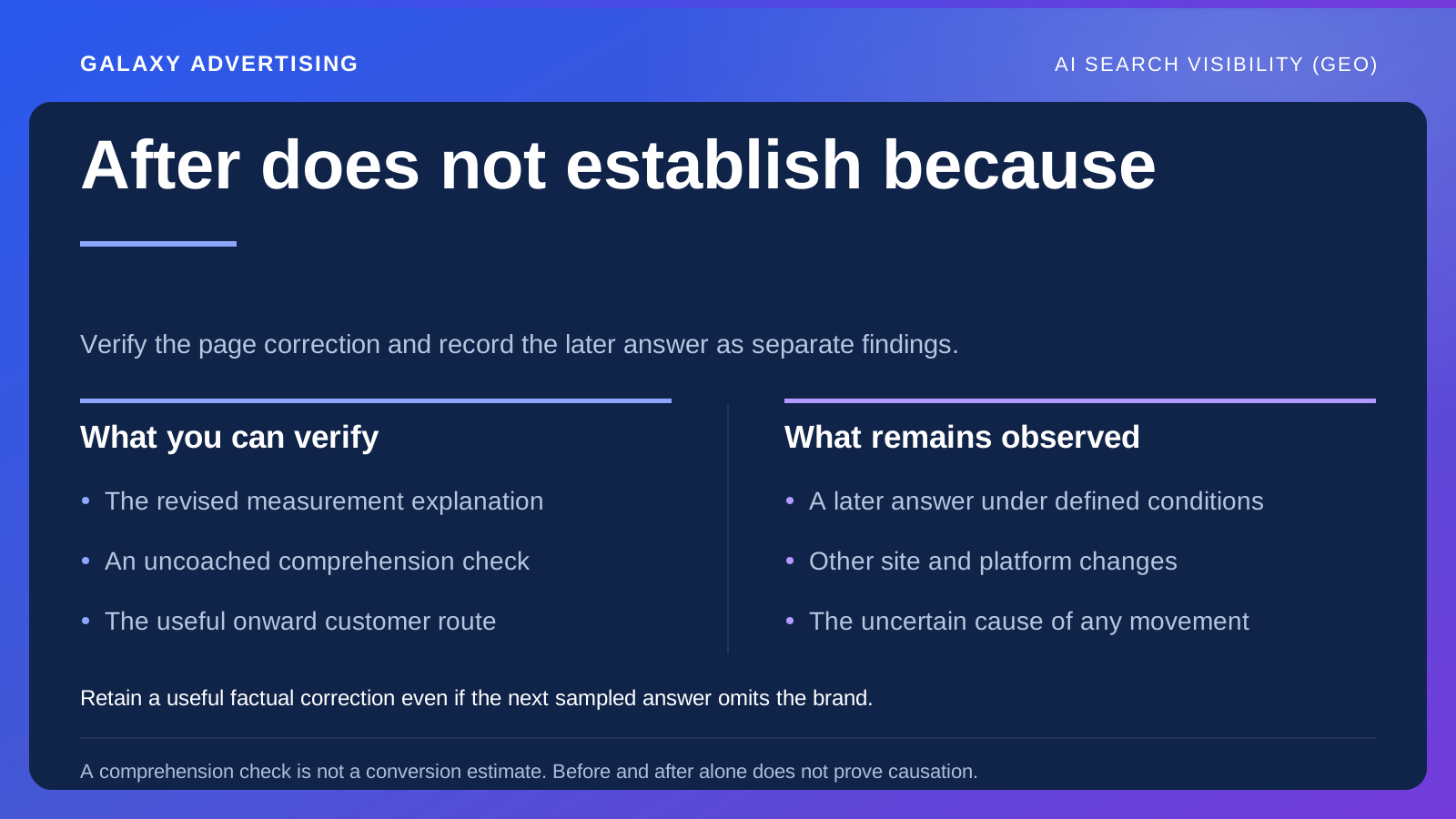
Your revised product guide is live, and a later AI answer mentions your brand. Someone puts the two observations together and calls the edit a successful optimisation test.
The change may have helped. That sequence alone doesn't establish that it caused the answer or that another customer would receive the same response.
Begin with a narrower claim. Identify the information problem, verify its correction and observe the route through a defined method. That gives you something useful to judge without turning before and after into proof of a ranking mechanism.
Name the problem without mentioning the hoped-for citation
Describe what customers find missing, unclear or inaccurate. A hypothetical appliance guide might fail to distinguish product dimensions from packaging dimensions. That's a concrete problem whether or not an AI tool links to the page today.
Name the source verifying the correction and the person approving it. Don't make the writer responsible for inventing an answer that merely sounds stronger. Resolve the product fact before asking the wording to carry it.
Explain what should improve. In this example, readers should identify which measurement relates to the installation question and where relevant manufacturer guidance can be obtained. That's something you can check. Becoming the preferred AI recommendation is a much larger promise, and not a substitute for defining the information task clearly enough to review.
Record the change before making it
Keep the page section, proposed explanation and supporting reference together. Leave unrelated changes out of the release where practical. This makes the correction easier to understand and gives later reviewers a clear account of the work.
Necessary corrections sometimes need to happen together. Describe them as a package. The result can inform the business without isolating the effect of a particular heading or sentence. Honest scope is more useful than a precise sounding test label that the implementation doesn't justify.
Retain the previous version and reason for revision. That saves future reviewers from relying on memory or comparing screenshots of different page sections. They should be able to inspect what changed and why, rather than reconstruct a story from fragments after the result is known.
Check whether a reader can use the answer
Ask a suitable reviewer to attempt the intended task without coaching. Can they distinguish the measurements and find the correct source? Record where the revised explanation helps and where uncertainty remains. The customer purpose gives the check its direction.
Call this a comprehension check. It isn't a representative estimate of conversion improvement. Its value is establishing whether the intended correction is understandable to the person trying to use it.
Follow the onward route too. A clearer answer can lead to an obsolete product or unrelated collection. The next sensible action is part of the customer purpose, so don't stop verification at the improved paragraph. Check whether the route preserves the understanding you've just helped somebody reach.
Keep the observation conditions steady where possible
If you're using an AI answer sample alongside the change, retain the question wording, tool and relevant conditions. Capture the output. Recording only whether your brand appeared strips away context that may matter to interpreting the observation.
Don't rewrite questions afterwards to make the result more favourable. A legitimate change in the question portfolio needs an explanation of the break. Keep earlier observations on their original basis so the comparison remains intelligible.
Repeatability reduces inconsistency you can avoid. It doesn't control everything affecting the response. Say that plainly. A consistent observation procedure isn't the same as a complete experimental control, however carefully you record it. The method should help people understand uncertainty rather than make it disappear behind a test label.
Record what else changed around the edit
Note material changes to the site, products and promotion during observation. A product launch or broader content release can alter available information at the same time as your specific page correction. Keep those alternative influences visible.
Platform behaviour can change outside your control too. You may not identify every external influence. A clean internal release record doesn't eliminate those uncertainties, so don't present it as though it does.
Keep the conclusion proportionate. You might establish that the correction is live, a defined sample later changed and identifiable visits stayed limited. Each is useful to know. Together they still don't prove one edit produced a stable visibility effect. The report needs room for those findings without compressing them into a stronger causal story.
Decide which uncertainty is worth more work
Before extending the test, identify what matters commercially. You may already have enough evidence that the page is clearer while its effect on discovery remains uncertain. Those conclusions don't require the same next expense.
Explain what new observation a continuation should provide and why it could change the decision. Repeating a sample indefinitely can cost more without improving confidence in the relationship you need to understand. More repetition isn't automatically more useful evidence.
Where stronger causal analysis is necessary, use qualified support and a design suited to available scale and systems. Describing a simple before and after comparison as an experiment doesn't make it causal. Match the method to the claim you actually need to assess.
Finish with the statements the test supports
Record the improvement, verification result, visibility observations and limitations separately. Then choose whether to retain the change, refine it or investigate another question. Give the work a conclusion without forcing all evidence into one verdict.
Don't reverse a useful factual correction because the next sampled answer omits the brand. Accurate information still matters to the customer. Equally, a favourable answer doesn't excuse a page that's misleading or difficult to use.
A plain conclusion might say that the page now distinguishes product and packaging measurements, an unfamiliar reviewer identified the difference, the defined sample changed in a specified way and causation remains unestablished. That preserves the useful result even if the external response changes again. The corrected answer belongs to your customer's route, rather than becoming a failed tactic whenever one observation turns less favourable.