Should your next development slot go to a new gallery, clearer delivery information or an unreliable option selector? Marketing, customer service and development can each make a persuasive case, without agreeing which problem deserves the money first.
All three ideas could be useful. A wishlist cannot choose between them for you.
Make the decision around the obstacle, the affected customer route and the work required to remove it. Include evidence quality, implementation dependencies and commercial exposure. Neither the biggest page nor the most convincing presentation automatically deserves the next available slot.
Describe the difficulty before choosing the fix
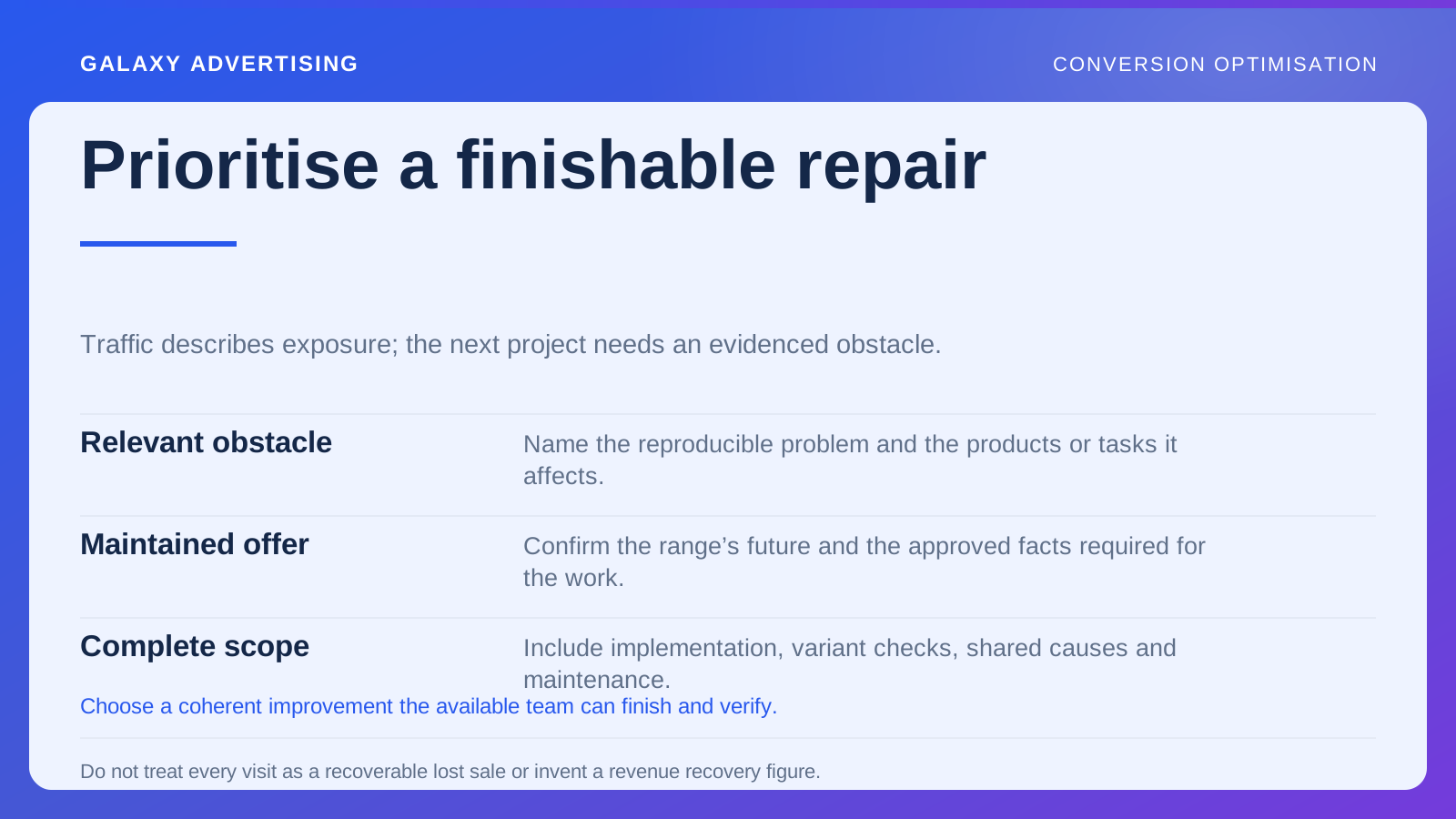
Say what the customer cannot reliably establish or complete. Perhaps selecting another fabric does not consistently update the displayed price on a particular template. That is more useful than jumping straight to “replace the purchase panel”.
Distinguish verified faults, documented information gaps and uncertain hypotheses. They are different reasons to invest and need different evidence. You could reasonably correct a reproducible order error before you can calculate its exact revenue effect.
Keep the issue bounded. Improving the entire customer journey is difficult to estimate or verify. Identifying the route and obstacle gives the team a clearer view of who can act and what completion should mean. It also makes competing proposals easier to discuss on their merits.
Understand exposure without inventing lost sales
Identify the affected products, templates and tasks. Use traffic, order and enquiry records to understand exposure. Everybody visiting the page is not automatically a lost sale you can win back.
Consider what happens when the task fails. A confusing decorative label and an incorrect selected configuration can affect similar visit numbers while causing very different problems. Include evidenced support workload and orders needing correction alongside the immediate interaction.
Label estimates and explain their basis. A hypothetical decision might give an actively advertised product family's fault greater urgency than a layout preference on a rarely used guide. That is a reasoned judgement about priority. It is not a guaranteed calculation of recoverable revenue, and it should not be presented as one.
Allow for the investigation the decision needs
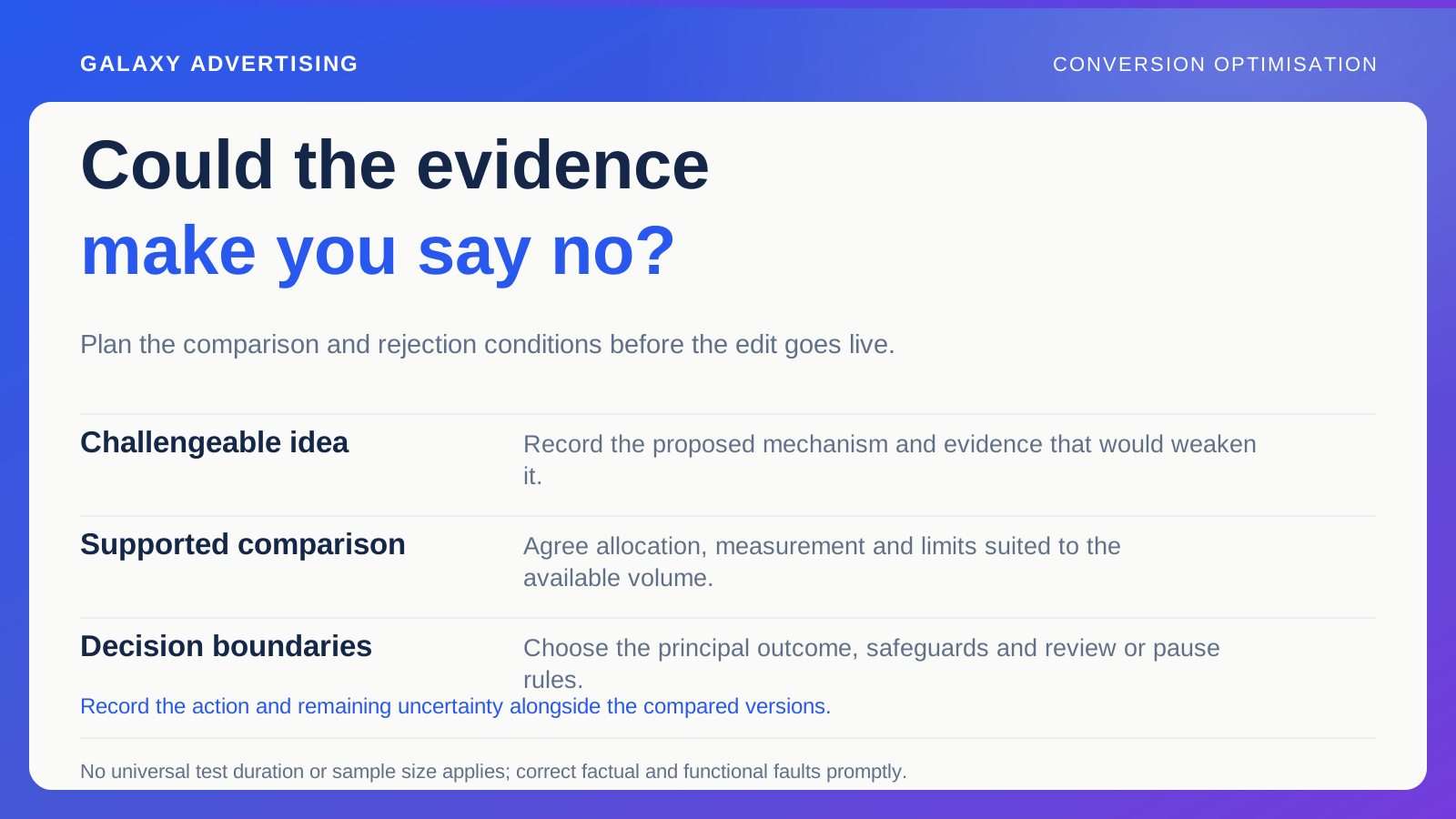
Some proposals need a short investigation before development can estimate them. Others are clear enough for direct repair. Forcing both through an identical process merely makes the queue look consistent.
A small research task can prevent a large redesign based on the wrong explanation. Trying a few realistic configuration routes, for example, might reveal incomplete source data behind an apparent interface selection problem.
Give the investigation a boundary: the question it must answer and the decision that follows. Research becomes wasteful when it keeps collecting observations after the next implementation choice is already clear enough. Budget for enough evidence to decide, rather than an open ended search for everything you could learn.
Ask what the complete intervention will cost
Include product facts, copy, design, development, review and maintenance. A modest build estimate can conceal substantial continuing work for merchandising.
Name dependencies explicitly. A comparison tool needs owned product attributes before it can provide reliable answers. A delivery calculator needs verified service rules. Funding only the interface can leave you with an attractive feature that soon becomes unreliable because nobody funded responsibility for its source.
Discuss what the team can maintain after launch. A simpler accurate explanation might be a better investment than an elaborate interactive component whose data nobody updates. The work should reduce customer uncertainty without creating an operational obligation the business cannot realistically manage.
Write down why one proposal should lead
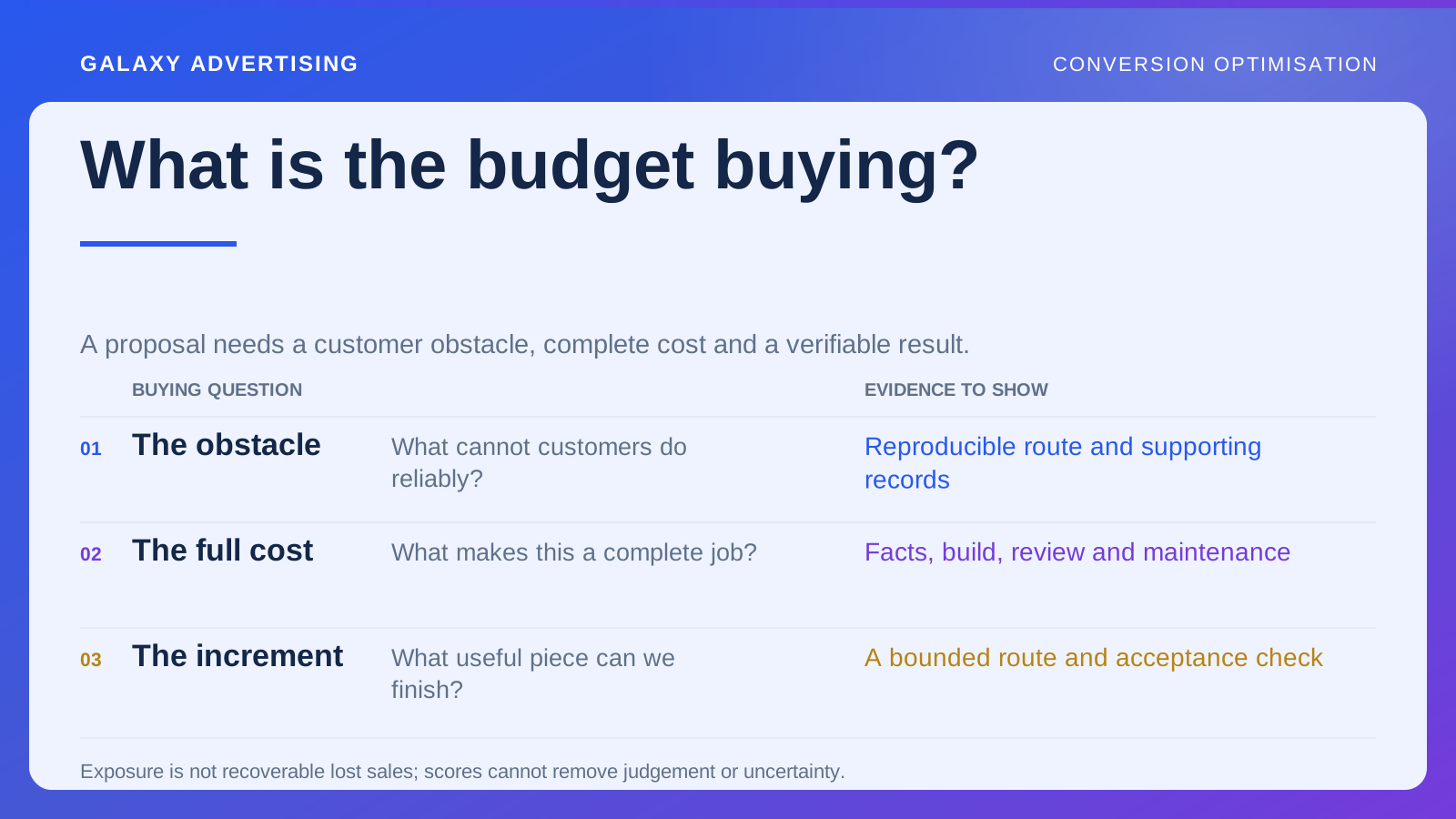
Use a compact record covering the obstacle, route, evidence, proposed work, cost range and remaining uncertainty. A scoring formula should not turn unexamined assumptions into an apparently precise ranking.
A score can organise discussion, provided it leaves the judgement visible. Ask why the leading proposal deserves priority and what fact would change the recommendation. This helps when different departments have different incentives or see different parts of the customer's problem.
Keep deferred proposals and their reasons. “Waiting for verified dimensions” gives somebody a task. “Low priority” can lose the commercial context, so the proposal returns to every planning meeting without new evidence or a clearer decision.
Fund a useful piece you can finish
Choose work that can be completed and checked independently. For delivery information, that might mean an accurate product family summary with a clear route to exceptions. A complex postcode tool can remain a separate proposal.
Keep the increment coherent. Splitting too narrowly can leave customers with an incomplete promise. The essential information and controls still need to work together in the piece you release.
After release, verify the intended route and review relevant observations. Let what you learned guide the next investment. Completing the first increment should make the following decision easier, rather than automatically approving every later item on the original wishlist. Each further commitment still needs its own reason.
Ask whose outcome the proposal serves
Have stakeholders describe the customer task as well as their department's benefit. A cleaner support queue, a more flexible template and an attractive campaign destination can each be worthwhile. They are different outcomes.
Making those differences visible lets the budget owner choose deliberately. It can also reveal useful pieces within a mixed proposal, instead of approving a large package whose commercial purpose changes with whoever presents it. You need a shared understanding of what the money is buying.
Leave room for a genuine urgent correction
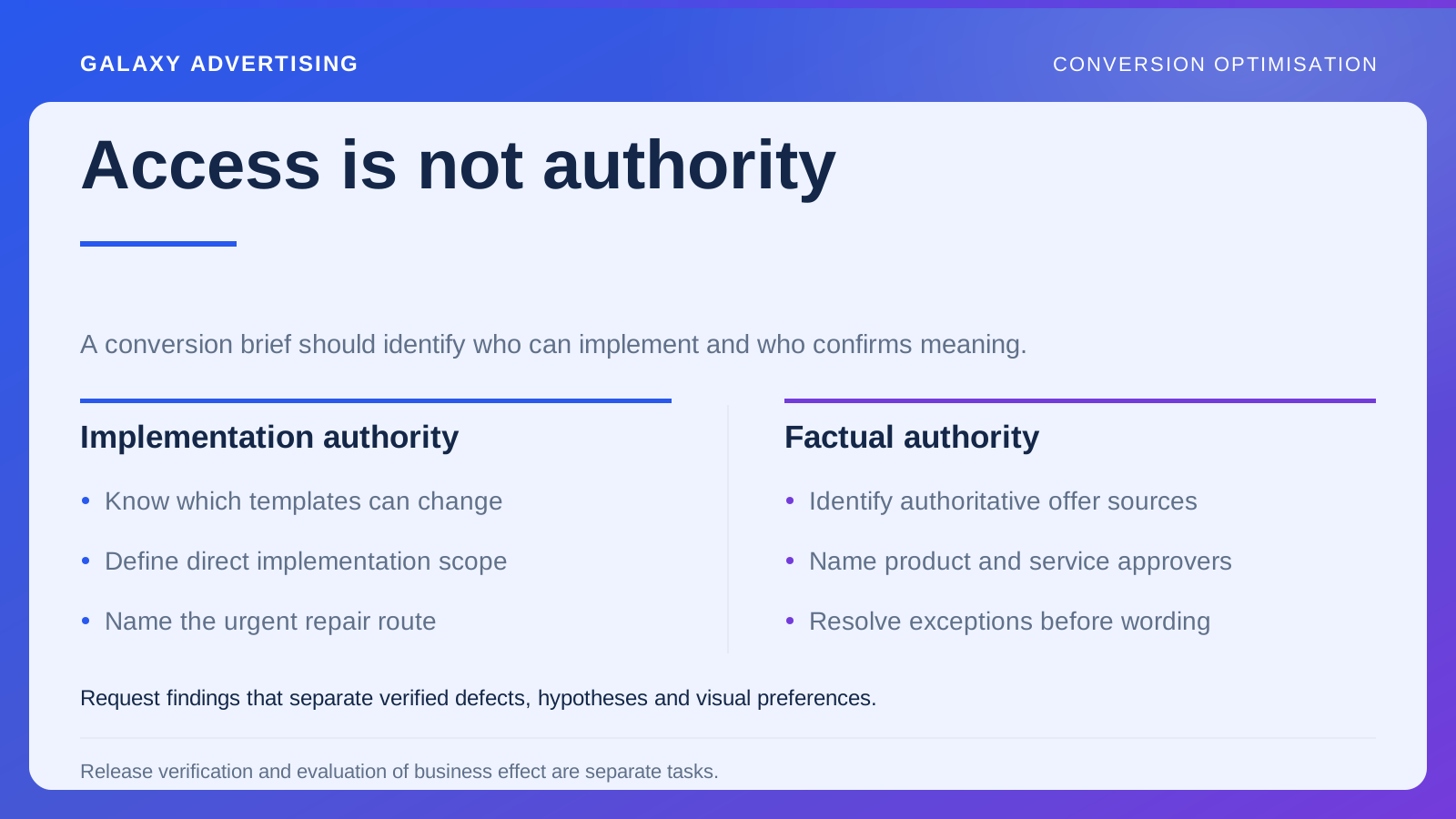
A fully committed roadmap can leave no capacity for new factual or functional faults. Agree how urgent issues enter the queue and who can authorise the interruption.
Require an explanation of urgency. An incorrect offer or broken ordering route needs a different response from a late preference for another colour. Record the distinction so every stakeholder request does not become commercially critical by default.
You do not need perfect forecasts to manage a conversion budget. You need an explainable choice about the obstacle worth addressing, the complete cost and the way completion will be verified. Limited capacity becomes more useful when it finishes a correction your business can stand behind.