What if the product page at the top of your redesign queue is less urgent than one further down it? Your most visited page might have dated imagery while an actively promoted product has a configuration error generating repeated support enquiries.
The traffic ranking tells you about exposure. It has not decided where the work should start.
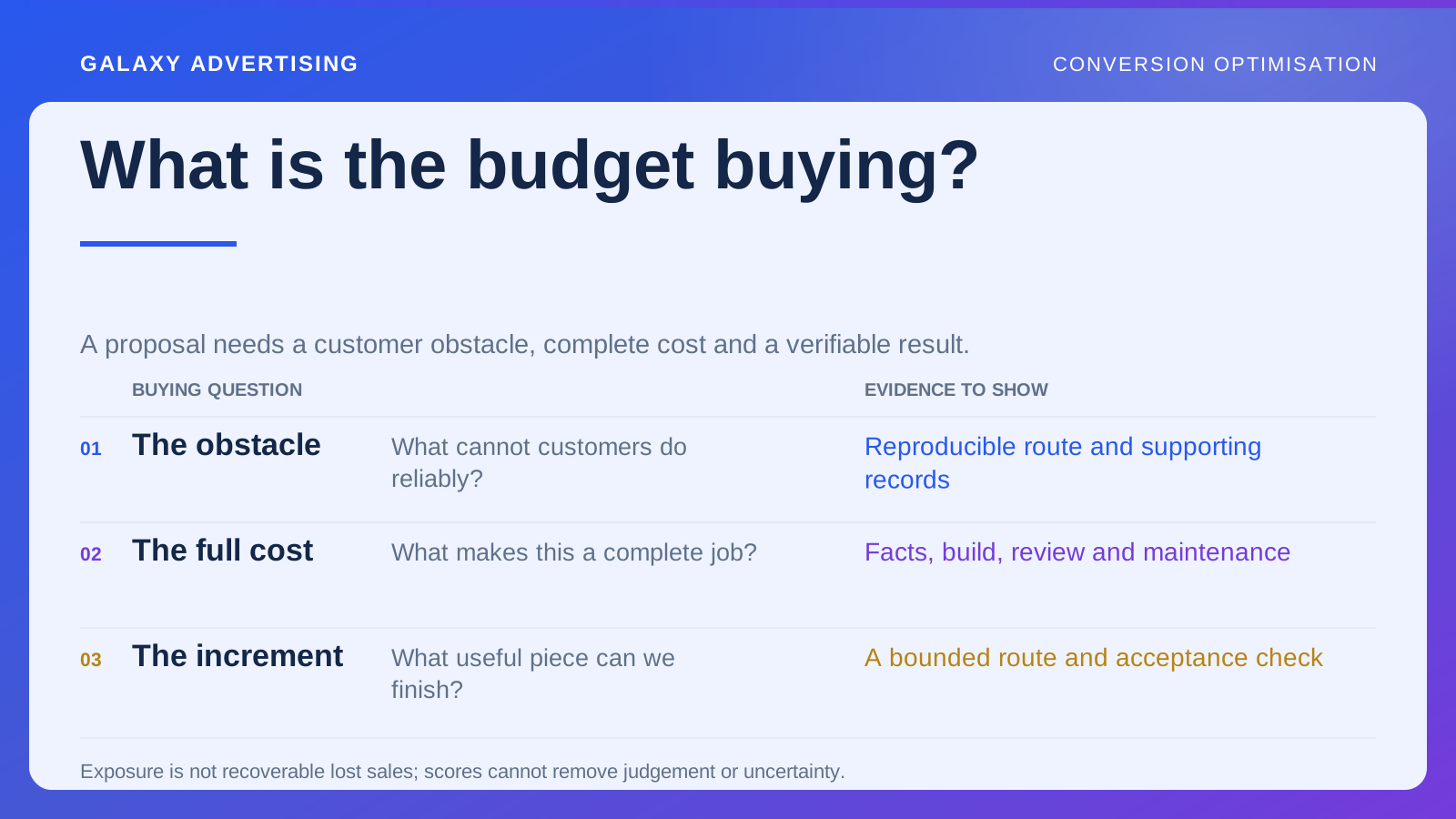
A useful priority connects the customer's obstacle with its business consequence and the conditions needed to correct it. That produces a queue your team can explain and complete, rather than an endless collection of pages somebody would like to make prettier.
Say exactly what is getting in the way
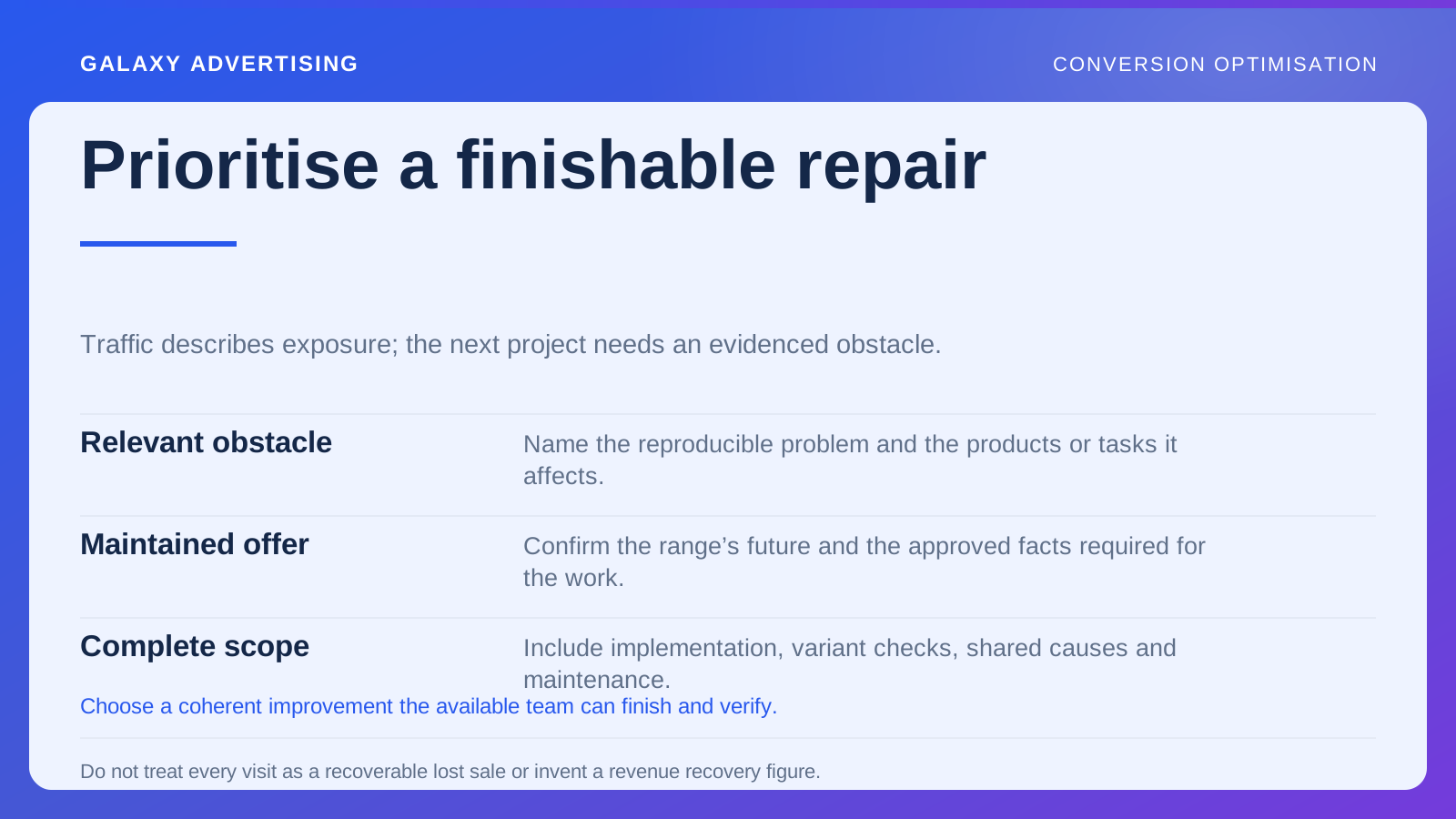
For each candidate, describe what the customer cannot understand or complete reliably. Missing package information, contradictory pricing and an unresponsive selection control are different problems. They can need different owners too.
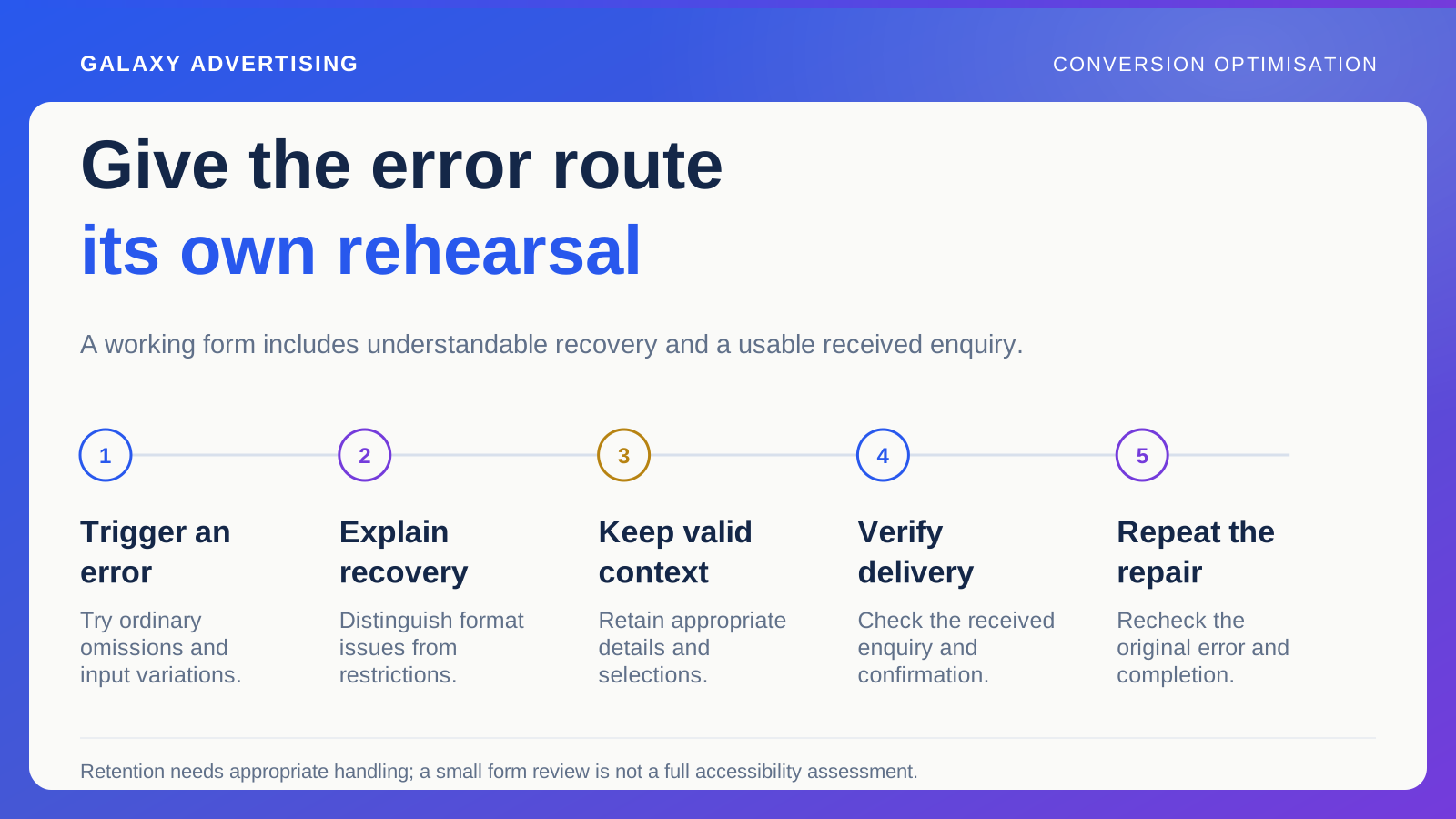
Keep the observation separate from your proposed solution. “The selected image does not change with the finish” is something the team can reproduce and investigate. “The gallery needs a redesign” commits everyone to a much larger intervention before you know what is wrong.
Keep visual preferences visible, but label them separately. Refinement may help a page without carrying the urgency of a factual or functional defect. The reason for the proposal tells you more than an unqualified opportunity score.
Work out what the obstacle affects
Identify the affected products, configurations and customer tasks. Visits, enquiries and order records help describe exposure. They do not turn every visitor into a recoverable lost sale.
Include downstream consequences where there is evidence. An unclear option could create unsuitable orders or repeated manual clarification. A decorative inconsistency may have a less direct effect on the business.
A hypothetical retailer could prioritise a selection fault on an actively advertised bed package over a cosmetic change to a popular information page. Explain that choice through the customer task and commercial risk. Avoid attaching a precise revenue recovery figure that the available information cannot support. A defensible priority does not need an invented promise.
Check whether this offer has a future
Ask whether the business intends to keep promoting and supplying the product. A major redesign for a retiring model may offer less useful value than work on a maintained range. Necessary factual corrections can still be appropriate.
Distinguish temporary availability trouble from an uncertain commercial future. These conditions affect timing and scope differently, so they should not become one general stock concern.
Get the relevant information from merchandising. Do not infer it entirely from the website. A page can look current while supplier arrangements or source records are changing. Your next investment should reflect the offer the business intends to maintain, alongside what its historical performance tells you.
Find out whether the facts are ready
An interface cannot supply missing dimensions, uncertain package contents or unverified service conditions. Identify who owns the facts and what must happen before the design work is genuinely ready.
A small investigation could clarify the next move. Reviewing a product record might reveal that the issue belongs in the catalogue rather than in the page template.
Keep the dependency in the queue with a useful label. “Awaiting approved package contents” gives someone a specific responsibility. “Needs optimisation” can conceal the reason nothing moves. It also invites visual work that cannot yet be completed accurately, because the team still does not know what the page needs to say.
Check for a shared cause before scaling the fix
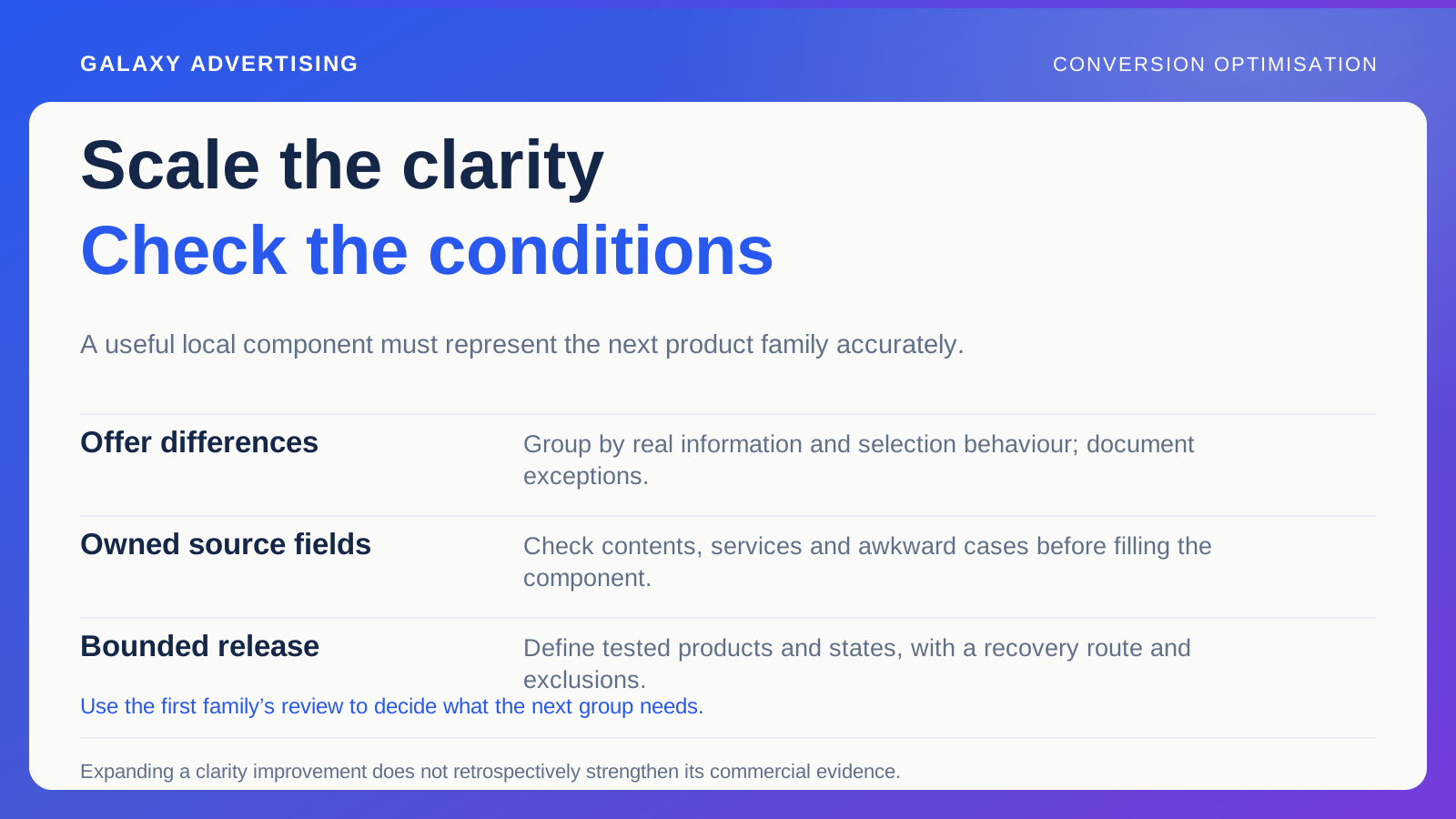
Pages can share templates or source fields. A verified fault on one is a reason to inspect the related group, rather than proof that every page needs the same change.
Choose a sample with meaningful differences, such as fixed and configurable products or different service arrangements. Establish the scope before commissioning work across the catalogue.
You may find the best first project is a shared source or control correction, rather than a complete redesign of one page. State that opportunity explicitly. Otherwise the business can keep paying to solve the same underlying problem through separate product briefs, without recognising why it keeps returning.
Compare the whole job, including maintenance
Estimate the work needed to provide approved information, implement the correction, review relevant variants and maintain the result. A seemingly modest visual task can become a larger obligation if somebody must manually update its data for every product.
Ask what a coherent first increment would be. A verified package summary for one product family could be useful on its own. An unfinished selector redesign might not offer a safe point to release.
The smallest development estimate is not automatically the best choice. Compare work your business can finish and verify. A cheap task that leaves the main obstacle untouched can use up capacity without improving the customer's route.
Put two realistic candidates side by side
If the queue becomes unwieldy, choose two plausible next projects and write a short recommendation between them. Cover the obstacle, affected route, verified facts, implementation effort and reason to act now.
Then ask what new fact would reverse the recommendation. One product might be leaving the range. The other might depend on missing supplier information. This makes the trade off visible without building a scoring model for the entire catalogue.
Record why the deferred page must wait, so it does not return next month as an apparently new proposal. The useful management question is which coherent improvement the available team should complete next. That is more actionable than debating which page has the greatest theoretical potential under assumptions nobody can verify.
Say when the priority needs another look
Record the leading page, why it deserves attention and what could change that judgement. Stock, supplier information or another urgent fault could alter the next sensible investment.
Review the decision when implementation starts. An old queue is not a permanent promise, but a change of priority needs an explanation. It should not silently abandon previously agreed work.
Traffic and revenue help describe an opportunity. The first page deserving attention is the one with a relevant obstacle your team has enough evidence and authority to address through a maintainable correction. Make that reason visible, and the queue becomes something the business can act on rather than keep admiring.