What if the budget is available, but the shoe your best advert promotes is running out of useful sizes? Advertising wants to expand it, merchandising wants replenishment and content wants clearer model guidance. All can sound sensible. Enthusiasm won't tell you which should receive the next pound.
Identify what each investment would change. More traffic, better information and a more purchasable range do different jobs, but depend on one another. The useful allocation funds a practical next improvement your business can support, with evidence that tells you whether a further commitment is justified.
Define the offer the extra advertising would promote
Name the model, finish, price, available sizes and destination. A broad category label can hide a depleted product behind your strongest asset. The proposal needs to describe the offer a new visitor will actually encounter, rather than the range as everyone remembers it.
Set out the commercial basis, including retained order value and material fulfilment or exchange costs. Don't borrow an attractive average from unrelated products. The economics need to concern the actual opportunity you're being asked to fund, with their relevant scope clear.
Ask the stock owner what will remain available if demand increases. That's an operating question, not a forecast for advertising to invent. If the offer is likely to change, make the dependency explicit in the allocation. Otherwise, the proposal can quietly assume a product selection you won't be able to sustain.
Separate unavailable sizes from unclear information
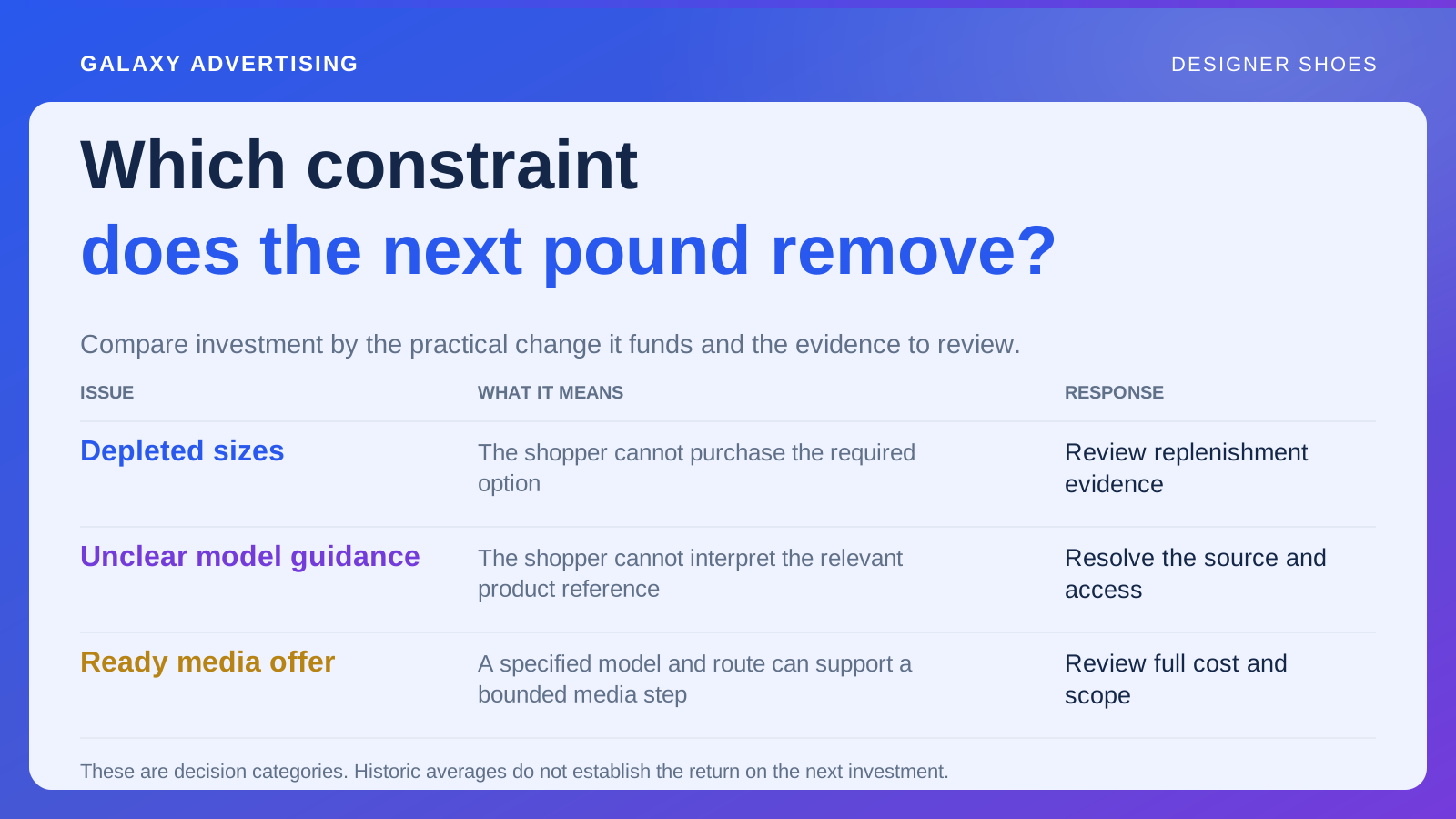
Someone unable to buy their size faces a different obstacle from someone unable to understand model guidance. Both can leave the page. They need different corrections, so a shared outcome doesn't establish a shared cause or justify the same investment.
Use actual product status, enquiries and the available route to classify the issue. Nonpurchase doesn't automatically show weak creative or an inadequate incentive. Look for the practical constraint before deciding which department's proposed fix best addresses it.
A replenishment request should explain the offer it restores and uncertainty about demand. An information request needs a specific ambiguity and the source required to resolve it. “More stock” and “more confidence” are broad ambitions; they don't give you enough to compare the work responsibly.
Put the full commitment beside the proposal
Include production, implementation and maintenance where relevant, alongside media. A new argument might need a shoot or a corrected purchase route before extra advertising can be used well. The account's ability to spend doesn't establish that the surrounding work is ready or funded.
Take a hypothetical £1,500 test requiring £800 of production. It's a different commitment from £1,500 using verified existing assets. Neither is inherently better because of those figures. They expose the cash you actually need to authorise, rather than leave necessary production outside the comparison.
Recognise shared benefits without inventing precise future value. Corrected model information might support several routes, but that doesn't prove an exact revenue return. Explain its useful role and available evidence instead of manufacturing precision so it can compete with a media forecast on appearances.
Ask what the next increment changes
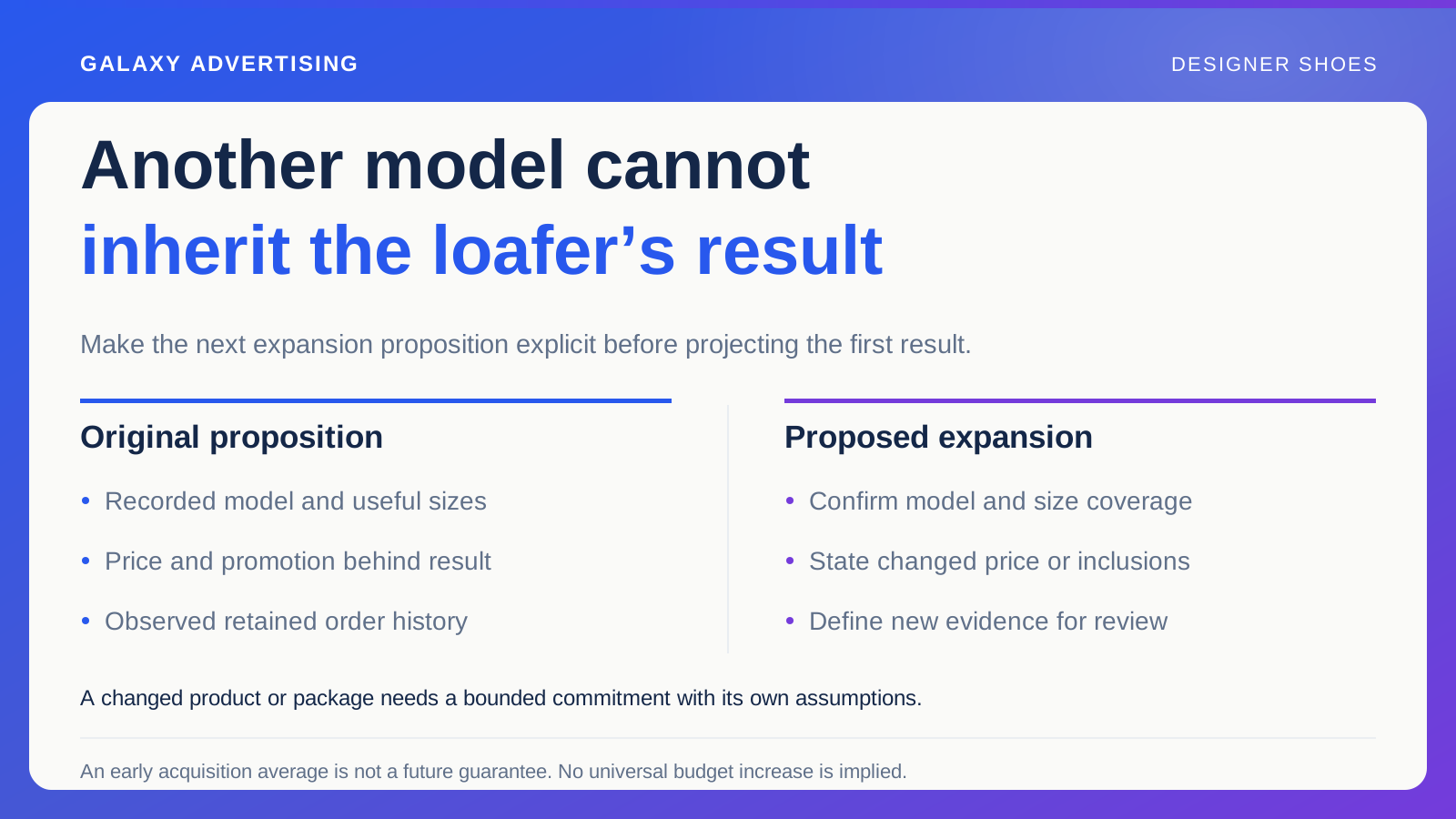
An existing campaign average doesn't establish what additional investment will produce. The next spend could reach another customer mix or promote sizes and models with different readiness. More budget isn't necessarily more of the same commercial opportunity.
Ask the campaign owner to describe the marginal opportunity, meaning what this next investment adds, in ordinary language. Is it the same coherent offer, another model or another buying argument? Each has dependencies that deserve their own review. Make the proposed change concrete enough to inspect.
Don't require a precise forecast where evidence can't support one. A bounded test with explicit assumptions may be more defensible than projecting an old average confidently into the future. You're deciding how much uncertainty the business is willing and able to fund, not removing uncertainty by formatting it as a forecast.
Complete the prerequisites in a useful order
Correcting an inaccurate size reference or restoring a reliable destination may need to happen before wider promotion. Name that prerequisite and the completion check. “The website needs improvement” can postpone acquisition indefinitely; a specific mismatch, owner and verification route create a way forward.
Stock alone doesn't supply an acquisition argument either. If nobody can explain why the next model deserves attention, a proposition or production brief may be needed first. Sequence the commercial idea with the work required to deliver it, instead of treating each proposal as an isolated request.
Check cash timing as well as order economics
Replenishment, production and media can have different payment schedules. Review them with the responsible owner. An attractive calculation per order doesn't establish immediate affordability. Contribution is the money remaining after the costs included in that calculation, and expected contribution isn't the same question as when commitments need paying.
Record the initial approved amount and the condition for authorising more. An allowance per retained order differs from a monthly spending commitment. Revisit assumptions if a product or promotion changes: a different discount or fulfilment arrangement can alter affordability before the advertising dashboard appears to move.
Keep a short decision record for dependencies. You could authorise a corrected model guide now, reserving later media for review once the route is verified. That preserves the opportunity rather than rejects advertising indefinitely. Name what the next owner must complete, and keep the deferred amount as a future decision. A task marked done shouldn't trigger an automatic payment without review.
Review whether the money removed the intended constraint
At the next review, check the job you funded. Did replenishment restore useful availability? Can shoppers find the corrected guidance? Did media produce an interpretable commercial result? Assess the intended change rather than merely confirm that a budget was used.
Retain deferred options and the condition that would change their priority. That gives the next discussion a starting point beyond another competition between departmental requests.
Demand, information and supply belong in the same decision, while each proposal still needs a role, cost and honest account of uncertainty. The next pound should support a change the customer can actually use, in an offer they can assess and purchase.