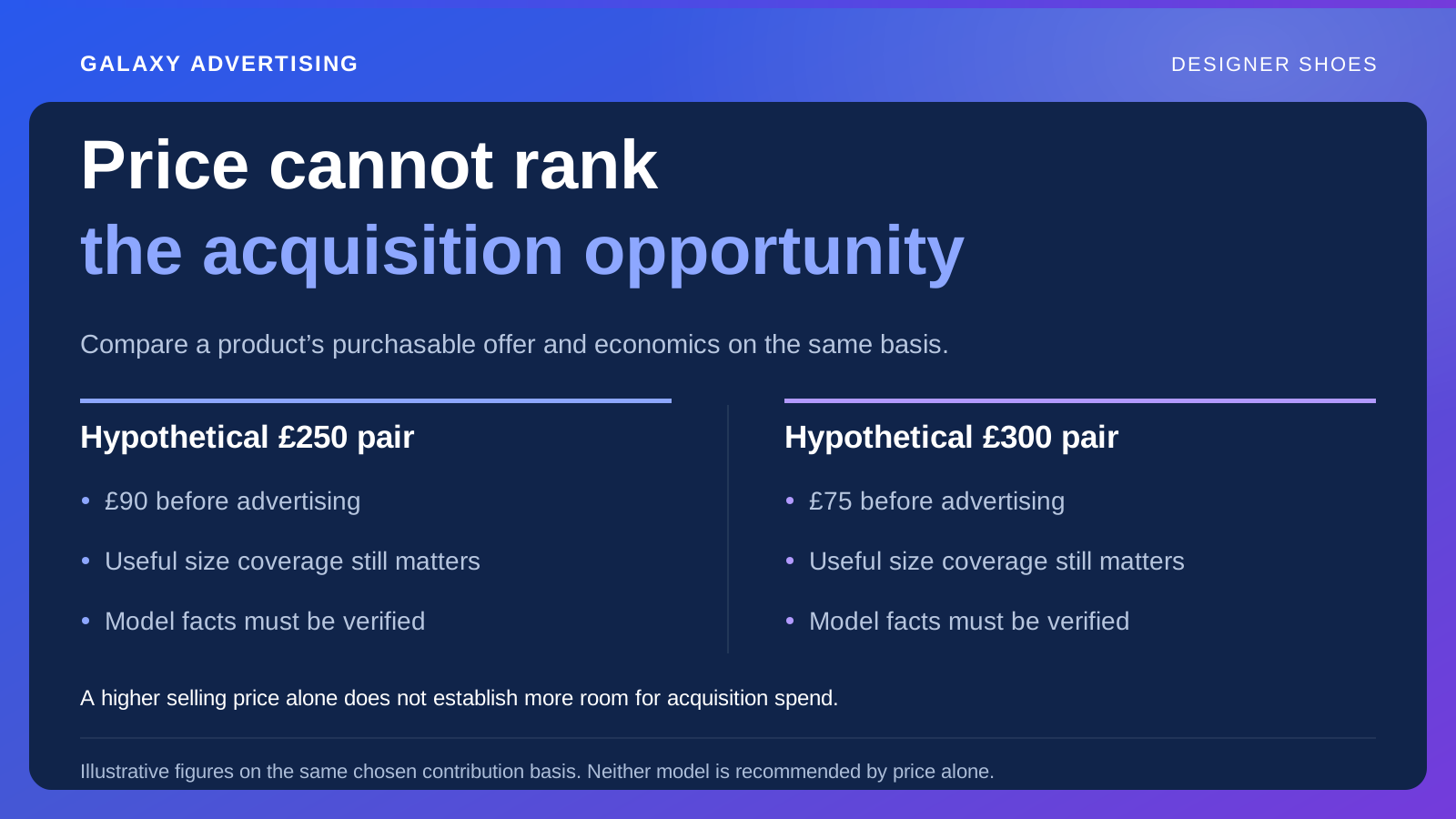
A hypothetical £250 pair leaving £90 before advertising can be a different opportunity from a £300 pair leaving £75 on the same basis. The higher price doesn't automatically make room for more acquisition spend. It certainly doesn't settle which shoe should lead your next campaign.
The striking loafer with excellent photographs may fit your visual identity beautifully while having only a few sizes left. A less dramatic model could offer a more useful range and clearer information. Choose the offer a shopper can actually assess and buy, with visual appeal as part of readiness.
Begin with the sizes people can purchase
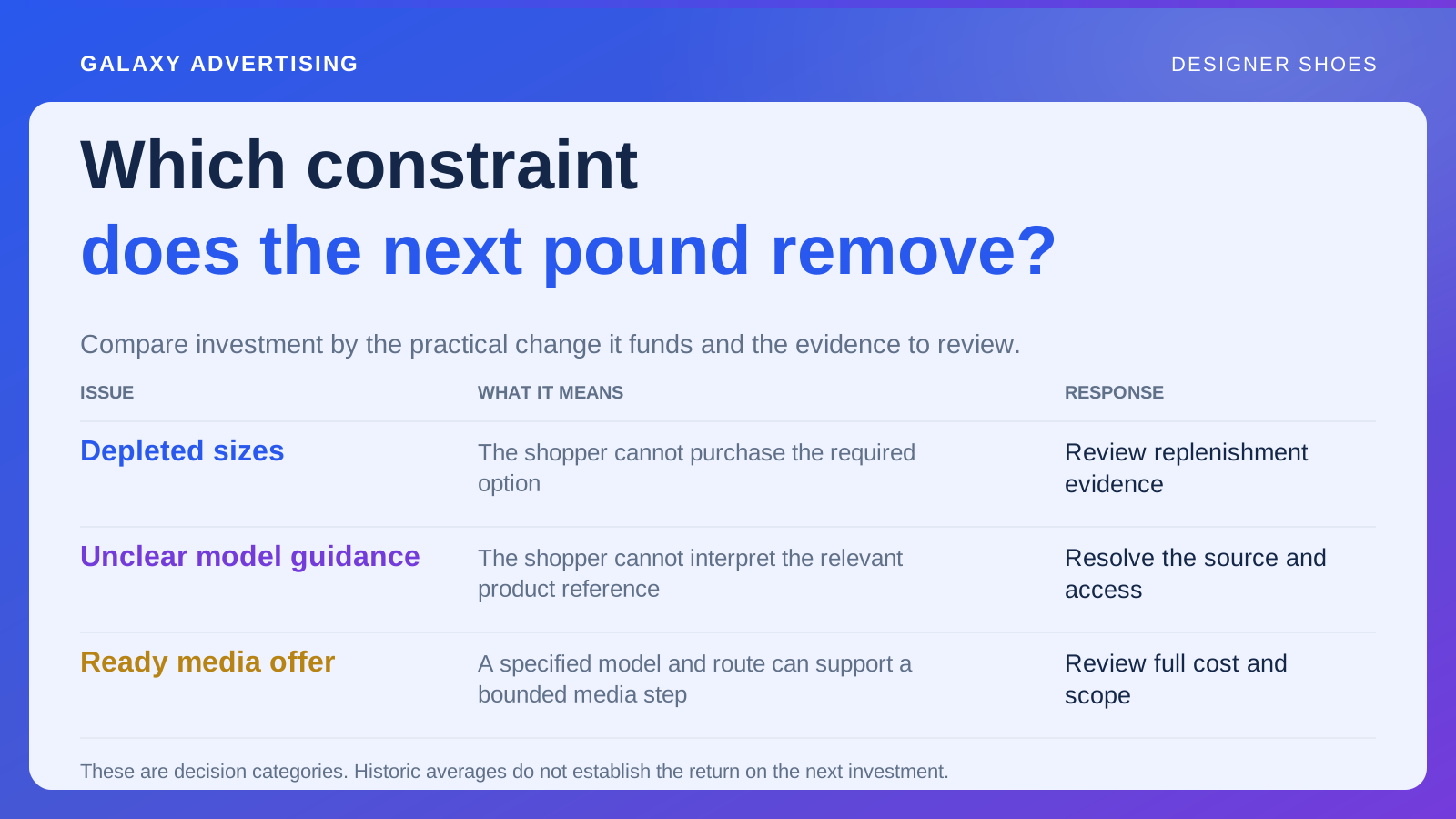
Inspect availability at the level relevant to the customer. A model can be generally “in stock” while offering little choice to the audience you intend to reach. A broad status flag doesn't establish that it is ready for promotion. Open the size options and inspect the offer behind it.
Use your own size demand and order information where available, with its limits attached. Historical sales reflect what was available and promoted. They aren't a perfect record of every size customers might have wanted, so don't let yesterday's supply pattern masquerade as a complete demand forecast.
Record material gaps and the expected operating response. Does the shortage change product priority, or require a clearly explained alternative? Give the campaign owner that context before the whole style sells out. Its promotional role may need reconsidering while some pairs remain available.
Make sure you can describe this model accurately
Check the current name, finish, material information, images and verified fit guidance. The destination should describe the actual item, rather than an earlier version or a superficially similar model. A plausible looking page isn't enough if the facts refer to something else.
A promising product may need only a small factual correction before advertising. That's different from being unsuitable. Give the correction an owner and a check that establishes whether the customer route is ready. The shortlist needs to distinguish fixable gaps from reasons to exclude the model.
Don't ask creative production to compensate for uncertain information. If nobody can verify a construction detail, obtain the reference or narrow the claim. A beautiful image can't settle a missing fact, however confidently the caption presents it. Resolve the uncertainty where it actually sits.
Give each model a reason to be introduced
Explain the product's particular role. It could demonstrate a distinct shape, a documented material difference or a styling use case the current campaign doesn't explain clearly. That gives production a buying argument, rather than a request to make another shoe look appealing.
Selecting several products that repeat the same vague claim about premium quality doesn't necessarily create a useful promotional range. Different models can give people different reasons to investigate the brand, provided each argument stays grounded in the actual product. Variety needs something substantive behind it.
Keep that role separate from a promised personal outcome. You can show an outfit or occasion without guaranteeing comfort, fit or suitability for every shopper in that context. The brief needs to name what the evidence can communicate, including where the customer's own assessment remains necessary.
Look at contribution on the same basis
Use your approved definitions to examine relevant revenue, product costs, fulfilment and expected later order adjustments. Contribution is the money remaining after the costs included in that calculation. A high selling price doesn't, by itself, establish a larger allowance for acquiring the order.
Return to the hypothetical comparison: £250 with £90 before advertising, against £300 leaving £75 on the same basis. The example illustrates why price alone isn't a ranking method. It isn't a recommendation to choose either price point or a benchmark for your range.
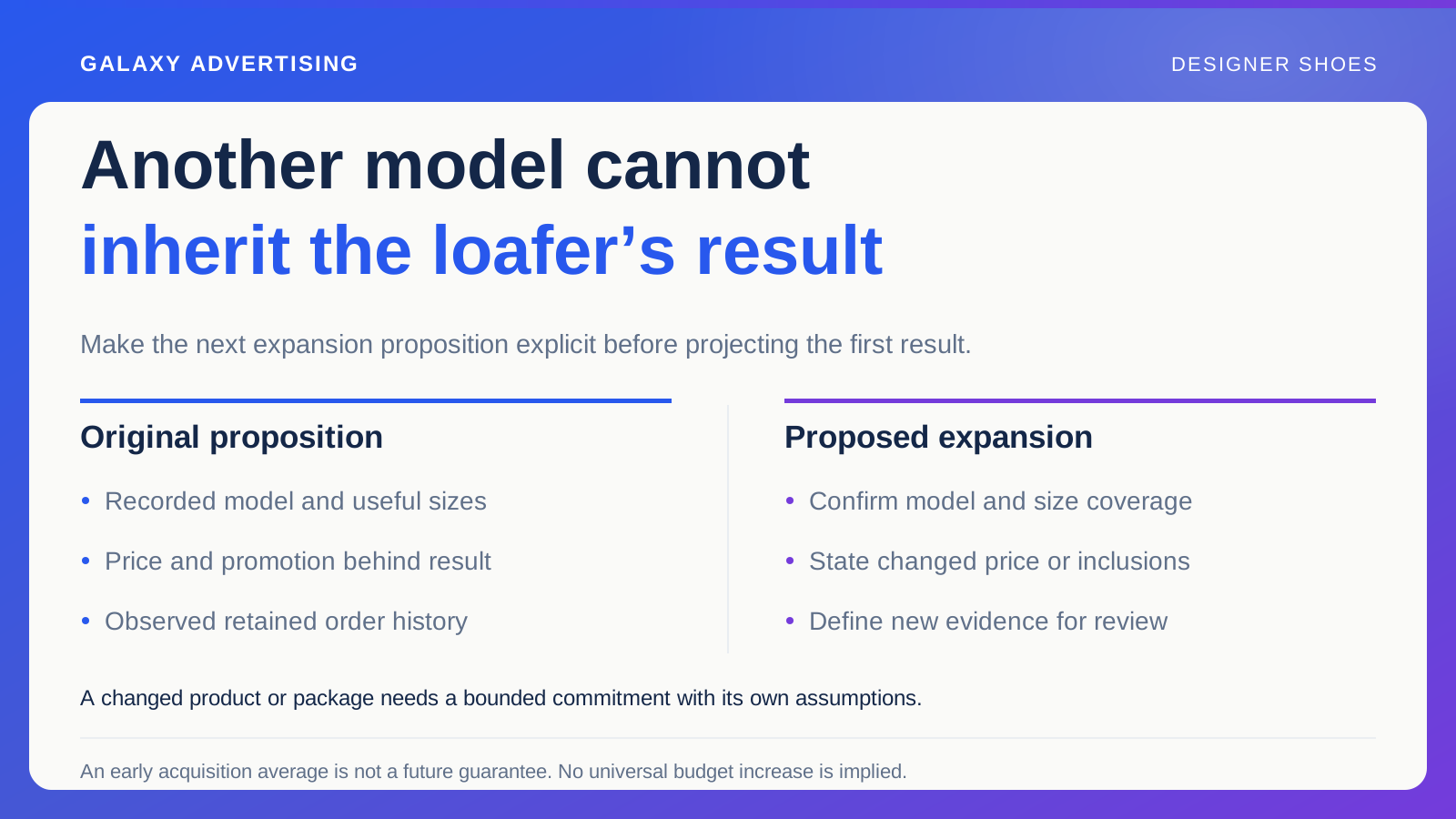
Keep uncertain exchange assumptions visible. If retained economics for one model aren't yet well understood, let that uncertainty shape the next commitment. The opportunity may still deserve investigation. It shouldn't borrow the confidence of a different product whose results are better established.
Walk the route before finalising the shortlist
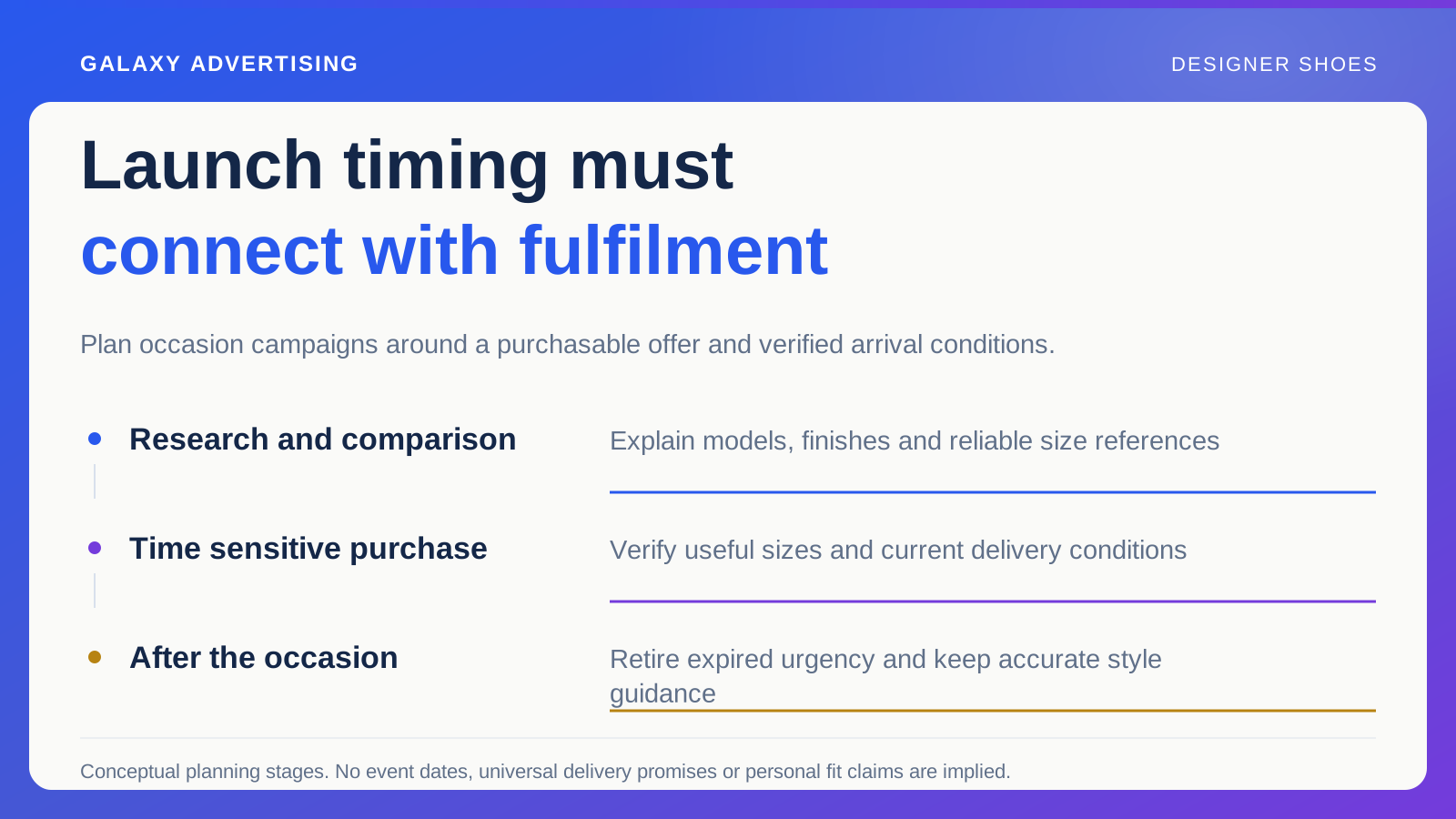
Follow the intended entry page, choose an available size and verify the basket item. Check relevant purchase and delivery information in the real route, including on a phone. Readiness needs to survive the customer journey, rather than exist only in the planning document.
If a size is missing, inspect the practical alternative. A random recommendation row doesn't establish that another model answers the same styling question or offers comparable fit information. Check what the shopper would actually be able to assess after reaching that point.
Ask someone unfamiliar with the range to identify the model and its key difference. This tests clarity, not likely sales. It can reveal where the argument relies on internal knowledge a new visitor doesn't have. Treat the exercise as a way to find an explanation gap, rather than a performance prediction.
Give the first commitment a manageable shape
Rank the shortlist by distinctions that change action: ready now, ready after a specific correction or unsuitable for the intended test. An elaborate score can look precise while claiming more than the evidence allows. The next action is more useful than decorative numerical certainty.
Give conditional products a clear next step. Accurate images require different work from a serious size coverage gap. Name what would make each model ready so it doesn't remain indefinitely labelled “needs improvement”. A conditional choice should come with a route to a decision.
Where uncertainty remains, fund a bounded introduction. Keep enough stable to interpret the result. Changing model, price and main destination together can be commercially valid, but limits what the comparison can explain. Make that limitation explicit before claiming to have tested one thing.
For a shortlisted model missing a size, inspect the proposed replacement before approval. Can someone understand its different shape, fit information source and price? A note saying another black loafer is available doesn't establish an equivalent buying route. The next useful investment may be explanation before extra media.
Revisit the choice when the offer changes
After initial promotion, review availability, information and retained order evidence. Diminishing useful sizes or changed commercial conditions can give a launch ready product a different role. Keep the original reasoning so you can distinguish a weak hypothesis from an altered offer.
An impressive photograph earns attention. A defensible promotional choice also remains purchasable and supports a clear decision. Your next model needs that whole combination, rather than winning the shortlist because it makes the best picture.