It's tempting to give a vintage chair a more impressive history than the records can support. “Iconic designer piece” sounds stronger than a stylistic resemblance and approximate age, but it also promises certainty your business doesn't possess.
The photography may be appealing and the intention understandable. The offer has still changed. You can make the piece interesting through its form, material, condition, practical role and verified history. Keep interpretation distinct from fact, and the customer can appreciate the object that's actually available rather than a story you've added to it.
Choose something the customer can judge
Identify what makes this object worth considering in its intended setting. That might be its proportions, storage arrangement, visible detail or a documented aspect of construction. Give the reader something they can examine rather than asking them to accept prestige on trust.
Use a concrete description before reaching for broad adjectives. A cabinet's arrangement helps a customer assess whether it suits their use. An unexplained claim of timeless excellence doesn't give them the same basis for judgement. Your proposition should make the object easier to understand.
Age alone doesn't explain value. Buyers can care about form, history, condition and practical use in different ways. You need a defensible account of this piece. You don't need a universal argument that every older object is automatically a better purchase than the alternatives.
Let the history say only what it supports
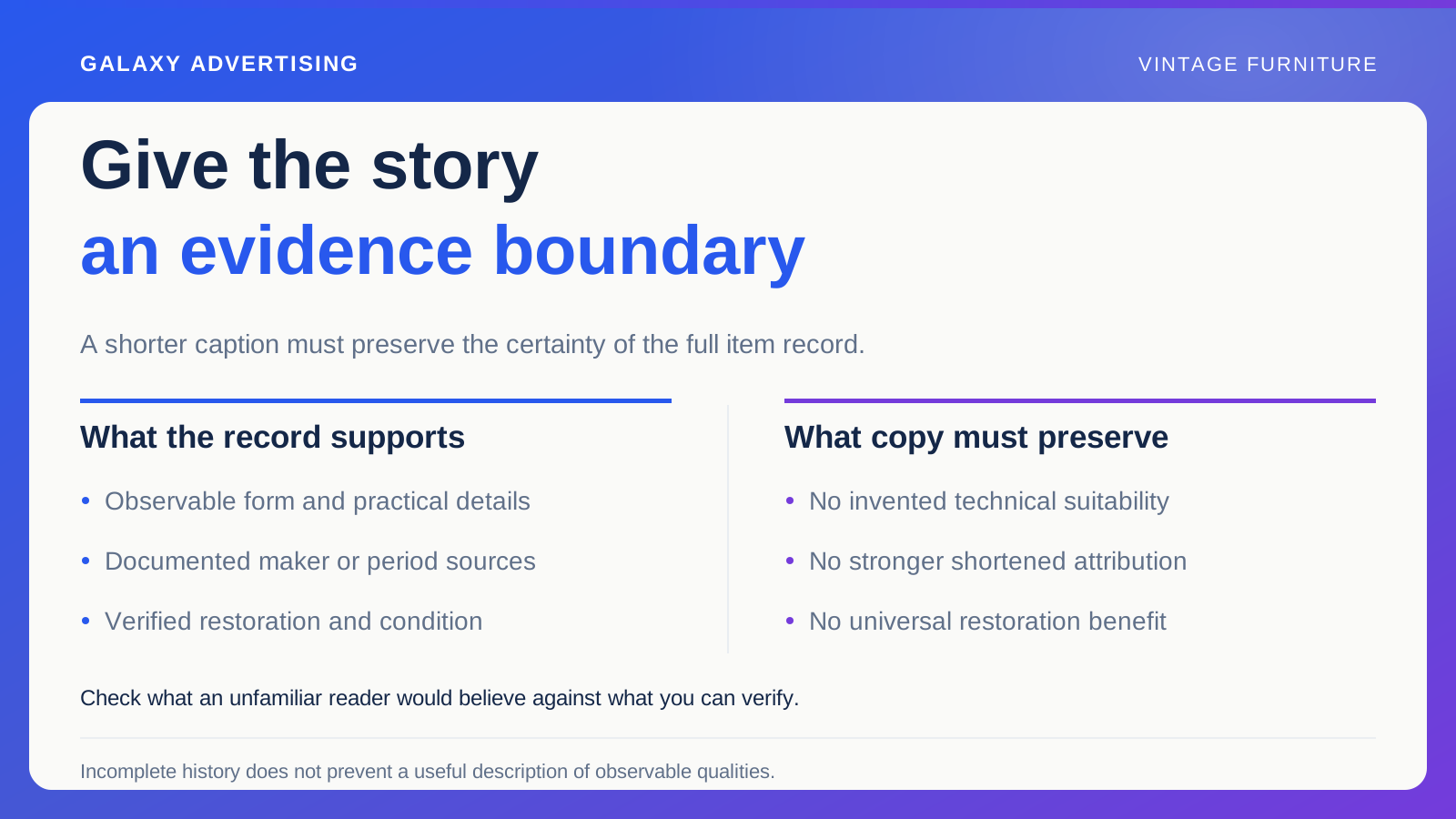
Review the evidence for maker, period and provenance statements. Keep relevant uncertainty visible. When a detailed listing becomes a short advert, its attribution shouldn't become stronger simply because there's less room for the qualification. Shorter copy still makes a purchase claim.
An incomplete history doesn't stop you describing observable qualities or explaining the basis of an interpretation. The piece can deserve attention without a fabricated biography. Work with what you know rather than filling every gap with a confident sounding line.
Keep the evidence accessible to everyone making new versions. Attach a source note to the item record instead of copying an assertion from an old caption without context. Repetition can make an unsupported statement feel established because everybody recognises it. Familiar isn't the same as verified.
Make condition part of the reasoned offer
Condition affects the purchase. Don't hide it behind the brand story as an awkward qualification. Explain relevant marks, alterations and restoration with clear references to the actual item. The customer needs to understand the object they're considering, including these details.
You can acknowledge visible history without declaring every imperfection desirable. One person may appreciate an aged surface. Another may need a different finish for the room they have in mind. Give both a fair basis for deciding rather than telling them which preference to have.
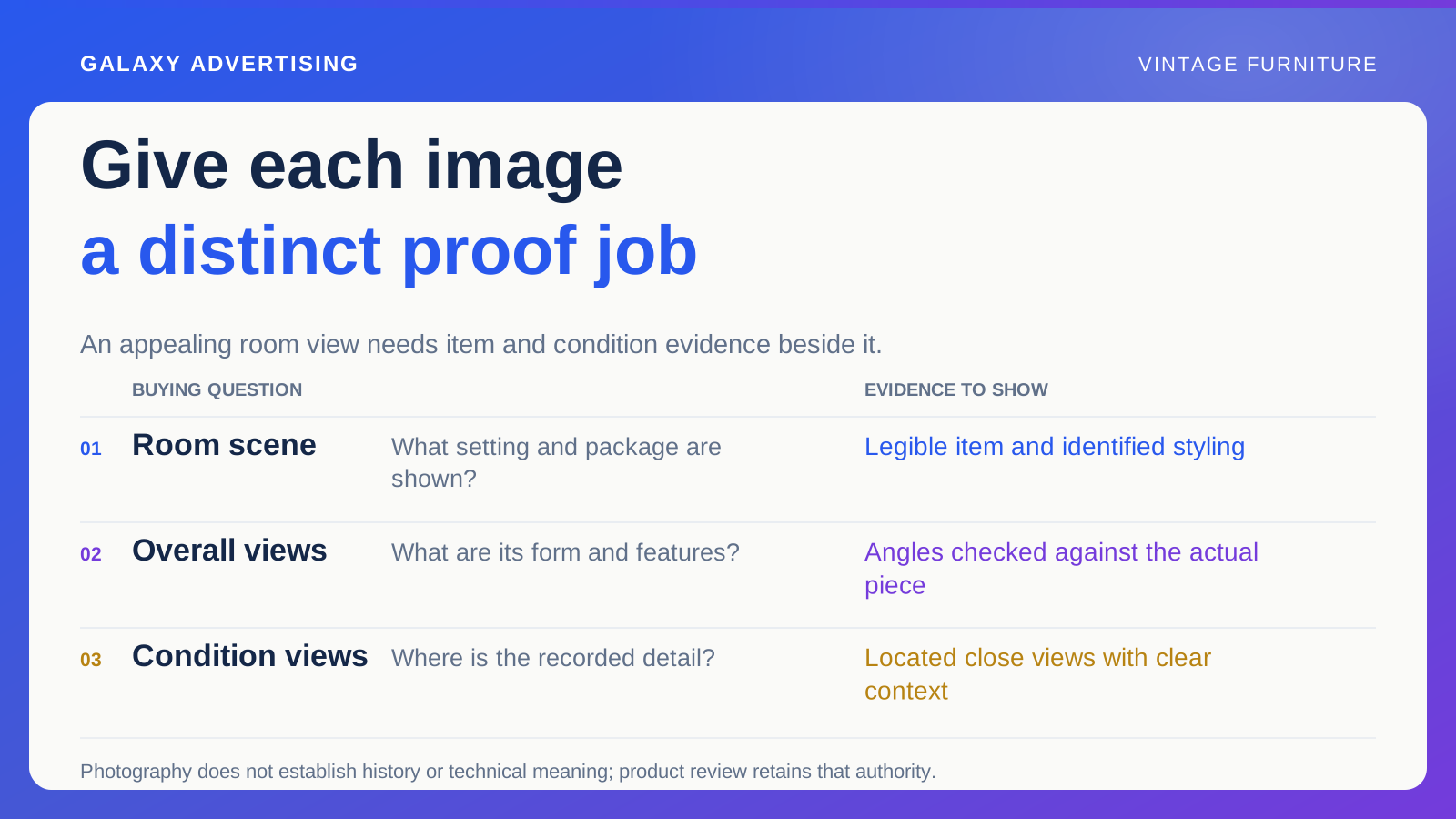
Use photographs that connect the explanation with the object. An atmospheric scene can create interest, while a relevant detail image makes the condition statement understandable. Both have a place. They don't have to pretend to perform the same job.
Explain restoration without assuming it proves superiority
Describe documented work accurately and explain how it relates to current condition. “Restored” isn't a complete account if the nature and extent of the work matter to the buyer. A useful description needs to make that relationship understandable.
More intervention doesn't necessarily mean more value or better suitability. Customer priorities differ, as do individual pieces. Say what was done rather than assigning it a universal benefit the evidence doesn't establish. The work can speak clearly without that extra claim.
If a detail of earlier work cannot be verified, retain the limitation. Adding a confident sentence for promotional consistency can create an expectation your item record won't support. A precise statement of what's known now gives you a more dependable basis for the sale.
Bring character back to practical ownership
Explain relevant dimensions, storage and use considerations so the customer can assess the piece in their circumstances. Character can create desire. It doesn't remove the practical question of what the object will do once it's in the room.
For a hypothetical desk, a buyer may need to distinguish overall footprint from working surface and internal storage. Copy focused only on period style leaves those decisions unresolved. These details help someone understand the practical role behind the visual appeal.
Stay within available evidence. Don't invent weight limits, care instructions or suitability claims to make a listing feel complete. If manufacturer information isn't available or the question needs individual inspection, provide an honest route to clarification. Improvised technical advice isn't a useful finishing touch.
Explain the price in the context of this purchase
Describe what's being bought: this object, in its recorded condition, with documented work and the stated purchase service. Don't defend the price using unrelated examples with different circumstances. A comparison needs to share enough of the basis to mean something.
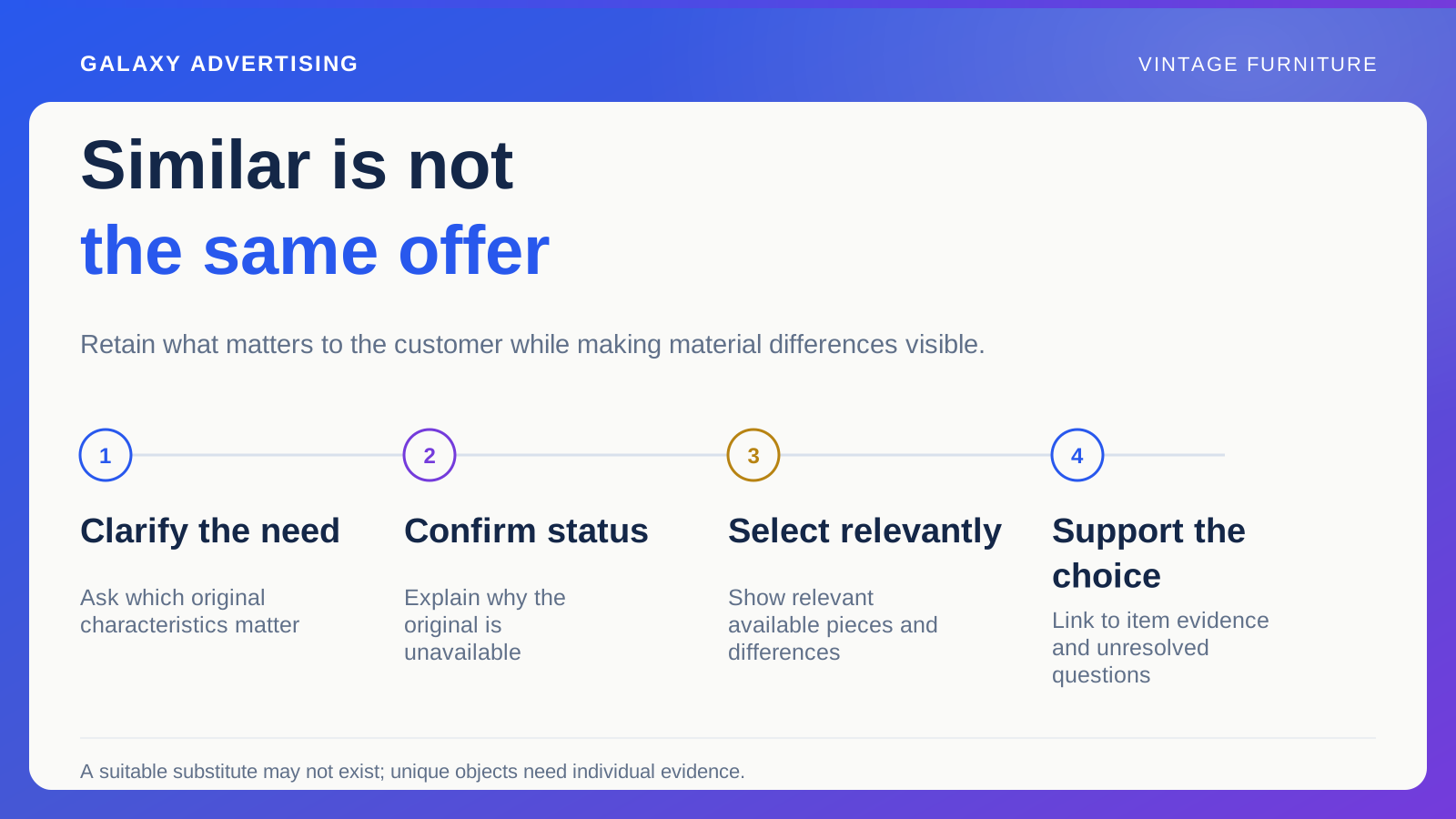
A superficially similar piece elsewhere may differ in dimensions, condition or history. That doesn't prove yours deserves a higher price. It means the comparison needs care. Explain meaningful differences without claiming you've established a universal market value for the object.
When the price changes, review the surrounding copy. Wording explaining an earlier package or service shouldn't stay attached after a material offer change. Your proposition needs to describe the purchase available now, rather than the story you originally hoped to sell.
Check shortened captions against the full item record before release. Editing for space mustn't convert an uncertain description into an unqualified attribution. The record should remain the authority however brief the promotional version becomes.
Check what an unfamiliar reader would believe
Ask someone who doesn't know the item to describe its identity, condition and reason for interest after reading the draft. Compare that understanding with what you can verify. This checks the impression the copy creates, rather than only the words you intended.
Look for implications too. A photograph of a maker's unrelated work or reference to a celebrated design movement can suggest an association stronger than the wording alone. Correct anything encouraging an unsupported conclusion. The piece deserves copy whose most persuasive details still lead back to the actual object.