Does your familiar model name describe the same offer in the supplier file, website and advert? A longer supplier code and a shortened advertising title can look close enough until a customer asks why the delivered package differs from the photograph.
Recognition can quietly replace verification. Electronics names are easy to remember; the references that distinguish versions are easier to overlook. Preserve the distinctions that change what people receive, even where the public copy uses a simpler name.
Establish the identity you can trace
Agree which reference identifies the item you actually buy and sell. Keep manufacturer identifiers, internal stock references and package references in labelled fields. Combining them in one ambiguous description makes later checking harder than it needs to be.
Ask purchasing how variants, the different selected versions or configurations, are distinguished. Similar photography and almost identical names do not establish equivalence. A regional version, revised model or retailer bundle can require its own treatment. Confirm rather than infer.
Document where the authoritative record lives and who can change it. If several systems maintain independent versions without ownership, a corrected page can leave the advertising source untouched. You need traceable relationships between records, rather than labels that merely look as though they match.
Separate product capability from package contents
Identify exactly what arrives with the order. A feature built into the product differs from an accessory you include, and both differ from equipment shown only to illustrate a possible setup. Keep those categories clear in the record.
For a hypothetical camera package, make the body, lens and additional accessory references explicit. A photograph of an assembled kit cannot establish which package the price covers. Supply that answer in the item record before producing copy or creative.
When a bundle changes, review the destination, imagery and associated advertising information together. Correcting words while leaving an old package image circulating can preserve the same misleading impression. Pictures communicate product information too, however carefully the structured fields have been updated.
Keep technical statements connected to their sources
Link important specifications to manufacturer documentation for the exact model. If supplier information conflicts, record the uncertainty. Choosing the more attractive number for the page leaves the underlying conflict unresolved and gives it a public audience.
Separate documented features from your explanation of usefulness. A connection type may be a product fact. Saying it solves a particular customer's arrangement also requires information about that arrangement. The second claim needs more than the first fact alone.
Provide a route for questions the records cannot settle. An unresolved detail honestly labelled is preferable to a confident inference repeated across several adverts. Once a claim has travelled through enough systems, finding where it originated can become quite a job.
Follow a sample across the public route
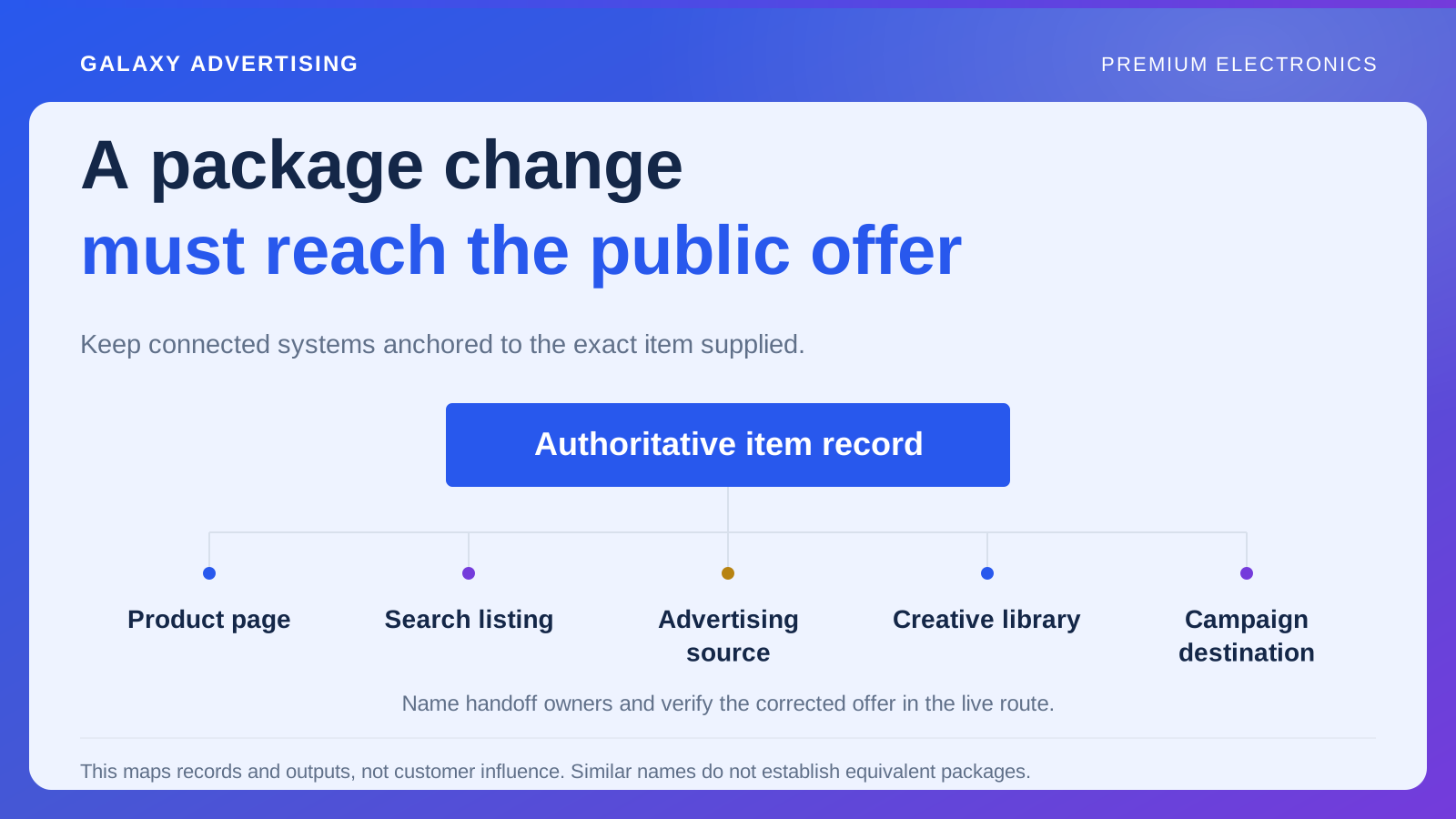
Pick a small set covering ordinary products, bundles and recent range changes. Compare the authoritative record with the product page, search listing, advertising source and creative library. Those different surfaces should still describe an intelligible relationship to the same offer.
Record item references and observed differences at each point. A colleague needs to know whether the issue is an identifier, image or outdated package. A broad complaint that the catalogue is wrong does not provide a reproducible task.
Follow the advertising destination and inspect the selected product. A working URL can open on another configuration or omit the pictured package. Technical availability is only the start: the customer's interpretation must remain coherent through the route.
Keep source documents retrievable by item reference. Someone investigating a disputed package should find the record supporting its description, rather than only the public page most recently edited. The underlying reference matters when accounts of the offer disagree.
Decide how a change reaches everyone who needs it
Map the practical update route. Purchasing might receive a revised supplier record, merchandising approve the public description and a developer maintain the export into advertising systems. Make the connections between those jobs visible.
Assign responsibility at each handoff. Everyone should know what counts as a material change and how to confirm it reached the next surface. An email addressed to several teams does not by itself establish ownership of all downstream corrections.
Keep a short history of significant changes. A package adjustment during a live campaign can explain customer questions or performance differences. It also stops an earlier advert being judged against a product record that did not yet exist when the advert ran.
Fix the differences that change the purchase first
A large range does not need every minor wording variation treated as equally urgent. Start with inconsistencies affecting identity, availability, price, included equipment or a material technical requirement. Let the consequence for the customer set the priority.
Distinguish a public error from an internal naming preference. Standardising an abbreviation can be worthwhile, but an advert for the wrong package needs attention first. The job is to protect the offer's accuracy, rather than make every label look alike.
Where repeated errors share a source, fix the process instead of editing outputs indefinitely. A transformation rule stripping a meaningful suffix can create problems across the range. Use the sample review to expose that pattern and direct the correction towards the underlying record.
Check the corrected offer as a shopper would
After a correction, open the actual destination. Inspect the displayed item, imagery, included equipment and relevant conditions. A successful export job or saved content edit does not prove the route now says what it should.
Ask someone unfamiliar with internal references to describe the contents of the offer. Their answer can reveal information that is technically correct but difficult to interpret. Clear labelling is part of accuracy when similar packages sit together.
Advertising needs a stable offer to promote, and commercial analysis needs to know which offer received attention. Dependability comes from the relationship between the promise, the record and the supplied product. Identical wording everywhere is a much less useful achievement if that relationship is wrong.