 Google Ads
The tempting mistake is to change several things, see revenue improve and call the result proof that your preferred idea worked.
Product selection changes, creative gets replaced, the target moves and a promotion goes live. Something helped. But the business still doesn't know which intervention mattered, or whether the result would repeat without the incentive.
A useful test starts with a disputed question and keeps enough structure to separate what you learned from what happened at the same time. Operationally necessary changes still happen. Their combined outcome just doesn't prove one explanation.
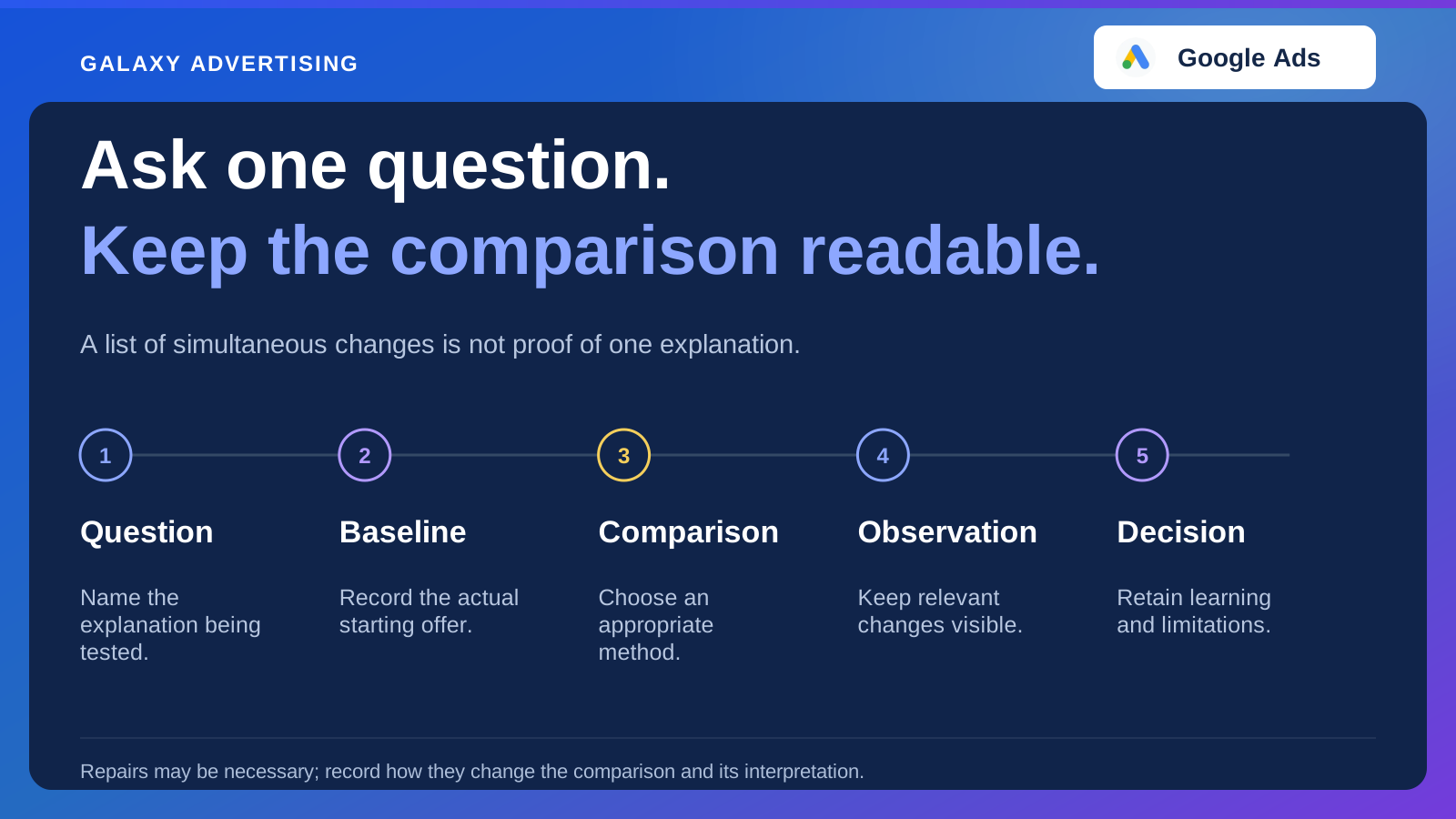
What explanation are you trying to challenge?
Write a hypothesis, a proposed explanation, with a customer or commercial mechanism. For example, a product group could attract suitable demand but fail to convert because its destination doesn't explain the configurations.
That identifies an obstacle, a correction and an outcome that could challenge the explanation. “Performance Max needs a refresh” could justify almost anything afterwards. It gives you very little to test.
Choose a question important enough to change a decision. You can document a comparison beautifully and still learn something nobody would act on. The value comes from helping the business decide what deserves its next commitment.
Know the starting position, including verified faults
Record the relevant products, availability, commercial offer, goal configuration, destination and important creative. Keep this baseline specific to the test. You don't need every account setting copied into a large document to establish the starting point.
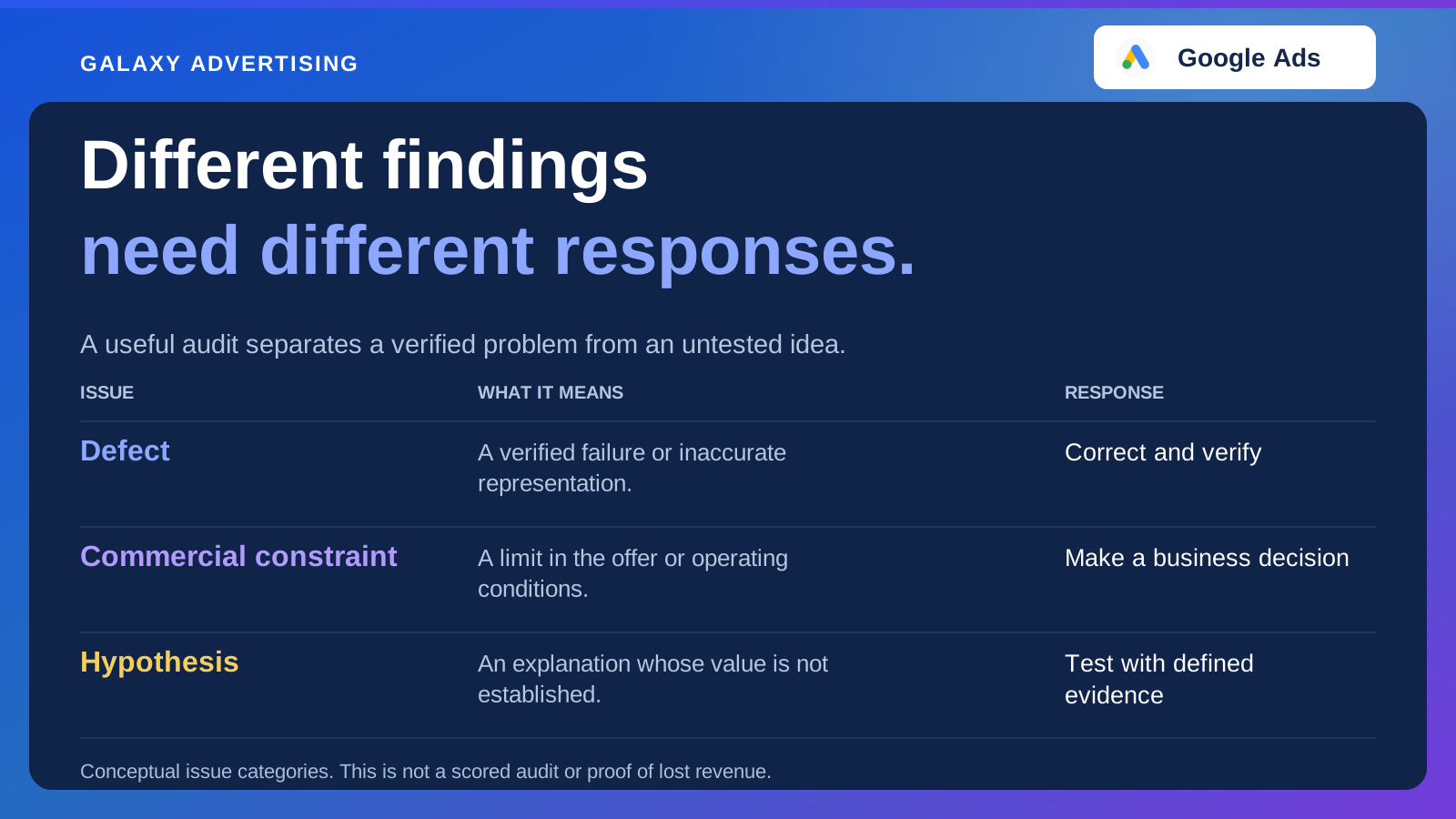
Check whether the suspected issue is already a verified fault. A broken destination or inaccurate product statement could need correcting without an optional experiment. Accuracy shouldn't depend on whether it wins a performance comparison.
You can test the effect of a broader improvement while still making that distinction. A repair and a strategy test have different purposes. Combining them into an impressive count of “optimisations” makes the report busier without making the learning clearer.
Use a comparison your account can actually support
Investigate testing capabilities that are available and suitable for the campaign. Use current platform guidance and explain the chosen method's conditions.
If a suitable controlled comparison is supported, describe the intended difference and outcome. If you're using an observational comparison instead, say so. A before and after view can inform a decision without giving the same confidence as a well designed experiment.
Don't borrow statistical language to make the chart look authoritative. Meaningful outcomes, how comparisons are assigned and the operating conditions matter more. The business needs to understand the strength of the evidence, rather than be impressed by its presentation.
Keep unrelated changes out where possible
If you're testing a destination explanation, avoid unnecessarily changing price and range at the same time. Record changes outside the team's control, including stock and fulfilment constraints.
A new product test deliberately changes the offer. That's fine when the question acknowledges it. You're trying to stop an unrecorded commercial change becoming an invisible alternative explanation, rather than freeze normal trading.
Agree who will tell the test owner when an important condition changes. Discovering a stock shortage at the reporting meeting leaves the team trying to interpret a comparison without knowing what customers could buy during it.
Decide what would count as a useful result
Choose the main business outcome and supporting observations. More clicks or a platform diagnostic could explain delivery without being the commercial result you intended to improve.
Define how you'll interpret orders, values and relevant costs. If customers take longer to buy, consider what evidence you'll need before concluding. A convenient short review period doesn't necessarily match the decision you're investigating.
Set operating limits as well. A technical failure, unsuitable offer or approved spending boundary can require prompt action before the planned review. Everybody needs to know when that applies, so the experiment doesn't become an excuse to leave a known problem running.
Don't keep rescuing the idea halfway through
If early results disappoint, inspect obvious faults before rewriting the purpose. Adjusting several factors continually can create a test that's always running and never capable of answering its original question.
Record necessary corrections. Explain whether they change the comparison or the way you'll interpret it. Don't discard inconvenient observations while keeping the flattering ones.
And don't stop at the first attractive order. A small number of unusually valuable transactions can temporarily make a weak explanation look convincing.
The hypothesis needs a fair hearing, not a rescue team.
Put the agreement on a page
Record the question, hypothesis, proposed difference, comparison method and principal outcome on one page. Add conditions that would weaken or invalidate interpretation, operating limits and the person responsible for noting changes.
Ask a stakeholder who didn't design it to explain what each likely outcome would support. If everything can count as success, the question or decision rule is too vague. If only the desired answer is acceptable, you're edging towards justification rather than investigation.
Leave an explicit place for an inconclusive result. Limited evidence could justify a smaller continuation or a different question. It doesn't oblige the team to announce a confident verdict.
When a material intervention becomes necessary, such as a destination repair or product withdrawal, revisit the agreement. Preserve the original reasoning and explain the effect on comparability. That discipline leaves more useful learning than reconstructing a list of changes after the event.
Keep the learning where the next decision can use it
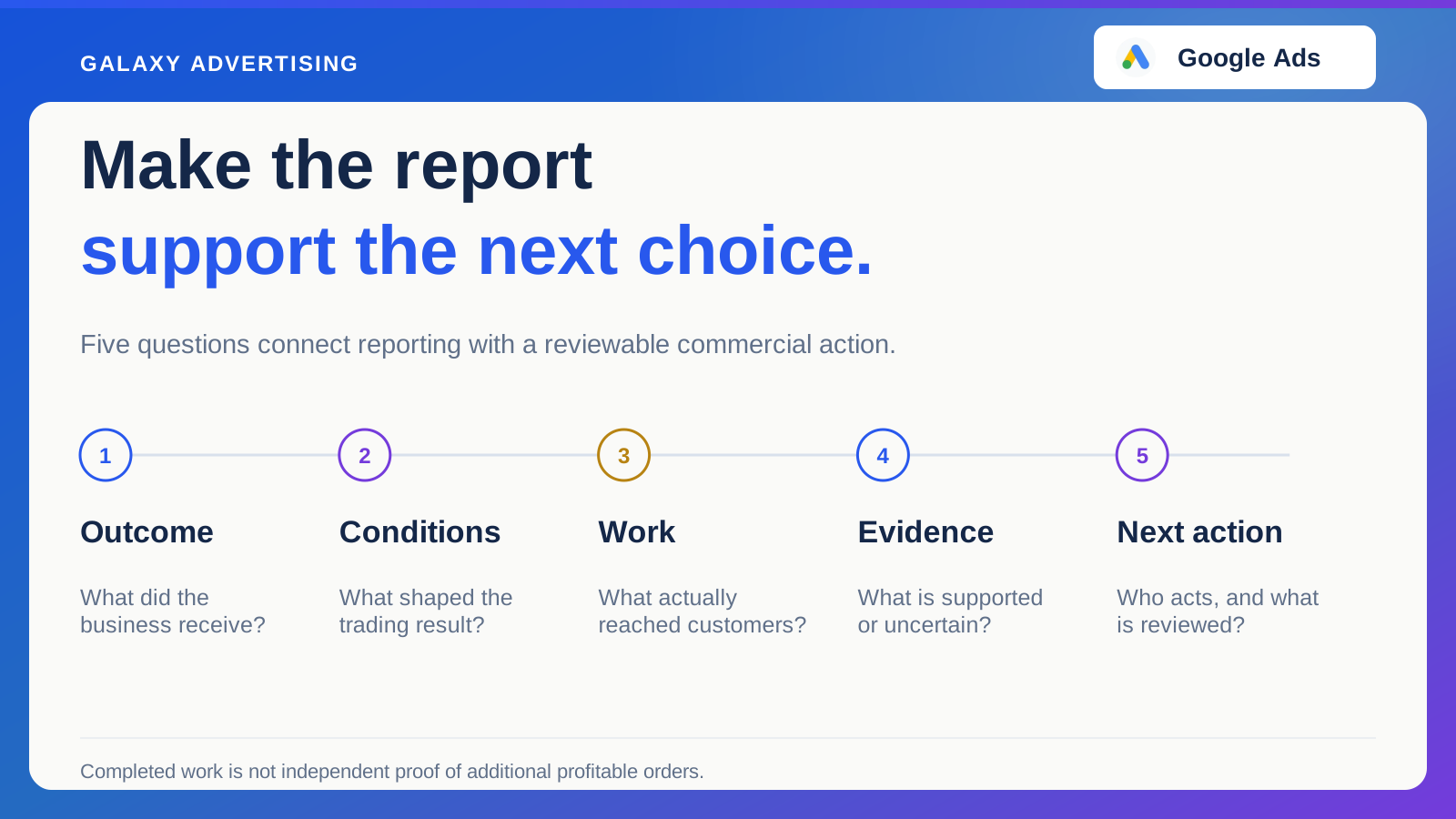
Write a short conclusion covering the hypothesis, method, actual changes, observations and limitations. State the next decision and what would make you reconsider it.
A test that doesn't support the proposed improvement can protect the business from a larger unsuitable commitment. That has value, even if it makes a less cheerful slide.
Performance Max uses multiple inputs and can serve across different inventory. A disciplined question helps you make sense of that setting. When the next change is proposed, you should be able to point to a reason for it that goes beyond “we changed a lot, and revenue went up”.