 Google Ads
What if your next £500 brought in £2,000 of revenue and still used £100 more than the contribution available before advertising?
Those are illustrative figures, not a forecast. They show why a healthy account average doesn't answer the question you're facing when someone asks for more budget. The existing result describes what happened. You need to decide what the next increment is likely to do.
Judge that next opportunity on its own purpose, evidence and commercial consequences. Extra investment can reach a different mix of products, customers or demand.
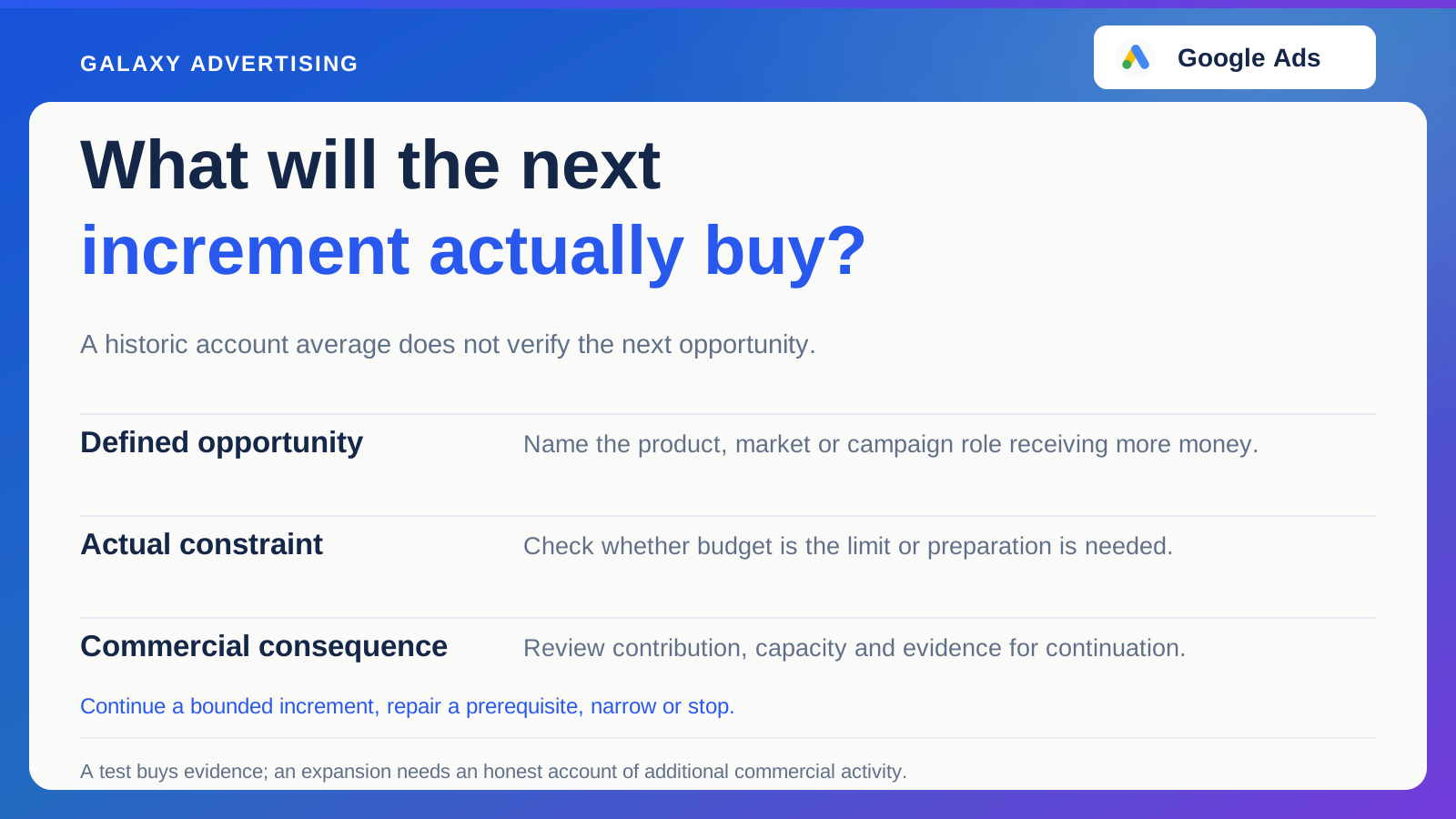
Be specific about what the extra money is for
Is it more activity around the existing offer, a new product group, a different market or another campaign role? They are different propositions, even inside the same account.
Don't automatically give it to the campaign with the best historical ratio. That campaign could be capturing existing demand that won't expand proportionately. Another opportunity could need a different commercial expectation. The old average doesn't settle either case.
Describe the use in terms you can assess. “Support the newly stocked dining range after its destination is ready” tells you more than “scale the account”. It gives the spending a defined job and makes the prerequisites visible before money is committed.
Is budget actually what's holding it back?
An attractive result doesn't establish that insufficient budget is the constraint. Product availability, a restrictive commercial target, poor destination information or limited relevant demand could be affecting activity.
Use the account's current evidence and settings to investigate. Ask the manager to distinguish a supported diagnosis from an assumption based on a favourable average. You need the reason more spending would help, rather than simply permission to spend it.
If the main obstacle is a missing product explanation, buying more traffic could be an expensive way to confirm what a page review already shows. The next investment might belong in preparation. Sometimes the most useful thing the advertising budget can wait for is a clearer answer on the website.
Follow the extra revenue through the costs
Use your own cost assumptions to establish what an additional suitable order is worth before advertising and what contribution needs to remain afterwards. Contribution means the money left after the relevant costs included in your calculation.
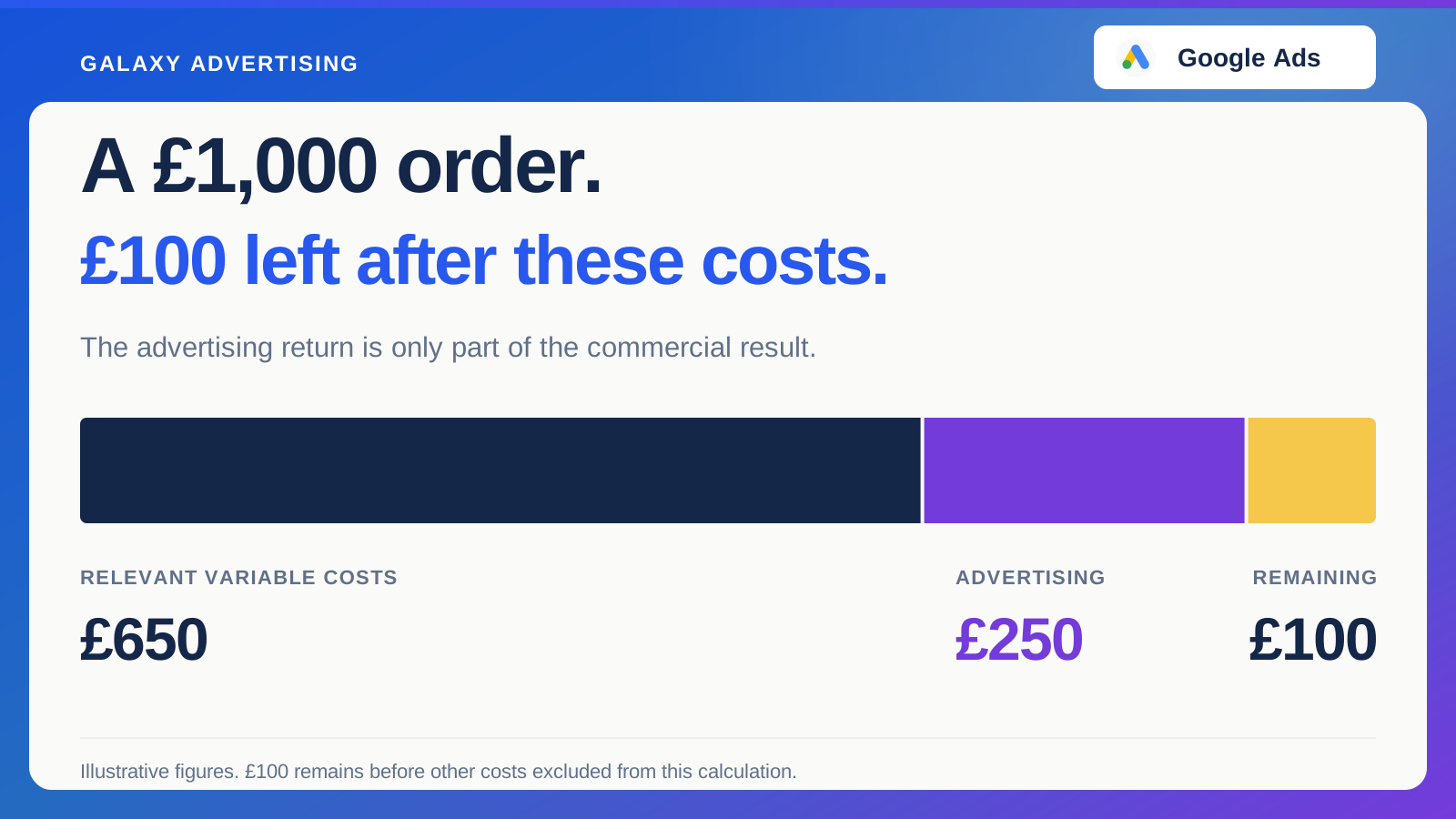
In this hypothetical example, you're considering an extra £500 producing £2,000 of consistently defined revenue. Suppose the relevant variable costs, those that change with the orders, consume £1,600. That leaves £400 before advertising on this basis.
The increment has used £100 more than the available contribution. Other costs excluded from the calculation still haven't been considered.
That's why the revenue alone wasn't enough.
These figures illustrate the question. They don't predict your result. Use your actual inputs and state uncertainty honestly, rather than asking a revenue target to stand in for product economics.
Are you expanding something or buying evidence?
Some spending tests an uncertain opportunity. Give it a defined question, approved operating limit and decision rule. Exploratory investment shouldn't be presented as guaranteed efficient growth.
Other spending extends an established offer under broadly similar conditions. Even then, monitor changes in customer and product mix as its scope increases. Familiar activity doesn't make the next increment identical to the earlier one.
Keep that distinction in reporting. A test explains what you learned. An expansion explains the commercial consequences of additional activity. Spending a larger amount is not, by itself, success for either. The distinction makes it easier to judge the decision you actually approved.
Can the business support the orders you're seeking?
Check stock depth, delivery capacity and the support workload attached to the proposed products. An attractive acquisition opportunity can become less useful if you can't maintain the offer as volume rises.
Specialist delivery deserves a different readiness review from stocked accessories. Inventory isn't the only condition that matters. You need to know the business can keep the promise alongside supplying the item.
Agree what happens if a material constraint appears. Whoever manages spend needs timely notice, rather than a retrospective explanation after advertising has kept directing people towards an offer you could no longer fulfil accurately.
Don't spread a small increment across everything
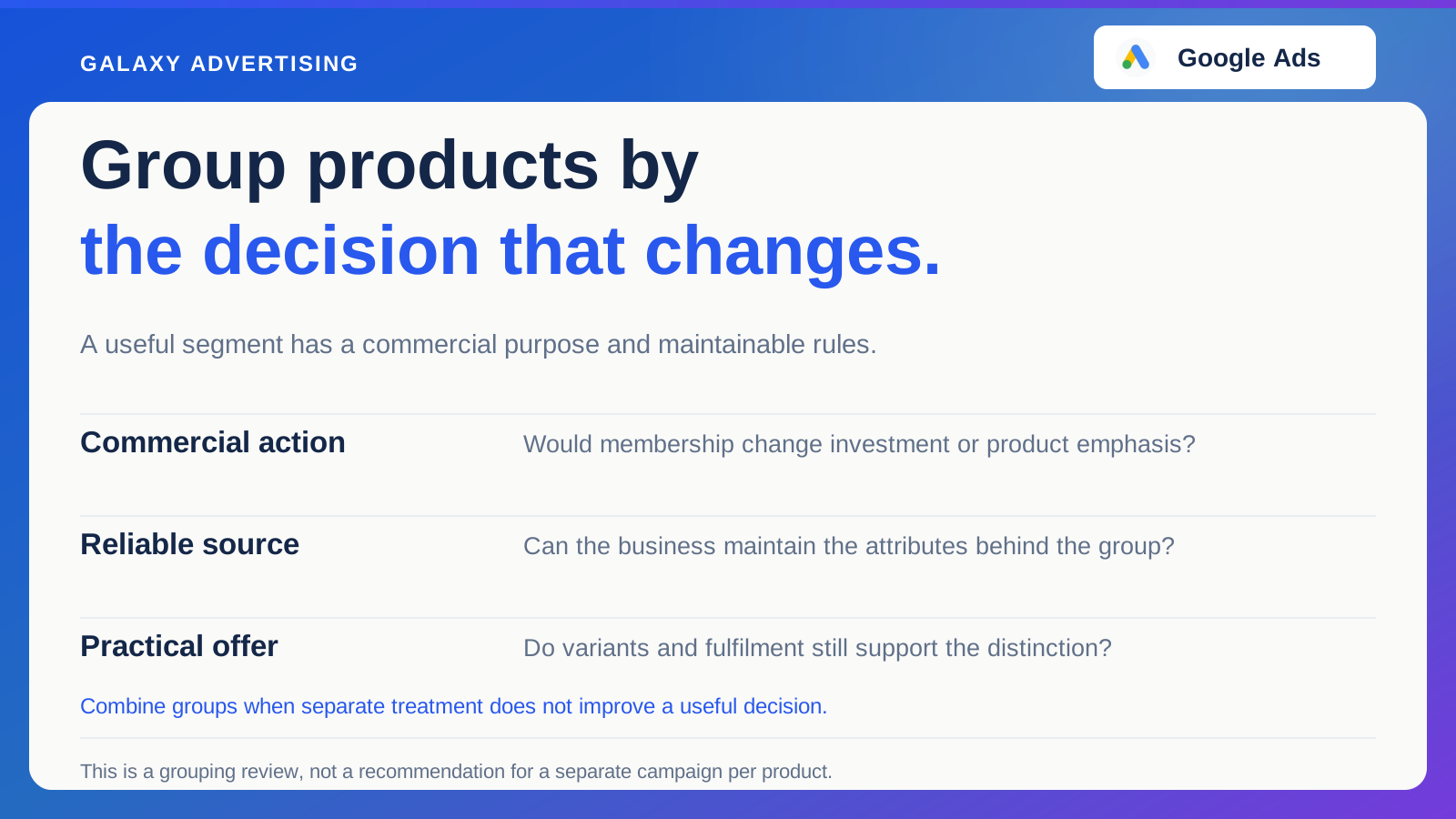
Divide £500 between many unrelated ideas and each could have too little evidence to answer a useful question. Extra line items don't necessarily mean extra learning.
Prioritise the next decision with the strongest combination of commercial relevance, readiness and an interpretable test. Keep other ideas in a queue. Commissioning everything at once to look balanced can leave the business unable to explain any of it properly.
The right concentration depends on the account and the cost of obtaining useful evidence. There's no universal sensible number of campaigns or products. Explain why this scope can support the particular decision you need to make.
Put competing uses side by side
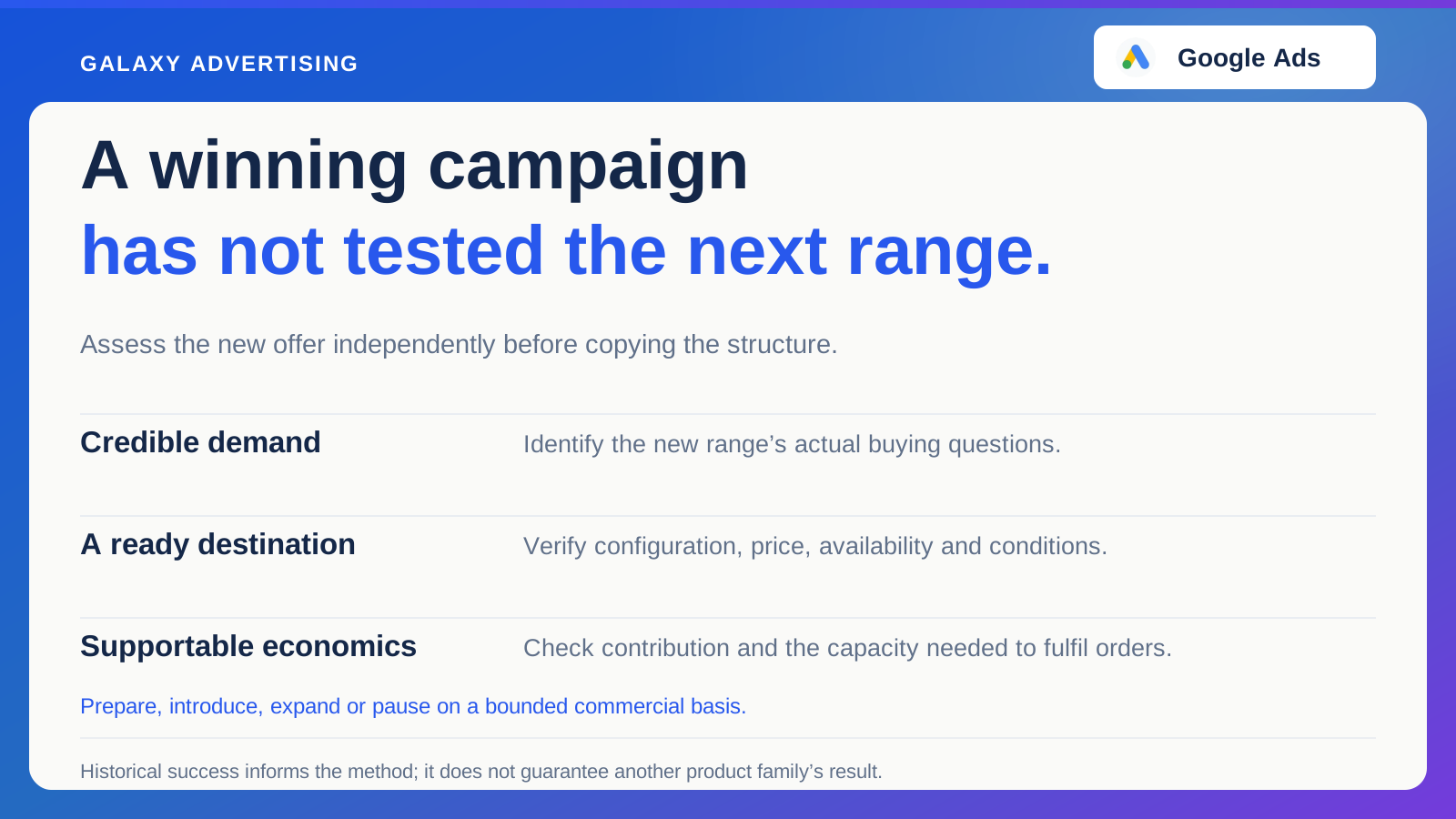
Suppose you could introduce a ready product group or add attention to an existing offer with an unresolved destination question. Write the commercial purpose, prerequisites and review outcome for each.
The established campaign isn't automatically lower risk because it has history. Its next increment still needs a supported opportunity. The new group doesn't deserve a test simply because it hasn't been advertised before either.
Compare offer quality and the usefulness of the evidence each could produce. If a small information correction would make one route more interpretable, do it before committing the full increment.
Record the choice and what would justify revisiting the other option. That creates an investment queue based on commercial merits, rather than a contest between managers asking for more of the same budget.
Look at the additional activity where you can
Record what changed, its investment and the outcome the available evidence supports. Compare conditions alongside totals.
A blended average can remain attractive while the increment is weak. Conversely, a temporary average change could conceal worthwhile expansion into a different mix. Keep enough product and customer context to distinguish them.
End with a concrete action: continue a bounded increment, repair a prerequisite, narrow its scope or stop the test. Your budget doesn't need to grow smoothly for its own sake. Each additional pound needs somewhere defensible to go, and a result you can learn from when it gets there.