 Google Ads
A longer fault list doesn't make a Google Ads audit more useful.
You've been given settings to change, keywords to inspect, creative to replace and recommendations to investigate. The document looks thorough. You still can't tell which three actions matter most or who will do them.
The useful work is prioritisation: separate what's demonstrably wrong, what's commercially limiting and what's still an idea to test. Those need different responses, rather than one dramatic severity list.
Start with what the business needs to improve
Ask what you're trying to achieve and what constrains it. Product contribution, stock readiness, fulfilment capacity and the decisions customers make before buying could all matter. Contribution is the money left after the relevant costs included in your calculation.
Don't expect the account's revenue column to explain the entire commercial model. A competently configured campaign can promote an offer that's difficult to supply or unattractive at the available acquisition cost. More precise account settings won't necessarily resolve that.
Record the review's scope. An account inspection doesn't establish every website, analytics or fulfilment fact unless those areas have actually been examined. A visible boundary helps you understand the conclusion. Limited access shouldn't be presented as a comprehensive diagnosis.
Check the meaning of success before judging efficiency
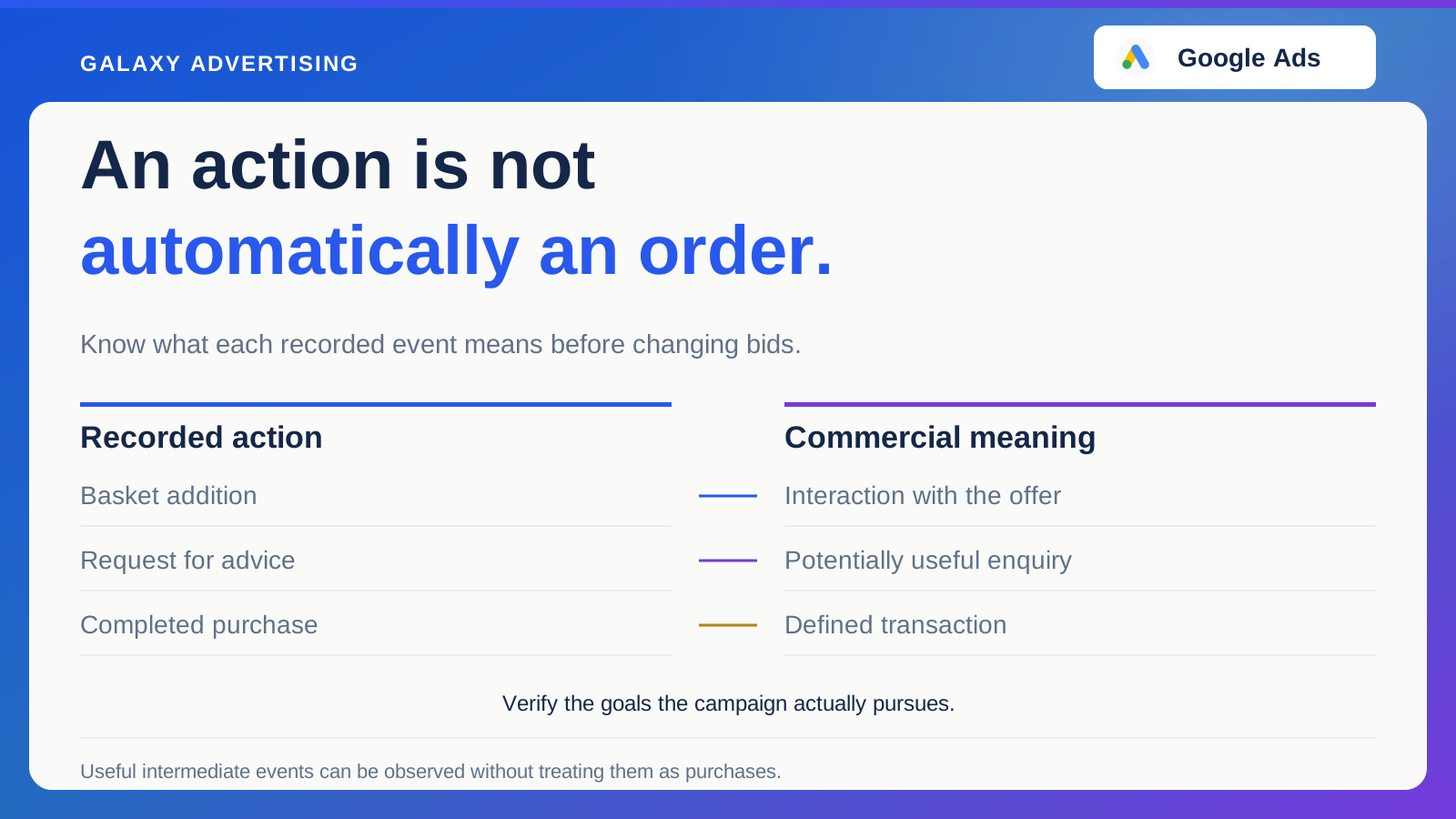
Identify the conversion actions and values used by relevant campaigns. Does the reported success measure match the outcome you expect from the business? A conversion is a configured measured action, so its label alone doesn't answer that question.
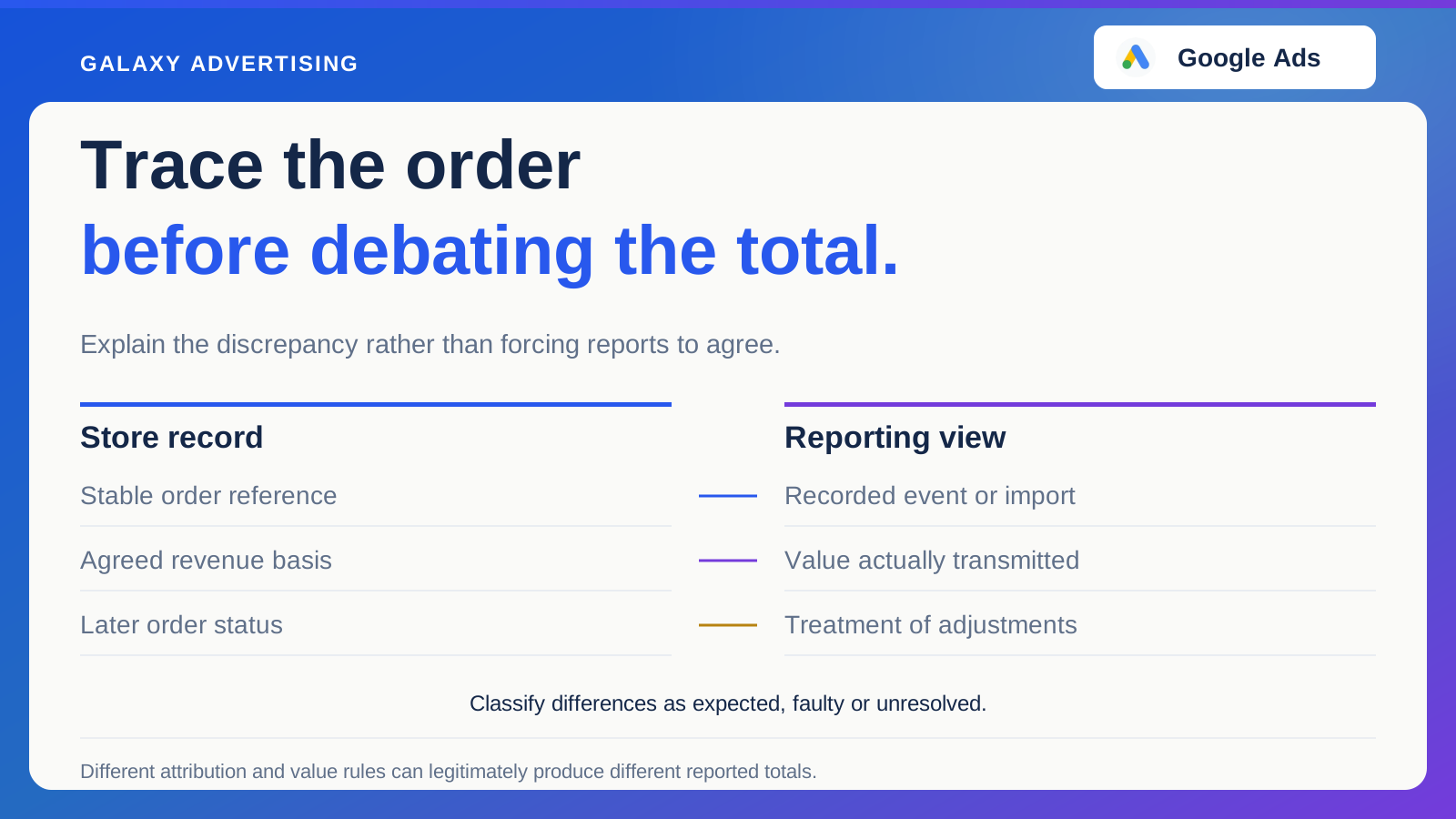
Investigate obvious discrepancies using a small transaction sample. A target recommendation built on a misunderstood value doesn't improve because somebody makes the proposed number more precise.
Separate confirmed implementation defects from unresolved reporting differences. Both could deserve attention, but their corrections and owners will differ. You need to understand which kind of problem you're being asked to approve work on.
Follow the offer the customer actually sees
Take representative live routes to products or other destinations. Check item, configuration, availability, essential information and purchase conditions.
A missing specification or confusing option selector can matter more than a cosmetic account preference. Record the actual observation and its likely consequence. Don't claim it explains every visitor who left. A specific finding can be useful without becoming a universal explanation for weak sales.
Where retail product information matters, compare important attributes with the destination and reliable business source. An audit that never checks the advertised offer can miss a practical constraint repeated bid changes won't fix.
Give each finding the right kind of response
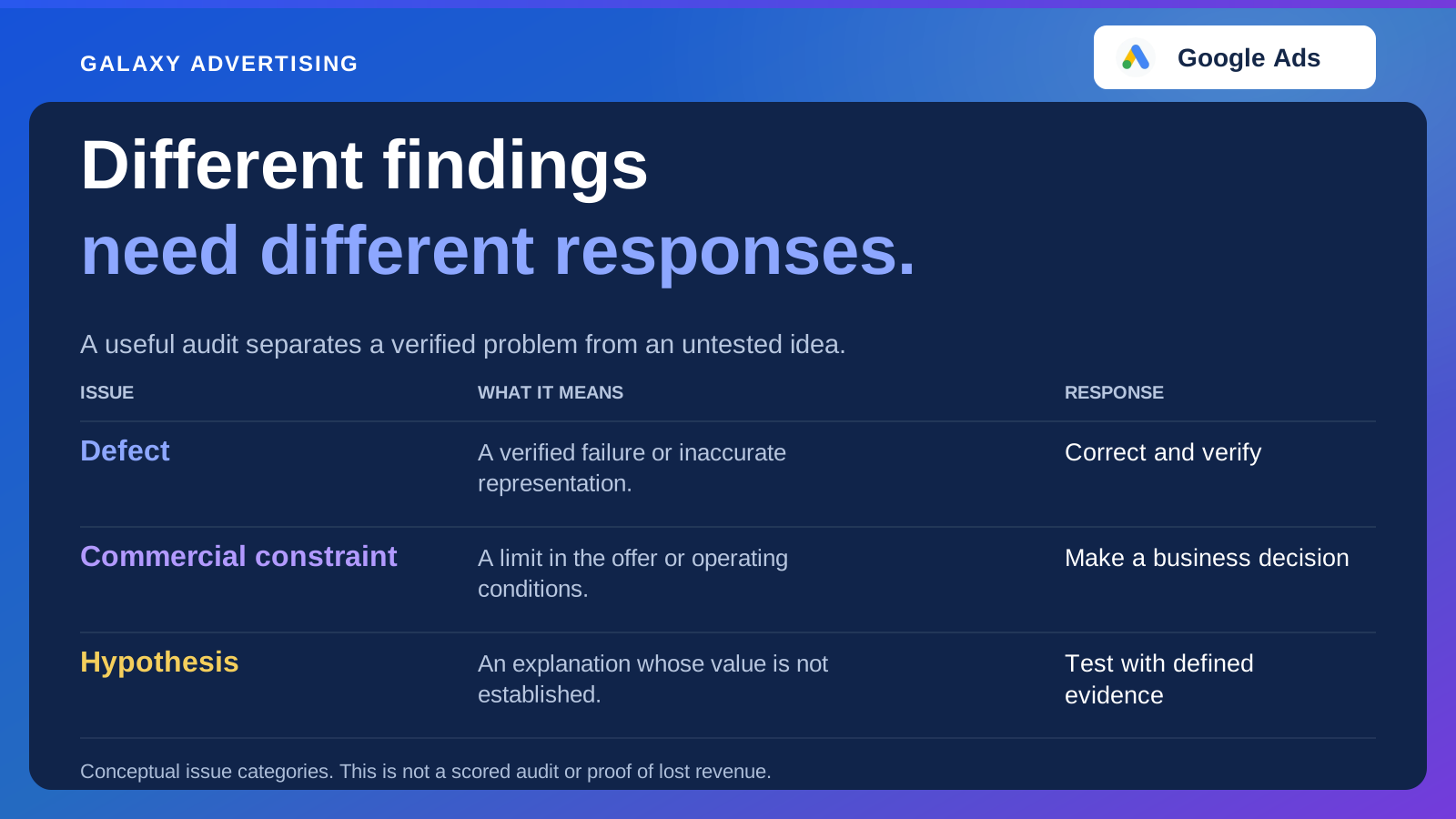
Use three clear categories. A defect is a verified failure or inaccurate representation needing correction. A commercial constraint concerns the offer or operating conditions. A hypothesis is an idea whose value hasn't yet been established.
A broken purchase route is a defect. An acquisition allowance too small for the current offer needs a commercial discussion. A proposed creative argument intended to attract more suitable buyers is a hypothesis.
Keep those distinctions intact. Otherwise, personal preferences can become supposed proven revenue losses, while difficult commercial facts get described as account management mistakes. A credible audit should make those conversations more honest, even when the distinction is inconvenient.
Put evidence and practical consequences ahead of easy wins
Assess potential business impact, strength of evidence and what the correction requires. Don't manufacture mathematical precision when the inputs are mainly judgement. A score isn't more objective merely because it has a decimal place.
A reproducible error affecting a major promoted range could need prompt attention. A small presentation change with uncertain benefit could wait behind it, however easy it would be to complete.
Identify dependencies. A campaign restructure could need reliable product labels first. An offer clarification could require supplier confirmation before writing or development begins. Let that sequence shape the priorities, rather than the order in which screenshots happen to appear.
Give the work to somebody who can complete it
Every action needs a problem, intended correction, responsible person and verification method. “Improve landing pages” doesn't provide enough to get started or establish completion.
Name the affected product or template, missing explanation and person able to approve the fact. Whoever implements the change might be different from whoever verifies it. Making both roles visible stops approval and completion being mistaken for each other.
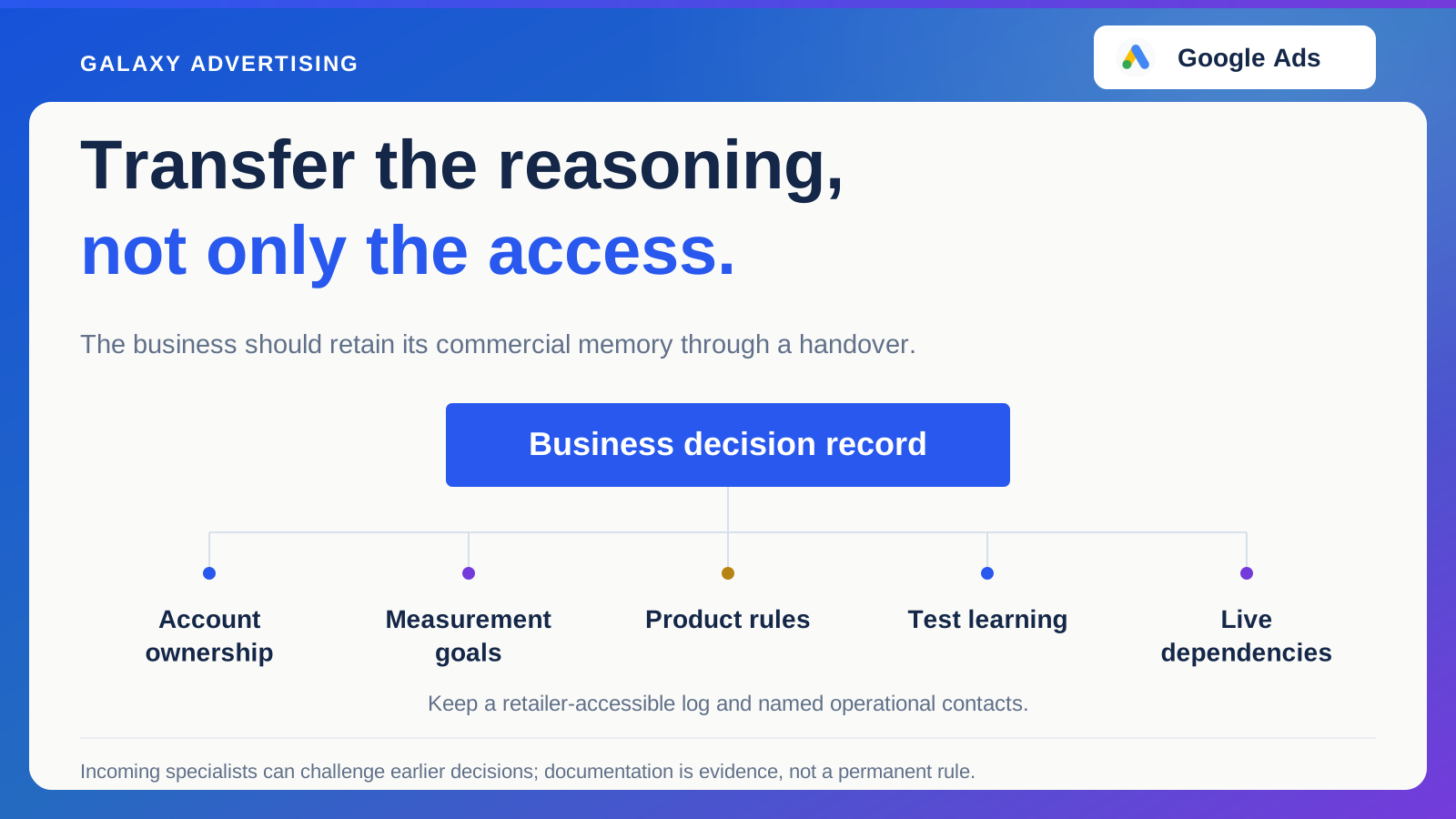
Record decisions that belong to the retailer. Pricing, product and operational dependencies can stall agency work while the report continues to describe it as underway. You want the actual dependency visible, rather than another month of apparently active recommendations.
See whether someone else can carry out one correction
Choose an important finding and give the task description to someone outside the audit. Can they identify the product or setting, reproduce the observation and see who approves the fix? If not, improve the task before adding screenshots.
Distinguish correcting the fact from measuring its consequence. An inaccurate delivery statement needs correction without proof it reduced sales. Testing a clearer presentation of an already accurate statement is a separate hypothesis.
After implementation, verify the live route and variations using the same template or input. Keep evidence of completion rather than accepting a status update alone. That closes the gap between insight and a practical improvement.
It also leaves the next reviewer a usable history: what was wrong, what changed and what you have or haven't established about its commercial effect.
Keep plausible ideas without calling them compulsory
Put nonurgent ideas in a separate test queue. State the hypothesis, relevant evidence and decision a test could support for each.
Choose among them by commercial relevance and the cost of useful learning. A long audit shouldn't pressure you into treating every idea as equally necessary. Confidence in the wording isn't evidence that all the work must happen.
At the next review, show verified corrections, changed constraints and hypotheses that gained evidence. Those consequences are where the audit earns its value.
You should leave an account review knowing what happens next, in what order and why. If all you're carrying away is a heavier document, the most important part of the audit still needs doing.