 Google Ads
It's tempting to add the Google and Meta figures when both reports show sales you can connect to their advertising.
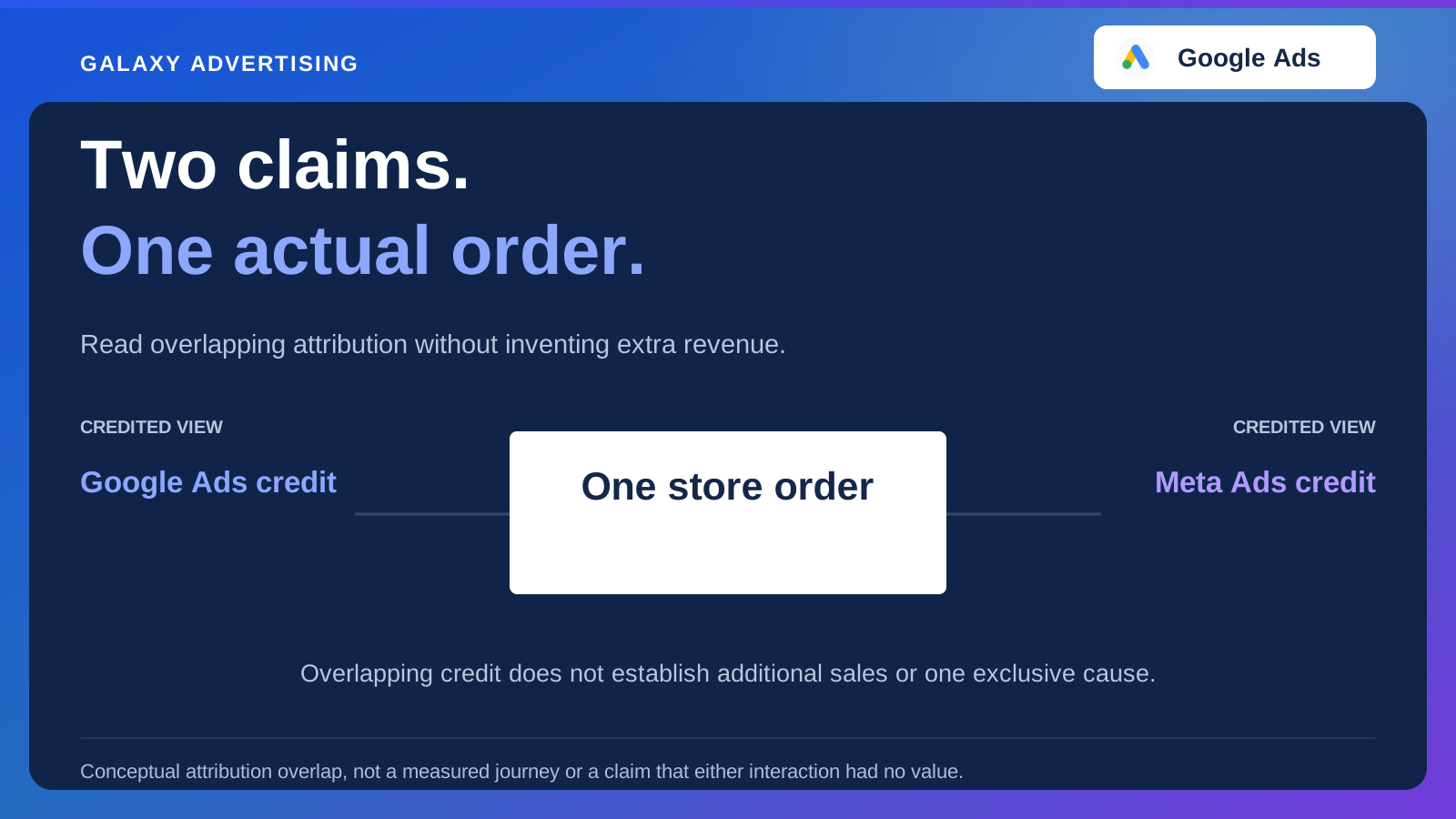
Take a customer who discovers a sofa through social advertising, returns through search and orders. Both platforms associate the purchase with their activity. That can give you useful evidence about the route. It doesn't mean the store earned twice the revenue.
The job is to understand the claims while keeping the fulfilled transaction in view. Overlap doesn't, by itself, make a platform dishonest or establish that an interaction had no value.
Separate the questions before comparing the answers
Store reporting asks which orders and revenue the business recorded. Platform attribution asks which observed outcomes qualify for credit under that platform's rules. Incrementality asks what would have happened without the activity.
Those questions are connected. Their answers aren't interchangeable. A transaction record doesn't fully explain influence. An attributed conversion, an outcome credited to advertising, doesn't independently establish an additional sale.
Put those distinctions in the reporting brief. When several measures are called revenue, the reader shouldn't have to work out the definition from where the chart happens to sit. A clear label prevents a useful observation becoming an unintended claim about what the business actually received.
What rules produced the totals?
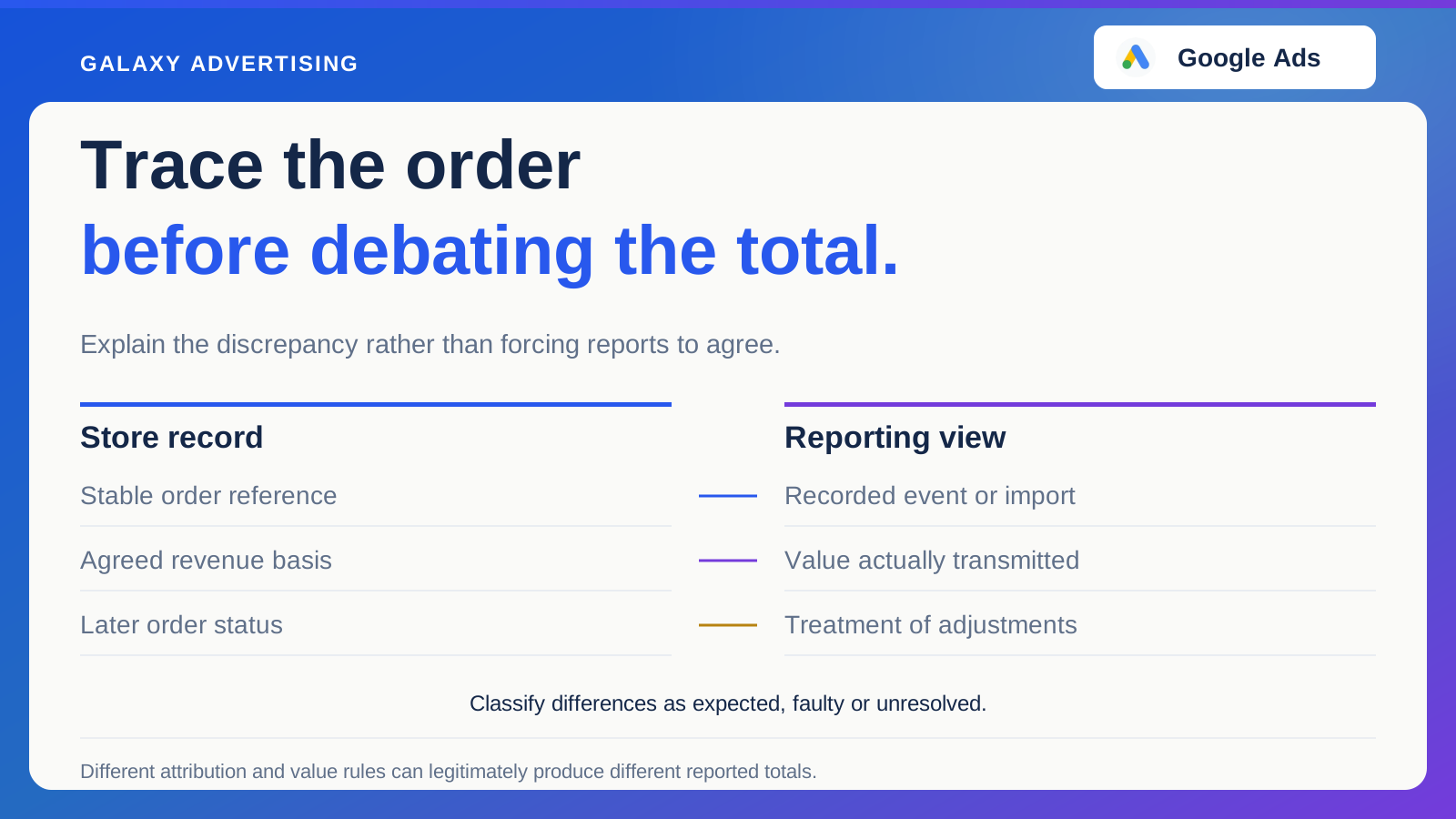
Identify attribution settings, conversion actions, value definitions and reporting periods. Check the current configuration. Don't assume both accounts work on the same basis because the headings look comparable.
Clarify purchase value, refunds and other material order changes. A difference can arise from the commercial definition as well as the crediting rules. Until you've separated those, an argument about attribution could actually concern how the order value was defined.
Keep the explanation readable. The management summary doesn't need every technical detail. It does need to say when two figures can't sensibly be treated as independent parts of the same total. That's the information an owner needs before using the report to assess spending.
Follow real transactions without writing the missing story
Use information legitimately available to inspect a small transaction sample. Record the visible connections and mark parts of the route you don't know.
Don't fill those gaps with a persuasive account of what the customer must have thought. An interaction is evidence that the interaction happened. It could support a hypothesis about influence without revealing the whole decision.
The exercise remains useful. You could find duplicate measurement, inconsistent values or a recurring route worth testing more deliberately. Narrowing the question is worthwhile. You don't have to produce an apparently complete story for each purchase to justify the inspection.
Give the business one reference for what it received
Use consistently defined store orders and revenue as the commercial reference. Put platform views beside it as attributed evidence. Don't add them as extra revenue without qualification.
Review total acquisition investment and relevant contribution assumptions, the money remaining after the costs included in your calculation. An individual platform can look efficient while the combined acquisition cost leaves an unattractive result for the business.
Keep channel detail because it helps diagnose decisions. The common reference stops several plausible reports creating an impossible account of the money earned. You can retain the useful differences without asking them to become a single additive total.
A blended ratio helps, but doesn't explain itself
A business level ratio of consistently defined revenue to advertising investment can monitor the overall relationship. It doesn't identify the cause of every movement or prove a particular channel created it.
Other marketing, existing customers, product mix, availability and seasonality can all matter. Include those conditions in the review. The blended figure isn't a replacement for investigating what's changed.
Don't import a universal benchmark from another retailer's numbers either. Its cost structure and customer base could be different enough to make a similar looking ratio commercially misleading. Your business still has to operate on what your own orders leave behind.
Test the disputed contribution where you can
If a major decision depends on whether an activity adds sales, investigate a method suited to the setting and evidence available. Define the hypothesis, comparison and limitations before acting.
A simple before and after observation could be the practical option. It can inform a bounded decision without being a definitive causal experiment when other conditions changed. Describe the strength of the evidence you have, rather than the strength you would like.
Imperfect measurement doesn't justify funding activity indefinitely without a useful question. You can choose a proportionate next step while admitting uncertainty about exactly how influence is divided. Uncertainty belongs in the decision, rather than becoming a reason never to make one.
Bring one order to the meeting
Choose an order represented in more than one source and show its actual commercial value once. Beside it, explain each attributed claim under its own rules. Mark what remains unknown.
Don't use it to prove every order follows that route. Use it to show why adding credited values can overstate transaction revenue, and why removing a claim doesn't automatically establish that interaction had no influence.
Show how the business review keeps the order reference separate from channel interpretations. A concrete example can resolve this misunderstanding more readily than another debate about whose dashboard is most accurate.
If the sample exposes genuine implementation duplication, treat that as a distinct repair with an owner. Correctly understanding overlapping attribution shouldn't become an excuse to ignore faulty measurement or avoid a difficult investment decision.
Ask the managers for judgement, not exclusive ownership
Ask each channel manager to explain the activity's purpose, evidence within its reporting view and recommended commercial decision. Discourage a contest in which everybody has to own the same purchase exclusively.
Record explained differences and those needing investigation. Make attribution changes visible so a new reporting basis isn't mistaken for a sudden improvement in customer behaviour.
Your business needs an understandable acquisition system. It doesn't need a fictional agreement that every order has one simple owner. Let the reports contribute evidence, while keeping the money the store received and the combined cost of obtaining it firmly on the same table.