 Google Ads
Stocked dining chairs, made to order tables and small accessories can share a shop without sharing the same economics.
You know that when you're arranging delivery or deciding what the business can afford to promote. Yet a single advertising average can flatten those differences until everything appears to be pulling its weight equally.
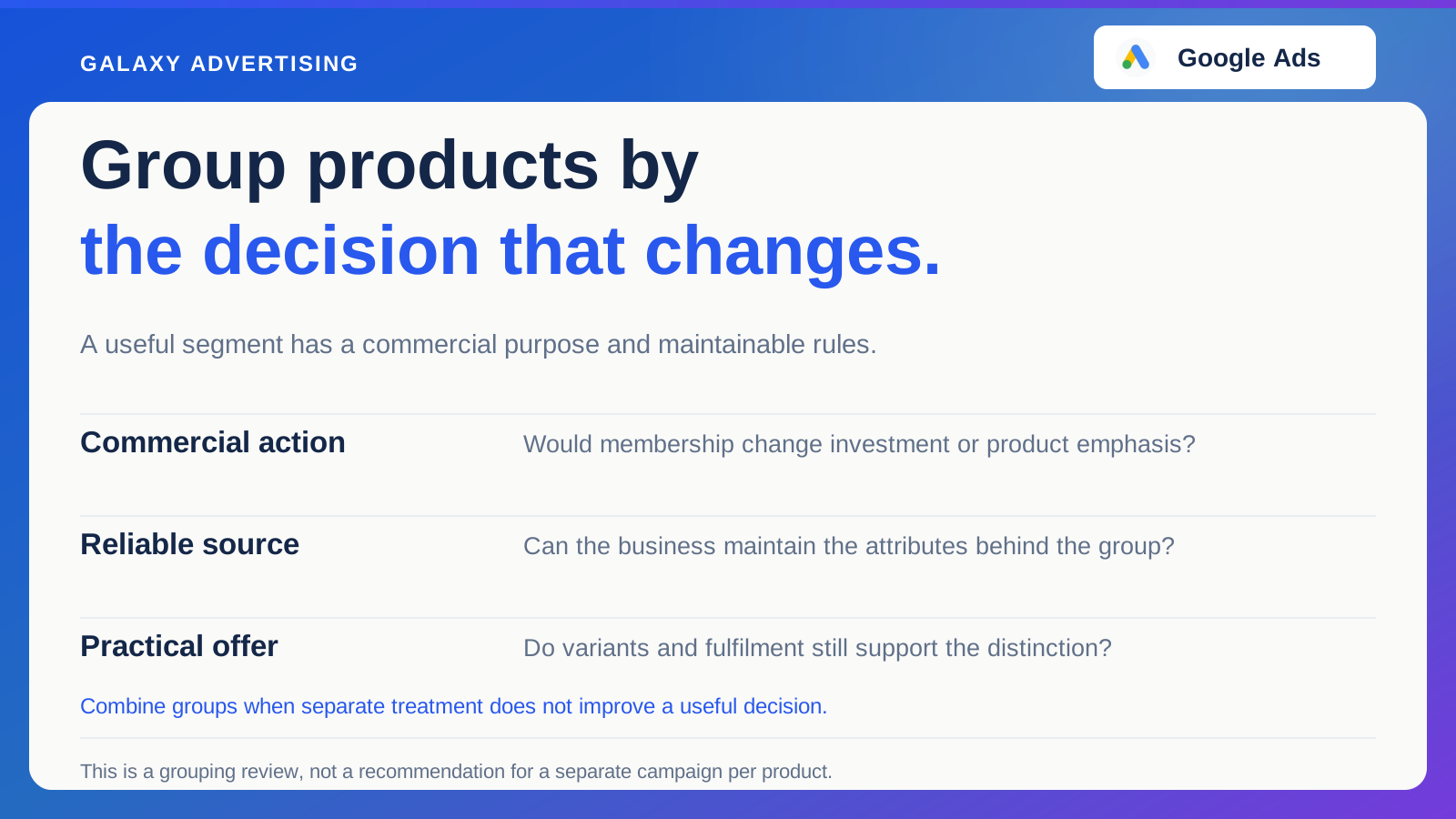
The answer is to group products where the distinction changes a commercial action. It isn't automatically a new campaign for every item. You need enough separation to understand the account without leaving each group with too little evidence to interpret.
What would you actually do differently?
Start there, before naming the groups. Perhaps you'd prioritise reliable availability, distinguish delivery models, protect a necessary contribution level, the money remaining after the relevant costs, or investigate unusually expensive returns.
Membership needs to change that decision. Otherwise, the label gives someone more maintenance and the business little else.
Stocked chairs and made to order tables can require different customer promises and readiness checks, even though both sit in the dining room category. Conversely, two colour labels might not justify different investment if economics, availability and demand are similar.
A tidy distinction isn't necessarily a useful one. Write down the action first and ask whether the proposed group helps you take it.
Use information somebody can keep accurate
Product category, fulfilment model and documented margin bands can help if their definitions are clear. A subjective label such as premium is less dependable when everyone applies it differently.
Record the rule and who owns its source data. If you're using product data or custom labels in an advertising setup, check the supported configuration and whether the supplied values actually represent your rule. This keeps the account connected to the distinction you intended, rather than whatever interpretation happened to reach the system.
Don't let an agency estimate contribution from selling price alone. An expensive item can come with expensive delivery and product costs. If you don't have the relevant information, say so. A profitability group doesn't become reliable because its label looks precise.
Available to whom, in which configuration?
An item marked available can still be missing the versions customers want. Think of a shoe style with limited sizes, or a sofa with only one fabric remaining. Advertising can keep attracting people whom the current offer cannot serve well.
Check whether your grouping needs to reflect that practical reality. You don't necessarily need a permanent campaign for every variant, meaning each size, colour or configuration. A better stock signal, different product emphasis or a clear alternative route could be the appropriate response.
Agree what happens as stock changes. A manual spreadsheet can become stale after a few sales. Unless someone owns the updates, it's a shaky foundation for ongoing promotion. The maintenance question belongs in the plan, rather than in the explanation after the offer has stopped matching the advertising.
Every extra group has to earn its keep
More divisions mean longer reports, harder operating rules and potentially less stable evidence within each group. That cost is easy to overlook while the account diagram is still looking impressive.
Start with a small number of distinctions that matter materially. Check whether each explains performance or supports an action. Combine groups when keeping them apart doesn't change a useful decision. Simpler can be more informative when it leaves you with evidence you can interpret.
Be particularly careful about defining a group after a few exceptional historical orders. It can look attractive because you've drawn the boundary to capture those results. Record the commercial reason for the group before treating it as a repeatable opportunity.
Decide the structure after you've settled the reason
A useful product group doesn't automatically need its own campaign. Depending on the account, it could inform reporting, product selection, destination improvements or other supported controls.
Ask the manager why the proposed structure is necessary for the decision. “More control” needs a second sentence: control over what, and how will you use it?
Think about measurement and creative as well. A different fulfilment model could need different messaging and destination information. A new line in the advertising account won't explain that promise to a shopper by itself.
Check what moved before judging what changed
Products don't stay commercially identical forever. A supplier cost increase can change contribution. A delivery constraint can change readiness. Seasonal availability can narrow until a former priority becomes unsuitable to promote.
Record material rule changes so later comparisons still make sense. If performance changes after membership changes, inspect what's now inside the group before putting the whole movement down to campaign management.
Look at exceptions too. A usually unattractive group can contain something worth investigating. One exception doesn't necessarily justify rebuilding the entire account around it. Give it attention without assuming it rewrites the rule.
Try the rule on three awkward products
Choose one product that clearly belongs, one that clearly doesn't and one near the boundary. Have someone apply the written rule without help from its inventor.
If reviewers disagree, improve the definition before using it as an operating input. A contribution band needs its cost basis. A stock readiness group needs to explain how relevant configurations and fulfilment conditions are treated.
Then change an input and follow what happens. Does somebody update the source? Does the product move as intended? Can marketing explain why? This small exercise can expose a maintenance problem before you label a large catalogue and inherit it at scale.
You might find a simpler distinction supports the same decision. That's useful, even if the elaborate version took work to implement. Keep a group because it changes a worthwhile commercial action and survives ordinary updates, rather than because its original author can always explain the exceptions.
Can advertising and merchandising agree the next move?
Show the group definition, relevant investment, orders and the commercial or operational information used to judge them. Highlight evidence pointing towards better product information, an availability discussion or a change in promotional emphasis.
The report should help advertising and merchandising agree an action. If neither team can explain what happens differently because of the grouping, simplify it.
Your catalogue needs to reveal the differences that matter without becoming a collection of tiny businesses to administer. The strongest structure is the one your team can maintain, explain and revise when the offer changes. Even the most elegant diagram still needs somebody to run the shop.